Ernst Ruska and Max Knoll first electron microscope images (Berlin, 1931)
origin of the form
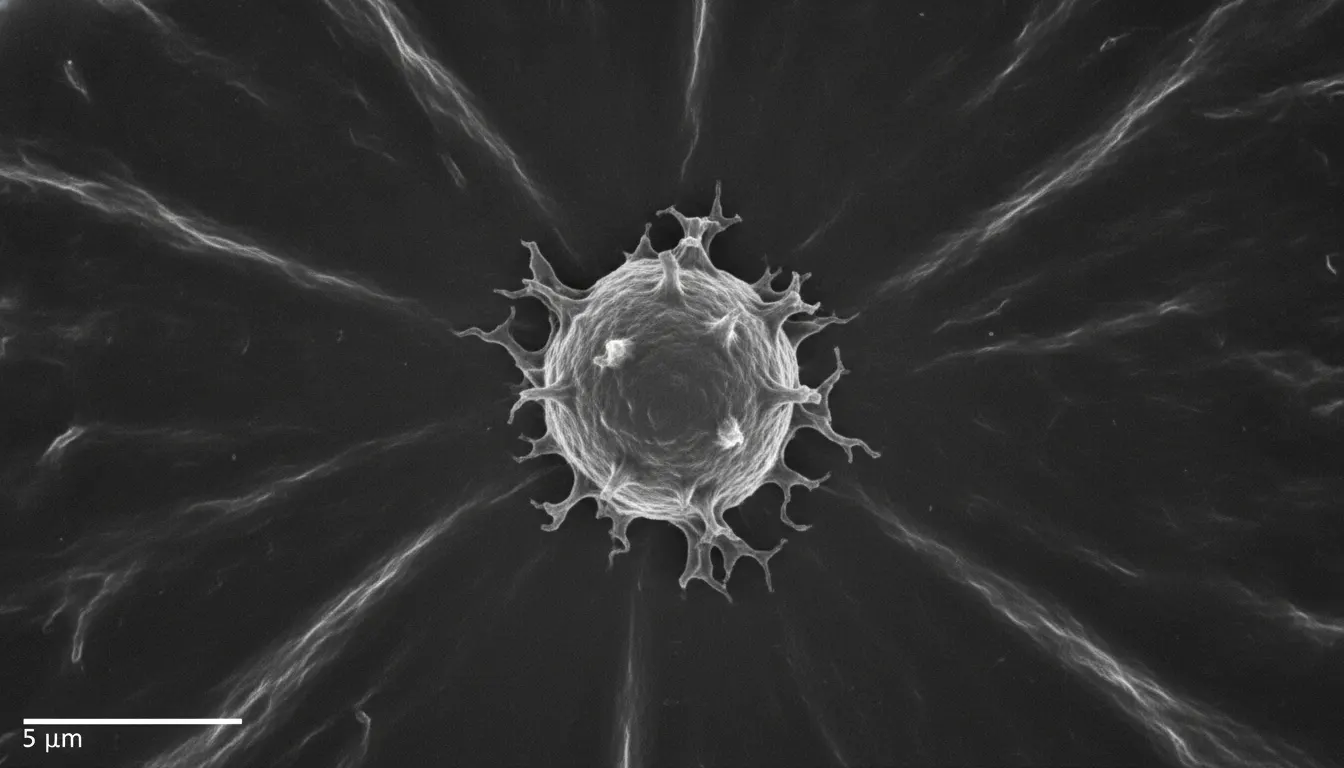
Scanning electron microscope at 5000x. Topographic greyscale, alien-textured surface detail, scale bar bottom-right, scientific micrography aesthetic.
The moves a human crew would use to get here. Cue applies them for you, and knowing their names is how you ask for a change.
everything in the frame equally sharp, front to back - the defining inversion of lens photography
color palette: gold-orange (#C8860A), cool blue (#4488FF), or split-tone dual-detector colorization
detail: displacement map or procedural noise simulating electron-bombardment surface topography
familiar subjects (insects, salt, skin) rendered at scales that make them unrecognizable as architectural forms
a white or gold measurement bar (e.g. '100 µm') in corner, the universal SEM image convention
SEM video moves slowly because specimen stage movement is controlled to nanometre precision
The electron microscope was invented by Ernst Ruska and Max Knoll at the Technische Hochschule Berlin in 1931, producing the first images that exceeded the resolution limit of light-based microscopy. Ruska received the Nobel Prize in Physics in 1986 for this work. By replacing photons with electrons - which have far shorter wavelengths - the transmission electron microscope (TEM) can resolve features at the atomic scale (0.1 nm range). The scanning electron microscope (SEM), developed commercially by the Cambridge Instrument Company in the 1960s (the Stereoscan, 1965), creates three-dimensional surface topology images by scanning a focused electron beam across a specimen and detecting secondary electrons.
SEM produces images of extraordinary visual distinctiveness: extreme depth of field (everything from the foreground surface feature to the background topography is in focus simultaneously, the inverse of shallow-depth-of-field lens photography); fine surface detail at scales invisible to light microscopy; and a grayscale palette (electrons produce intensity signals, not wavelength data, so raw SEM images are greyscale). The scale disorientation is fundamental - a fly eye at 1000x magnification looks like an alien landscape; a salt crystal looks like monumental architecture; textile fibers resemble carved logs.
False-color enhancement is the dominant post-processing convention for SEM imagery intended for publication or general audiences. Because the raw image is greyscale, colorization is applied either by mapping signal intensity to a color LUT (often gold-orange or cool blue), by applying multiple imaging passes with different detectors and mapping each to a separate color channel (Backscattered Electron detector for composition vs. Secondary Electron detector for topography), or by fully manual colorization by scientific illustrators. Dennis Kunkel (b. 1945), whose Kunkel Microscopy company produced widely published false-color SEM images of bacteria, insects, and biological tissues from the 1980s-2010s, defined the aesthetic for popular science publishing. Lennart Nilsson's 'A Child is Born' (1965) used SEM and optical microscopy to show fetal development, reaching mass audiences in Life magazine.
The two main electron microscope types produce distinct aesthetics. Transmission electron microscopy (TEM) passes electrons through an ultrathin specimen (typically 70-100 nm sections), producing high-contrast internal structural images at atomic resolution - the characteristic black-and-white images of virus particles, cell organelles, and crystal lattices seen in medical publications. Scanning electron microscopy (SEM) rasterscan a focused beam across a surface, detecting secondary electrons to build a three-dimensional surface topography image - producing the dramatic landscape-like surface renderings of insects, pollen, and materials. SEM images have the softer, more three-dimensional quality that dominates popular science use; TEM images have harder contrast and flat structural quality more common in technical publications. Most consumer-facing 'electron microscope aesthetic' is SEM; TEM appears more in biotechnology branding.
The EM aesthetic in video is produced either by using actual SEM footage (available from university research departments and stock libraries like SPL, Science Photo Library) or by simulating the look in CGI: extreme depth of field across all planes (achieved by using very small virtual apertures), fine surface micro-detail displacement maps, a grayscale or false-color grade, and scale disorientation through unexpected subject matter or scale-indicator bars. Stock SEM footage providers including Pond5 and Getty Images carry curated collections; university research departments frequently license footage for commercial use on case-by-case terms.
origin of the form
defining popular science SEM aesthetic
1965
mass-audience microscopy landmark
1965
commercial SEM origin
2020
defining science communication use case
2013
fine art SEM photography monograph
unexpected application of EM aesthetic to culinary subjects
public display benchmark for EM aesthetics
A Look is not a filter. It is a set of stored decisions the pipeline reads before it makes a single frame, so two videos in the same Look actually match.