Clifford the Big Red Dog
Norman Bridwell / Scholastic / PBS Kids · 2000
The canonical television adaptation; the definitive expression of the painterly Clifford aesthetic
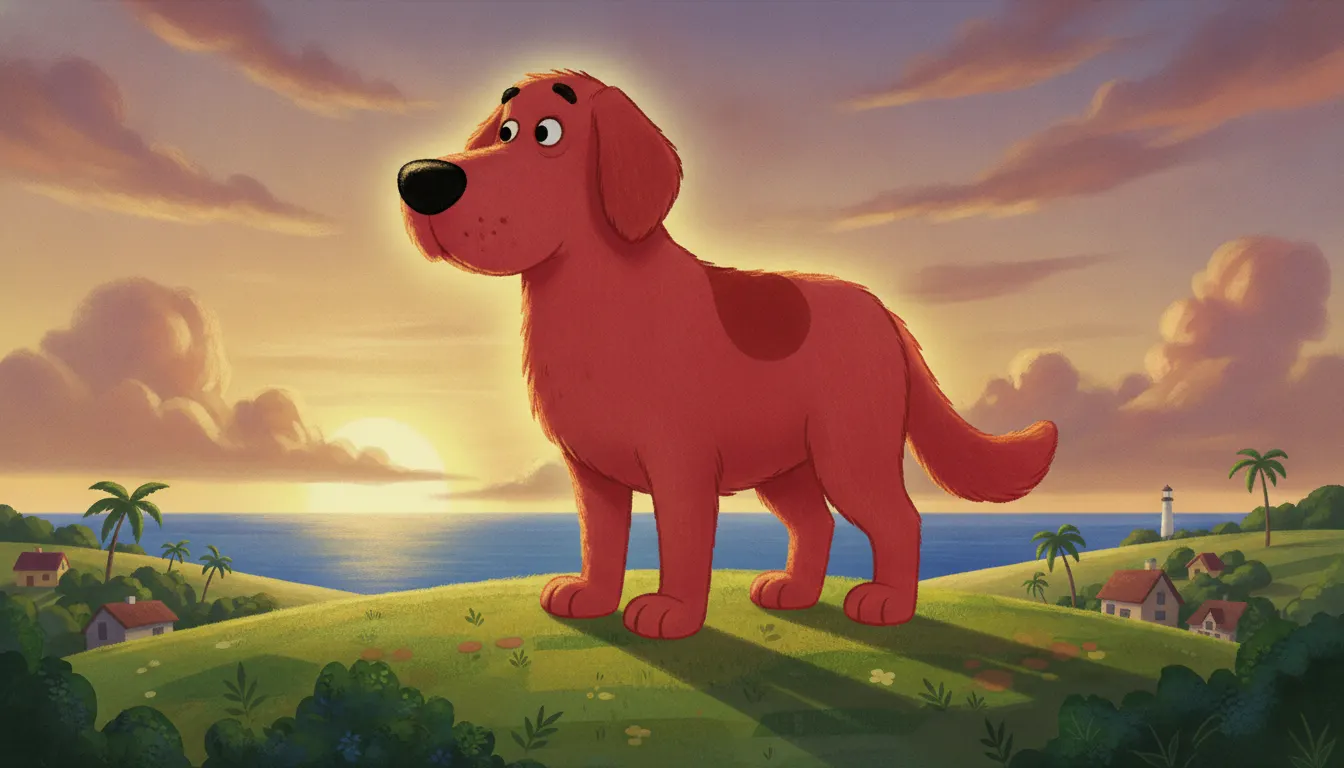
Norman Bridwell book adaptation, Scholastic / PBS Kids painterly preschool series. Birdwell Island coastal palette, giant friendly red dog, hand-painted storybook backgrounds.
The moves a human crew would use to get here. Cue applies them for you, and knowing their names is how you ask for a change.
Clifford's impossible size relative to buildings and humans is maintained with complete visual seriousness, making proportion itself a visual joke.
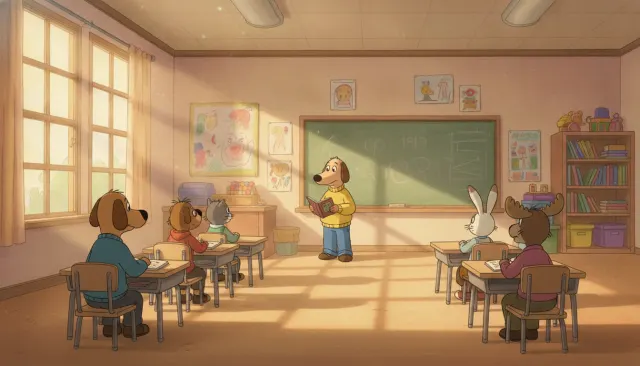
Birdwell Island environments use visible brushwork and soft watercolor washes that maintain the picture-book illustration feel.
Ochres, warm greens, harbor blues, and sandy tans evoke actual Cape Cod coastal environments in a safely stylized register.
Clifford's design uses large, simple red blocks with minimal interior detail -- optimized for readability at both small and gigantic scale.
The TV series maintains close visual fidelity to Norman Bridwell's original 1963 book illustration style across three decades of source material.
The island setting is rendered with consistent geographic logic -- harbor, lighthouse, hill, town -- giving the world physical coherence.
Clifford the Big Red Dog premiered on PBS Kids on September 4, 2000, based on the children's book series created by Norman Bridwell, who produced the first Clifford book in 1963 for Scholastic. The television series was produced by Scholastic Entertainment and animated by Nelvana Limited, with art direction that translated Bridwell's original watercolor-and-gouache illustrations to the television animation format. The show ran through 2003 and was rebooted as a CGI series by Paramount Animation in 2019.
Clifford the Big Red Dog occupies a specific visual position in children's animation: the warmest and most deliberately painterly of the major PBS Kids properties. The show's most famous visual element is Clifford himself -- an enormous red dog so large he dwarfs buildings on Birdwell Island. This visual conceit (the scale joke made literal) is held with complete seriousness, and the background art is designed to accommodate Clifford's impossible scale with specific attention to the visual comedy of proportion.
Nelvana's animation team worked to maintain the watercolor illustration feel of Norman Bridwell's original books. Backgrounds are rendered with visible brushwork, soft color washes, and the gentle texture of actual watercolor paper -- techniques shared with other PBS Kids contemporaries but executed with specific care for the New England island-town setting.
Birdwell Island is a loosely coastal New England setting -- weathered wooden houses, a harbor, a lighthouse, rolling grass hills -- rendered in warm, slightly desaturated watercolors. The palette favors ochres, warm greens, harbor blues, and sandy tans that evoke actual Cape Cod or Martha's Vineyard coastal architecture.
Bridwell's original books used flat, bold outlines with watercolor fills -- a children's book illustration style of the 1960s that was transitioning from the full-painted Golden Book tradition. The television series maintained this tradition while adding the animation movements and environmental depth that television demands.
Clifford himself is drawn with bold, simple strokes -- large blocks of red with minimal interior detail, enormous black eyes, an expressive and readable face. This simplicity is necessary because Clifford must be animated at scale against environments. The supporting cast -- Emily Elizabeth, T-Bone, Cleo, Mac -- are designed with the rounded, friendly proportions of classic children's book illustration.
Clifford was part of the PBS Kids programming strategy of the late 1990s and 2000s: acquire beloved children's book properties and translate them to television with fidelity to the source illustration style. This produced a lineup (Clifford, Arthur, Berenstain Bears, Curious George) that maintained the picture-book aesthetic standard as a PBS Kids brand value.
The 2019 CGI reboot (Scholastic/Paramount) abandoned the painterly 2D aesthetic for contemporary 3D, representing the industry-wide shift away from hand-drawn children's animation toward computer-generated production. The original 2000 series remains the definitive visual expression of the Clifford aesthetic.
Norman Bridwell / Scholastic / PBS Kids · 2000
The canonical television adaptation; the definitive expression of the painterly Clifford aesthetic
Scholastic / Paramount Animation · 2019
CGI reboot; represents the shift away from the painterly 2D aesthetic the original established
Norman Bridwell / Scholastic · 1963
The source that defined the visual language all adaptations draw from
Marc Brown / PBS Kids · 1996
Direct PBS Kids contemporary; shared the picture-book-to-TV painterly translation mission
Stan & Jan Berenstain / PBS Kids · 2003
Contemporaneous PBS Kids book adaptation with similar warm domestic watercolor aesthetic
Universal / PBS Kids · 2006
Later PBS Kids adaptation that continued the warm-painterly-background tradition
A Look is not a filter. It is a set of stored decisions the pipeline reads before it makes a single frame, so two videos in the same Look actually match.