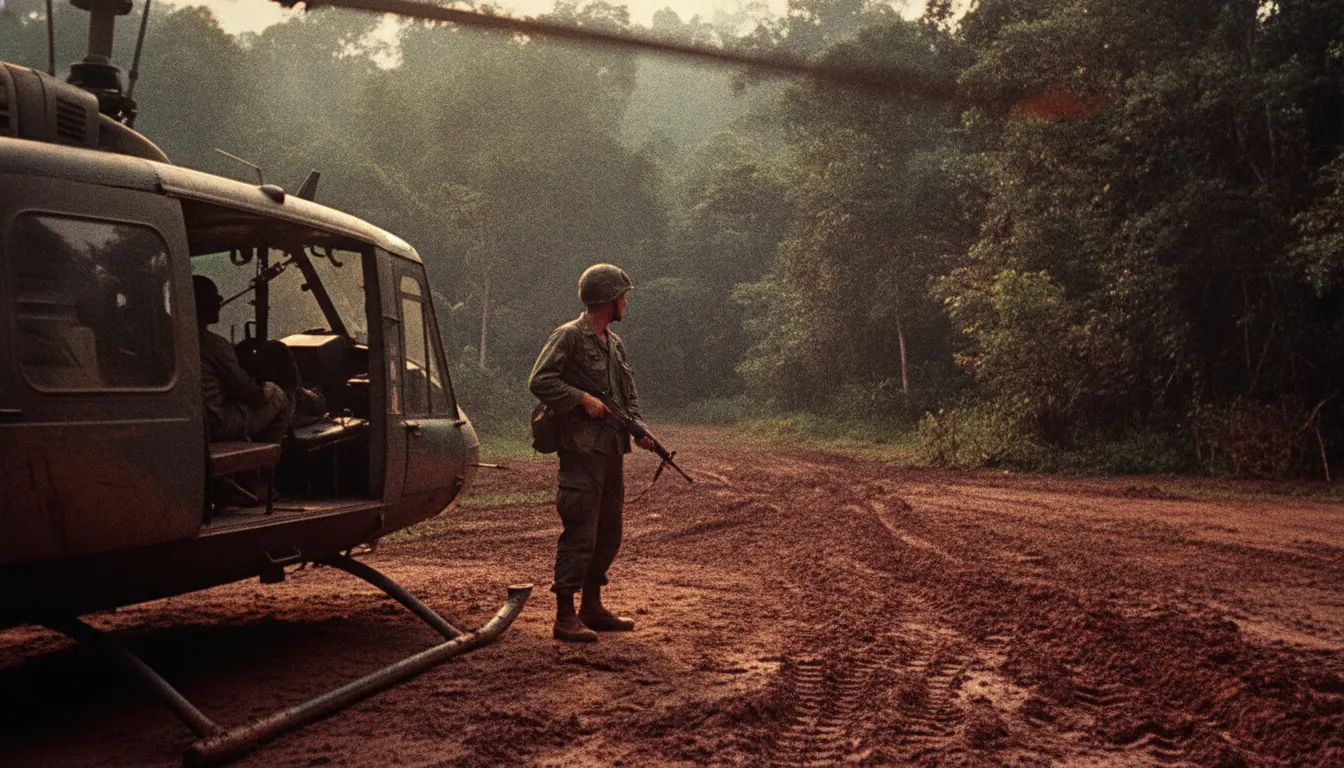
Larry Burrows
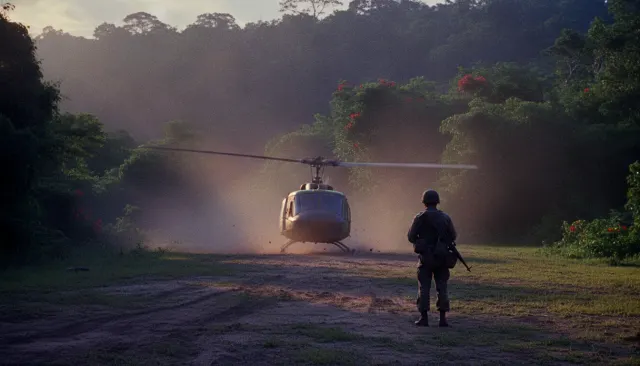
Yankee Papa 13 (LIFE Magazine, April 1965)
Vietnam War magazine color photojournalism. Tim Page Eddie Adams Larry Burrows, helicopter exit door, jungle green and red mud, raw color witness.
The moves a human crew would use to get here. Cue applies them for you, and knowing their names is how you ask for a change.
saturated green jungle, warm skin tones, dense shadow detail
angle proximity in combat: 28-35mm in close to subjects for visceral inclusion
harsh noon sun creating strong shadows
moment decisive frame selection: the single image that summarizes the emotional content
page spread format: maximum image scale for emotional impact
speed of publication was as important as image quality
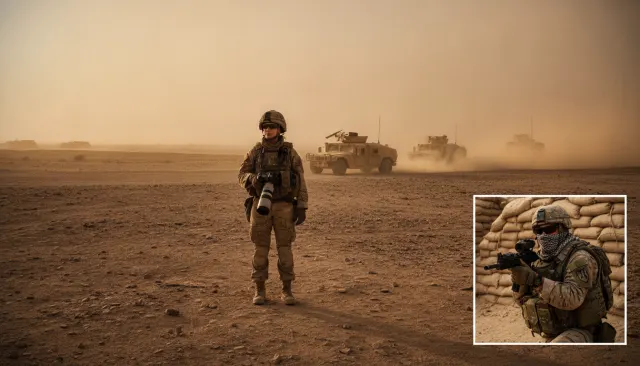
The Vietnam War produced the defining photojournalism of the 20th century and was the first major conflict systematically documented in color. Photographers working for LIFE Magazine, AP, UPI, and Time-LIFE through the late 1950s and 1970s created images that directly shaped American and global public opinion about the war and, through their influence, helped establish the modern conventions of combat photography.
Larry Burrows was the defining photographer of the Vietnam War. Working for LIFE Magazine from 1962 until his death in a helicopter crash over Laos in 1971, Burrows produced color essays of extraordinary technical and emotional precision. His most famous image sequence, published in LIFE in April 1965 under the title Yankee Papa 13, documented a Marine helicopter crew through a single combat mission - from briefing through engagement to the aftermath of the crew chief weeping over a dead comrade. The essay was shot on Kodachrome, and the saturated red of the blood, the green of the jungle, and the gray of the helicopters have a terrible beauty that drove the emotional impact of the reporting.
Burrows work represented the apex of LIFE s color documentary tradition: technically masterful, compositionally rigorous, emotionally devastating.
Vietnam produced several of the most widely reproduced photographs in history. Eddie Adams captured the Saigon Execution on February 1, 1968: Nguyen Ngoc Loan executing Nguyen Van Lem on a Saigon street. Nick Ut photographed Phan Thi Kim Phuc running naked from a napalm attack on June 8, 1972 - the image that became universally known as Napalm Girl and for which Ut received the 1973 Pulitzer Prize. Both images were made for AP wire distribution and reproduced in hundreds of newspapers worldwide.
Vietnam War photography has a specific color signature shaped by Kodachrome 64 and Ektachrome film stocks of the era: rich, slightly warm color with strong greens (the jungle), muted khaki (American and South Vietnamese uniforms), and dense shadows. The contrast curve is relatively steep compared to modern digital, giving midtones a punchy quality. Grain is present but fine, with the characteristic Kodachrome sharpness in highlights.
Vietnam photojournalism established conventions that persist in conflict documentation today: proximity to subjects, willingness to show injury and death, sequential narrative across multiple frames, and publication timing timed to affect political debate. The genre directly shaped the coverage of the Gulf War, Iraq, and Afghanistan.
Yankee Papa 13 (LIFE Magazine, April 1965)
Saigon Execution (AP, February 1, 1968) - Pulitzer Prize 1969
Napalm Girl / The Terror of War (AP, June 8, 1972) - Pulitzer Prize 1973
Reaching Out (LIFE, 1966) - wounded Marines image
1971
Vietnam Inc. - book collecting sustained anti-war documentation
1951
This Is War! / Vietnam coverage - Korean and Vietnam combat comparison
Vietnam and Southeast Asia coverage for The Sunday Times 1968-1972
A Look is not a filter. It is a set of stored decisions the pipeline reads before it makes a single frame, so two videos in the same Look actually match.