Undertale (Toby Fox, 2015)
the defining minimalist pixel bullet hell RPG
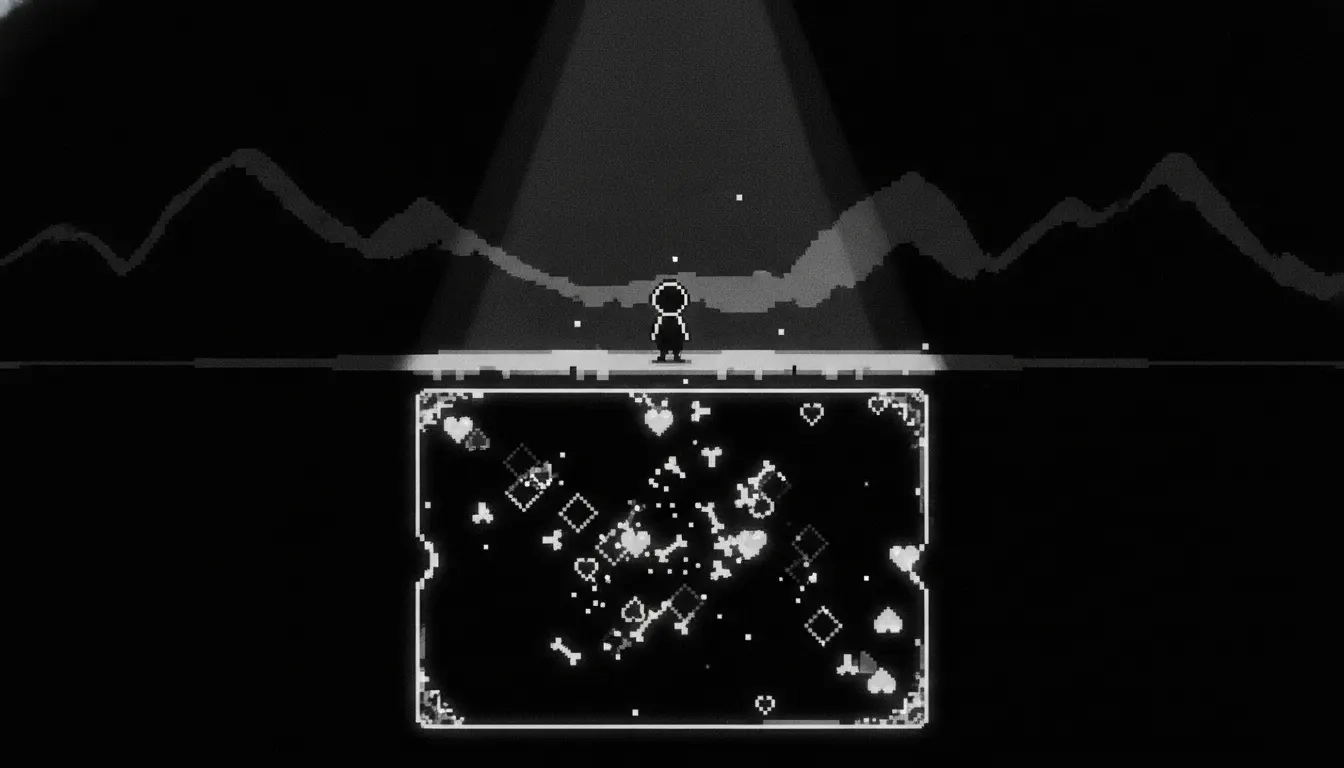
Undertale minimalist black-and-white pixel aesthetic. Stark monochrome battle box, bullet-hell soul mechanic, Toby Fox indie RPG pixel charm.
The moves a human crew would use to get here. Cue applies them for you, and knowing their names is how you ask for a change.
background bullet hell combat space with white geometric projectile patterns
style overworld with top-down perspective and simple room tile construction
iconic minimalism with maximum legibility
specific projectile design: bones for Sans, pie for Toriel, musical notes for Napstablook
Undertale (Toby Fox, 2015) is one of the most culturally impactful games of the 2010s, achieving massive emotional resonance through deliberately minimal pixel art. Fox, a musician who taught himself to make games in RPG Maker, created a visual style that stripped pixel art to its functional essentials - characters legible at a glance, combat readable under pressure, world-building through furniture and NPC dialogue rather than detailed environments. The result is a game that proves emotional sophistication has nothing to do with visual complexity.
Fox cited EarthBound (HAL Laboratory, 1994) and its predecessor MOTHER (1989) as primary inspirations. Both games used RPG structures to explore everyday suburban environments rather than fantasy kingdoms, and both employed a cheerful surface aesthetic over disturbing thematic content. Undertale inherits the MOTHER series' small-resolution character sprites, the comedy in flat NPC dialogue boxes, and the use of mundane settings - a snowy forest, a monster town, a hotel corridor - to ground fantastical encounters.
Undertale's most distinctive visual system is its combat interface: a small heart-shaped player icon in a black bordered box, dodging geometric projectiles in a bullet hell paradigm while managing RPG turn-based choices. This abstraction - the RPG battle becomes a shooter minigame - required a visual language of clean geometric patterns: white circles, triangles, bone shapes, and character-specific projectile designs against black backgrounds.
Boss fights use increasingly complex bullet hell patterns that are simultaneously visual spectacles and mechanical challenges. Sans's fight - considered the hardest in the game - uses every projectile type simultaneously, creating abstract geometry that is beautiful in a purely formal sense while requiring precise pattern recognition. This combination of aesthetic beauty and mechanical function in the bullet hell space is Undertale's most original contribution.
The game's low-resolution sprites and limited color palette create space for player imagination. Toriel's pixel art sprite suggests kindness; player projection does the rest. Sans's face is two white circles and a grin; the expression conveys everything through context. This minimalism functions as what game designers call "meaningful abstraction" - enough visual information to anchor imagination without constraining it.
Undertale's alternate "Genocide" route uses the same visual vocabulary to horrifying effect. The empty corridors, the slaughter message replacing encounter data, the altered battle animations - all achieved through existing assets recontextualized. The horror is not in new visual material but in the familiar aesthetic deployed against its expected emotional contract.
the defining minimalist pixel bullet hell RPG
Fox's sequel with higher visual production values
primary visual and tonal ancestor
foundational MOTHER series origin
parallel solo pixel RPG achievement
emotional pixel RPG in the Undertale tradition
A Look is not a filter. It is a set of stored decisions the pipeline reads before it makes a single frame, so two videos in the same Look actually match.