Tunic (Andrew Shouldice, 2022)
the defining isometric fox translation adventure
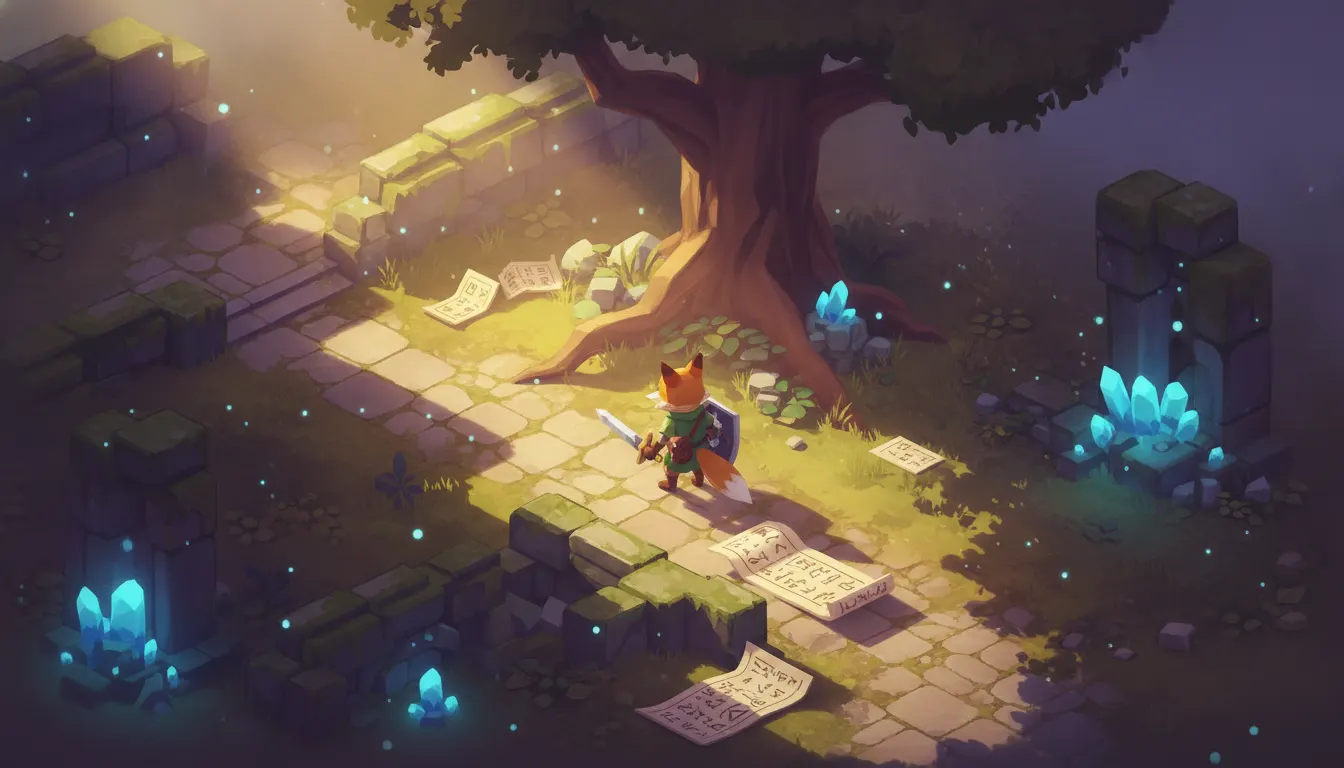
Tunic Andrew Shouldice fox isometric aesthetic. Cute Zelda-like fox protagonist, in-world untranslated manual mystery, painterly low-poly isometric world.
The moves a human crew would use to get here. Cue applies them for you, and knowing their names is how you ask for a change.
poly soft 3D geometry with baked ambient occlusion providing form depth
world document artifacts (manual pages) with invented script annotations
Tunic (Andrew Shouldice, 2022) is a puzzle-adventure game that reconstructs the feeling of encountering a game from an alien culture - a game whose instruction manual you find in fragments, written in a language you can barely parse. Shouldice spent seven years developing the game solo, creating both the fox adventure on screen and an elaborate in-game manual in an invented script that players piece together alongside gameplay. The isometric visual design is inseparable from this translation-discovery concept.
Tunic uses a fixed isometric camera - not fully 3D, not 2D, but the 2.5D axonometric view associated with Diablo (Blizzard, 1996), Bastion (Supergiant Games, 2011), and the original Zelda games on Game Boy. This perspective choice serves the game's mystery design: isometric views can hide things behind geometry, allow walls to conceal spaces the player cannot directly see, and create sightlines that reward observation. The environment is full of hidden passages, elevated ledges invisible from certain angles, and architectural details that only resolve into meaning through patient exploration.
The geometry is low-poly with soft ambient occlusion and a warm, slightly desaturated palette reminiscent of early 2010s indie game aesthetics (Journey, 2012; Fez, 2012). Stone ruins, overgrown paths, and crystalline towers dominate. The world has the quality of a place that was once known and is now being rediscovered.
The player character - a small, unnamed fox cub - is rendered at a scale that makes the ruins feel genuinely large and ancient. This scale relationship (common to Zelda design philosophy) creates a sense of the protagonist being small and vulnerable in a world built for beings larger than themselves. The fox's animations are simple but expressive: a head-tilt when examining objects, a stumbling recovery after taking damage, a hesitant step when approaching a new area.
The in-game manual pages found throughout the world use a deliberate visual design: pages from a real instruction booklet, with diagram annotations, numbered sections, and a mixture of intelligible symbols and the invented Tunic script. This document design - which evokes the physical instruction booklets of 1980s and 1990s cartridge games - is part of Tunic's aesthetic argument: that the physical artifact of a game manual represents a lost form of discovery that contemporary games have abandoned.
the defining isometric fox translation adventure
parallel indie isometric puzzle-platformer
isometric narrative adventure aesthetic predecessor
evolved isometric action in a comparable visual register
manual-dependent play tradition
parallel warm desert aesthetic with small-protagonist scale
A Look is not a filter. It is a set of stored decisions the pipeline reads before it makes a single frame, so two videos in the same Look actually match.