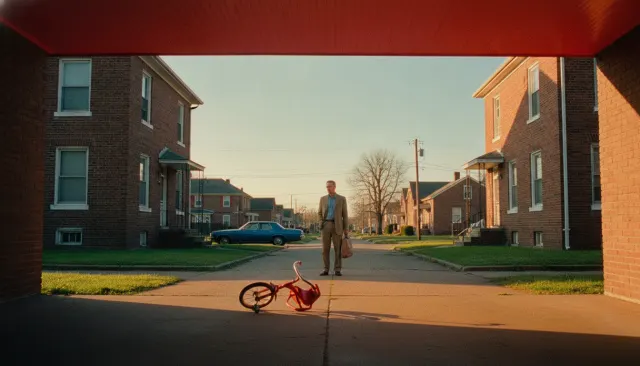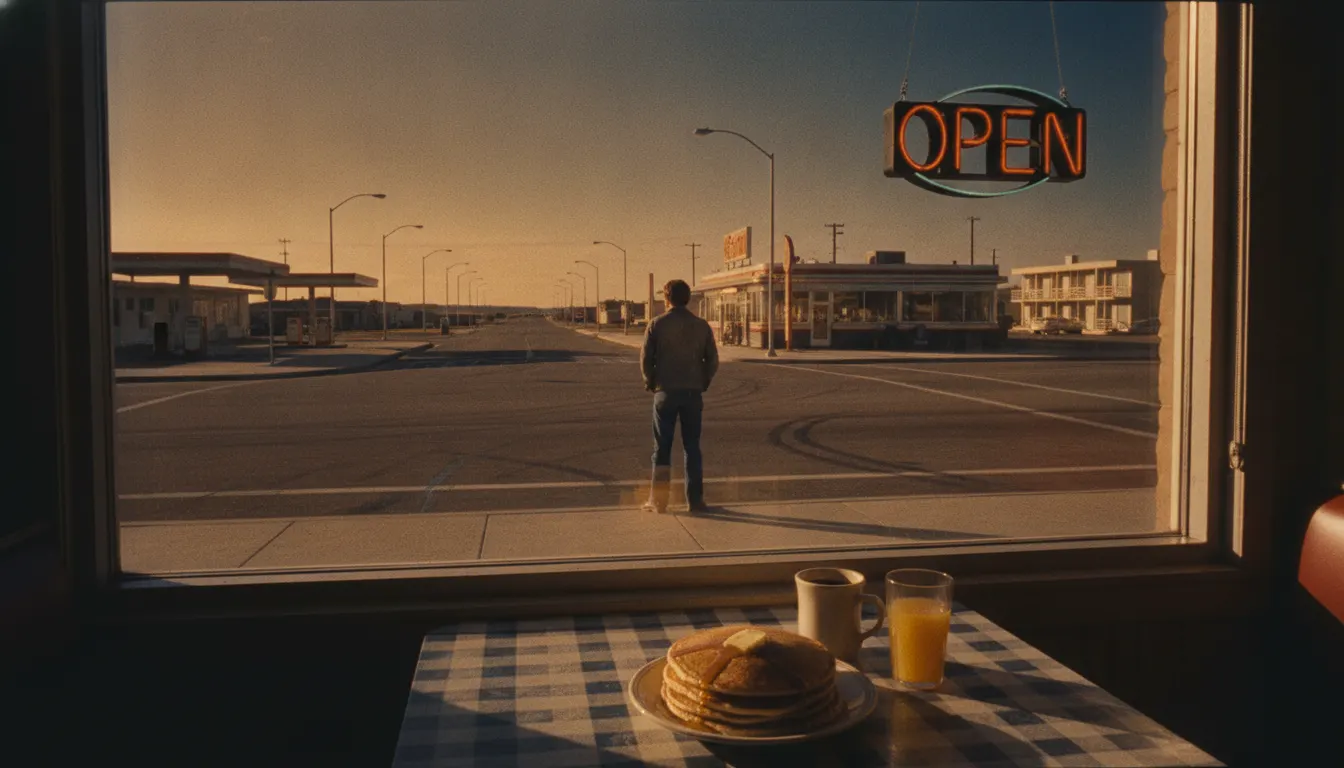
*Uncommon Places* (Aperture, 1982)
foundational New Color Photography monograph
Stephen Shore Uncommon Places 8x10 view camera. Saturated American vernacular, intersection wide shot, diner pancake breakfast still life.
The moves a human crew would use to get here. Cue applies them for you, and knowing their names is how you ask for a change.
format view camera on tripod for maximum tonal resolution and perspective control
light shooting to avoid dramatic golden-hour emotion
off architectural geometry - no expressive tilt
motels, diners, parking lots, gas stations
turquoise, orange, institutional beige read as facts
Stephen Shore's Uncommon Places (1982) is one of the defining photographic books of the 20th century, establishing the visual and intellectual grammar of the New Color Photography movement. Where earlier art photography had treated color as decoration or commercial compromise, Shore demonstrated that color could carry the full philosophical weight of a serious artistic practice.
Shore began the extended road trip project in 1973, driving a series of American routes and stopping to photograph the vernacular landscape - motels, diners, parking lots, suburban intersections, and roadside views - with 8x10 large-format view cameras. The project concluded in the early 1980s and was published as Uncommon Places in 1982 by Aperture.
The choice of 8x10 was deliberate and radical. Large-format photography required a tripod, a dark cloth, and methodical composition on the ground glass - the opposite of the spontaneous 35mm street photography that had dominated postwar photography discourse. Shore's images have the quality of pure seeing: there is no expressive camera shake, no dramatic timing, no flattering light. The camera sits level, the horizon is respected, and the ordinary subject is treated with the same compositional rigor reserved for grand landscapes.
Shore's palette reads as documentary rather than expressive. He worked largely in midday and mid-afternoon light - the conditions most photographers avoid - which produced flat, even illumination that let color function as pure information. The turquoise of a motel swimming pool, the orange vinyl of a diner booth, the brown of a McDonald's uniform exist as facts rather than aesthetic choices. This 'democratic' relationship to color directly influenced William Eggleston, who had been developing parallel ideas simultaneously.
Shore was among the first artists given a solo show at the Metropolitan Museum of Art (1971, when he was 23), an unusual event for a living photographer. Uncommon Places anticipates the visual vocabulary of New Topographics photography, the deadpan American commercial photography of the 1990s and 2000s, and the Instagram aesthetic of flat midday light and vernacular subject matter. Photographers including Alec Soth and Todd Hido have cited Shore as foundational.
A second expanded edition of Uncommon Places was published in 2004, adding images from the later period of the project.
foundational New Color Photography monograph
8x10 street corner image, widely reproduced
motel pool, exemplary midday color palette
1972
earlier color snapshot work preceding Uncommon Places
roadside diner, frequently cited as signature image
A Look is not a filter. It is a set of stored decisions the pipeline reads before it makes a single frame, so two videos in the same Look actually match.