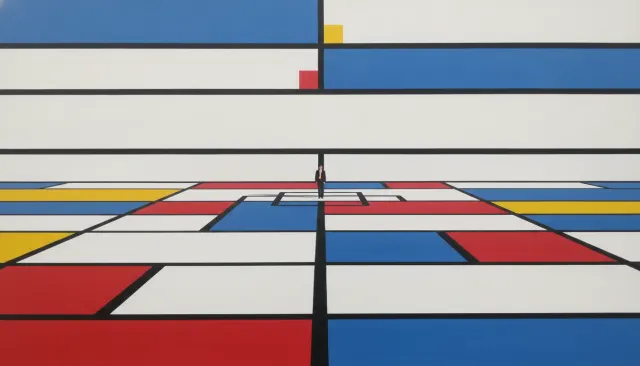
Carlton Room Divider
Ettore Sottsass / Memphis Group · 1981
Asymmetric plastic-laminate shelving unit - the movement's single most iconic object
Ettore Sottsass postmodern industrial design. Valentine typewriter red, Olivetti playful machinery, oblique angles, color as polemic.
The moves a human crew would use to get here. Cue applies them for you, and knowing their names is how you ask for a change.
Bacterio amoeba patterns, geometric grids, and terrazzo-dot fields - the physical textures that defined Memphis materiality.
Forms combine spheres, cones, cylinders, and planes without ergonomic logic, prioritizing visual play.
Cobalt, coral, acid yellow, and forest green applied simultaneously without one color dominating as base or accent.
Multiple distinct patterns appear in the same composition without a neutral zone to rest the eye.
Decorative elements that serve no structural purpose, directly contradicting Bauhaus form-follows-function doctrine.
Forms scaled for visual statement rather than spatial efficiency; asymmetric compositions that resist restful equilibrium.
Ettore Sottsass (1917-2007) was the Italian industrial designer and architect who founded the Memphis Group in Milan on December 1, 1981, and in doing so detonated the most aesthetically disruptive movement in postwar design. Memphis - named for a Bob Dylan song playing at Sottsass's apartment during the founding meeting - declared war on good taste, Bauhaus functionalism, and the grey sobriety of Italian Rationalist furniture. The movement lasted formally only until 1988, but its influence on surface design, fashion, and graphic culture continued for decades and experienced a major revival beginning around 2015.
The Carlton room divider (1981), designed by Sottsass himself, is the single most reproduced image of the Memphis aesthetic. A freestanding shelving unit built from plastic laminate-covered wood, the Carlton rises to an asymmetric triangular form with shelves at irregular angles, surfaces covered in the laminate patterns that became Memphis signatures: jagged lightning-bolt patterns in black and white, terrazzo-like multicolor dot fields, pastel-on-pastel geometric prints. The furniture's functions - storage, display - are secondary to its visual address, which announces the object as sculpture and cultural statement.
Other founding members included Michele De Lucchi (1951-), who designed the First Chair (1983) with its yellow sphere-topped back; Marco Zanini, Aldo Cibic, Nathalie du Pasquier, and the Japanese designer Masanori Umeda, whose Tawaraya boxing-ring-shaped bed (1981) summed up the movement's theatrical ambition.
Memphis/Sottsass design is identifiable by its cheerful attack on functionalist principles. Color is applied as surface pattern rather than as functional coding: acid yellow, cobalt blue, coral pink, and forest green appear together without hierarchy. Patterns are bold and repetitive: the Bacterio laminate (designed by Sottsass, a field of amoeba-like black-and-white shapes) and the various geometric laminates designed by group members were applied to furniture surfaces, domestic objects, and consumer electronics. The Olivetti Valentine typewriter (1969), designed by Sottsass before Memphis, anticipated the movement's color and personality with its red plastic housing.
Forms combine multiple geometric volumes - spheres, cones, cylinders, rectangular planes - in compositions that prioritize visual play over ergonomic logic. Materials mix freely: plastic laminate, glass, metal, ceramic, and wood appear together without the modernist insistence on material honesty.
Memphis arrived as a response to the perceived austerity and elitism of Italian Rationalist design and the anonymous functionality of German industrial design. Sottsass framed it explicitly as anti-functionalist: objects should communicate culture, memory, and pleasure, not just serve purposes. The movement attracted immediate media coverage - the 1981 Milan Furniture Fair launch was attended by hundreds of journalists - and celebrity collectors including David Bowie, Karl Lagerfeld, and Peter Halley.
The Memphis revival from approximately 2015 onward reflected a broader postmodern rehabilitation in which millennial and Gen Z consumers rediscovered the movement's irreverence as a corrective to minimalist aesthetic dominance.
Ettore Sottsass / Memphis Group · 1981
Asymmetric plastic-laminate shelving unit - the movement's single most iconic object
Michele De Lucchi / Memphis Group · 1983
Yellow sphere-topped back chair that summarized Memphis's playful anti-functionalism
Masanori Umeda / Memphis Group · 1981
Boxing-ring-format bed that announced Memphis's theatrical and sculptural ambitions
Ettore Sottsass · 1969
Pre-Memphis portable typewriter in red plastic that anticipated the movement's color philosophy
Ettore Sottsass · 1978-1981
Amoeba-black-on-white surface pattern that became the signature Memphis material texture
Barbara Radice · 1981
Publication that documented and theorized the movement, circulating it internationally
A Look is not a filter. It is a set of stored decisions the pipeline reads before it makes a single frame, so two videos in the same Look actually match.