Landsat 1 first images
NASA / USGS · 1972
First images from ERTS-1 establishing the 50-year Landsat archive and defining modern earth observation imagery
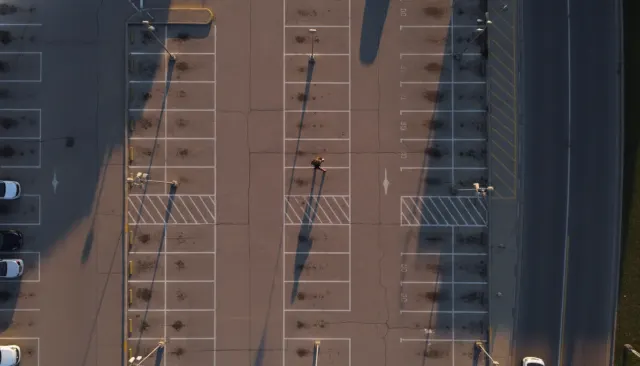
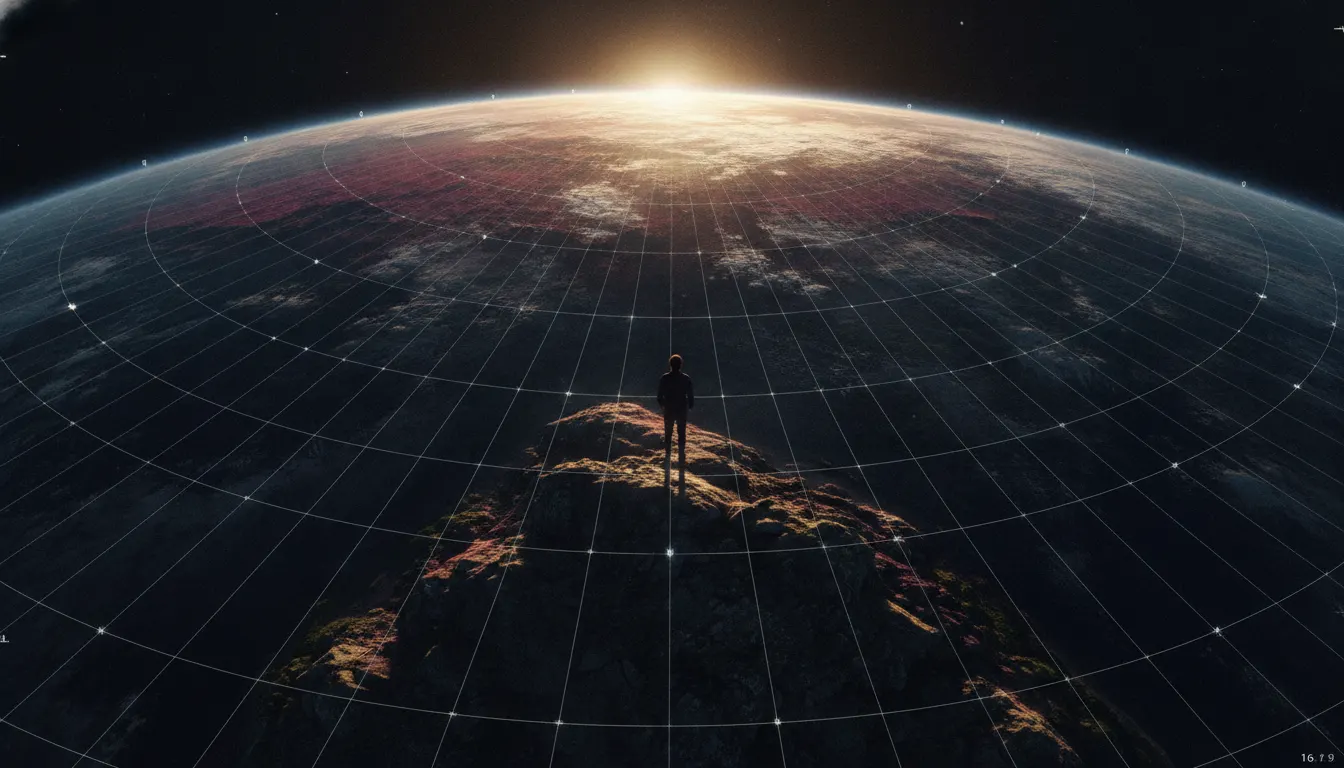
Top-down satellite earth imagery. Sentinel and Landsat true-color or false-color NDVI, geographic grid overlay, lat-lon coordinates.
The moves a human crew would use to get here. Cue applies them for you, and knowing their names is how you ask for a change.
Bands 4-3-2 in Landsat 8 or similar composited to approximate natural color, producing the familiar blue ocean/green vegetation/brown land satellite view.
Near-infrared assigned to red channel producing vivid magenta-red for healthy vegetation - the signature palette of scientific earth observation.
Normalized Difference Vegetation Index color-mapped from red (bare/low) to green (dense vegetation), producing abstract heat-map style agricultural pattern images.
Cloud shadows at orbital altitude create high-contrast patterns that give cloud formations visible three-dimensionality and depth cues.
Center-pivot irrigation circles, strip farming, and grid-pattern agriculture viewed from orbit create geometric abstract compositions.
Two or three acquisition dates assigned to different color channels, showing change in land cover as color shifts in a single composite image.
Thermal infrared bands visualized as false-color gradients reveal urban heat distribution, industrial emissions, and wildfire perimeters.
Satellite earth observation photography encompasses images captured by orbital sensors from 160 to 800 kilometers altitude, producing top-down views of the Earth's surface that reveal patterns, scale, and beauty invisible from the ground. The aesthetic has evolved from grainy 1960s reconnaissance imagery to the sub-meter resolution, false-color, and multispectral composites now widely available through public and commercial programs.
NASA's Landsat program, launched July 23, 1972, established the continuous record of global earth observation that remains the longest ongoing archive of any satellite program. Landsat 1 (1972) used the Multispectral Scanner System (MSS) at 80-meter resolution - enough to distinguish field boundaries, urban blocks, and major geological features. The ERTS (Earth Resources Technology Satellite) images from this era, with their characteristic yellow-brown-green false-color composite of bands 4-5-6, define the aesthetic most people associate with early satellite imagery.
Landsat 7 (1999) introduced 15-meter panchromatic resolution and 30-meter multispectral bands. Landsat 8 (2013) and Landsat 9 (2021) continue the program at 15/30-meter resolution with 11-band multispectral capability. The USGS Earth Explorer archive provides free access to the entire Landsat record from 1972 to present - an extraordinary resource that has shaped how artists and designers access satellite imagery.
DigitalGlobe (now Maxar Technologies) launched WorldView-1 (2007) and WorldView-2 (2009), providing 0.46-meter panchromatic commercial resolution - enough to see individual cars, boats, and building rooftops. Planet Labs launched its first Dove CubeSat in 2013 from the ISS; by 2017 it operated a constellation of 150+ Dove satellites providing daily global coverage at 3-5 meter resolution.
NASA's Worldview browser (2012), Google Earth (2005), and Sentinel Hub make high-resolution earth observation imagery accessible to anyone with a browser. The NASA Earth Observatory maintains a curated gallery of satellite images as art, with images like Spiral Glacier in the Karakoram (Landsat, 2000) and the Richat Structure in Mauritania achieving wide circulation as both scientific and aesthetic objects.
Satellite earth observation has a distinctive visual language: the top-down orthographic projection eliminates the atmospheric perspective and foreshortening of ground-level photography; geometric agricultural patterns create abstract compositions; cloud systems have clean, three-dimensional form against ocean or land; and multispectral false-color composites produce color palettes impossible in natural photography - infrared red for healthy vegetation, blue for water, yellow for desert.
NASA / USGS · 1972
First images from ERTS-1 establishing the 50-year Landsat archive and defining modern earth observation imagery
Apollo 17 crew · 1972
Iconic full Earth photograph from 45,000km altitude on December 7, 1972 - the most reproduced photograph in history
NASA / Voyager 1 · 1990
Earth photographed from 6 billion km by Voyager 1 at Carl Sagan's request, producing the most distant Earth image ever made
NASA / various satellite programs · 2000-present
Curated online gallery of earth observation imagery as science communication art, reaching millions with satellite aesthetics
Planet Labs / Dove constellation · 2013-present
Daily global coverage at 3-5m resolution from 150+ CubeSats, enabling time-lapse and change detection at unprecedented temporal frequency
Google / NASA · 2005-present
Consumer satellite imagery browsers that brought sub-meter orbital photography to global public awareness
A Look is not a filter. It is a set of stored decisions the pipeline reads before it makes a single frame, so two videos in the same Look actually match.