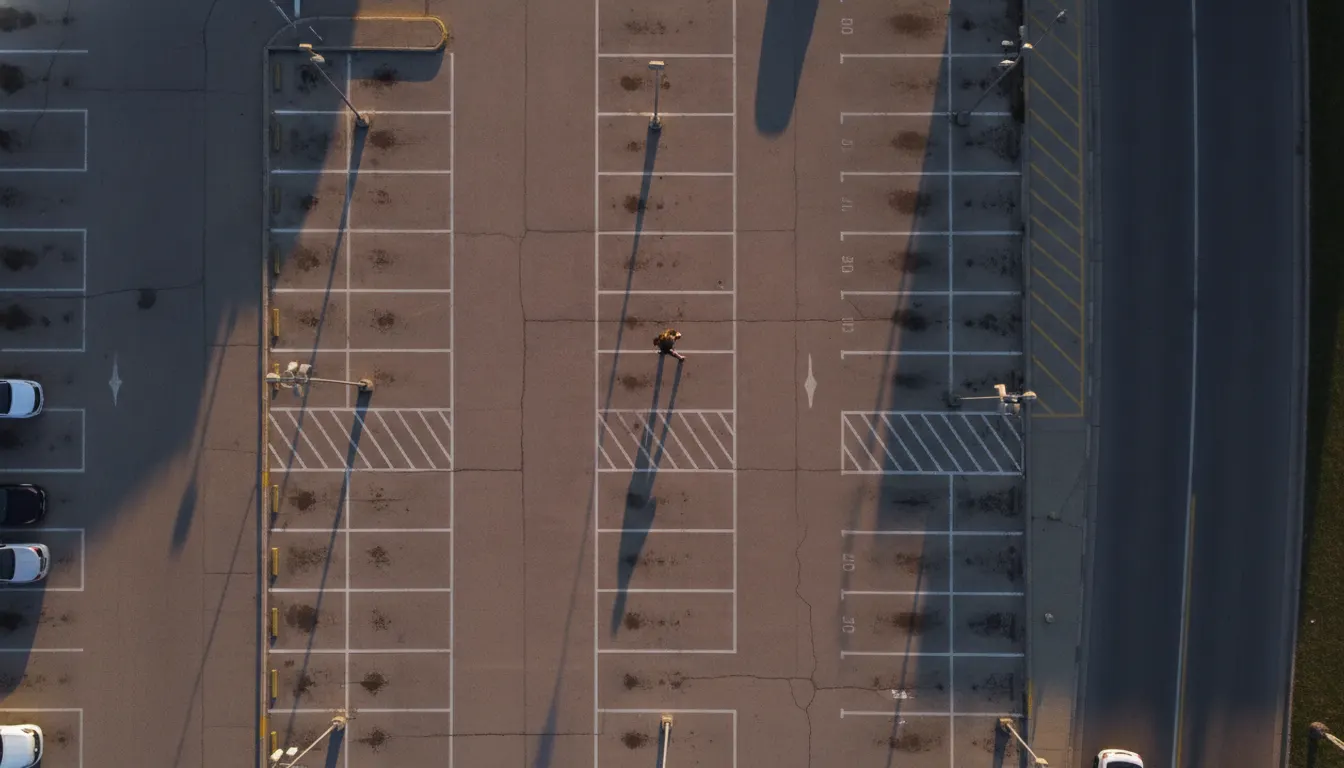
Bernhard Lang
*Aerial Views* beach and motorway series (2010s), National Geographic and Time
Drone aerial street photography. Top-down DJI Mavic perspective, geometric pedestrian shadow grid, parking-lot pattern, Instagram aerial movement.
The moves a human crew would use to get here. Cue applies them for you, and knowing their names is how you ask for a change.
down) framing to eliminate horizon and read urban surfaces as flat graphic planes
60 degrees) to retain architectural context while maintaining pattern readability
a single saturated element against a desaturated field creates natural focal point
long shadows at golden hour create abstract graphic lines on flat surfaces
using road intersections or crosswalks as graphic anchors
stabilized at altitude) for motion blur streaks of vehicles on dark asphalt
Drone aerial street photography applies the compositional logic of traditional street photography - the decisive moment, human pattern, urban texture - to a directly overhead or steeply angled aerial perspective only accessible since the popularization of consumer drones around 2013-2015. Where street photography seeks the collision of people and cityscape at eye level, drone aerial photography reveals urban geometry as abstract pattern: pedestrian crossings become graphic fields, traffic becomes flowing lines, and the relationship between people and infrastructure becomes visible only from above.
German photographer Bernhard Lang (active from 2010s) became one of the most influential figures in this aesthetic with his series Aerial Views, shot over beaches, ski slopes, car parks, and public spaces. Lang treats human crowds and their relationship to built infrastructure as pure visual geometry - his beach images reduce bodies to textured fields of color, his motorway photographs turn vehicles into abstract brushstrokes. Lang's work has appeared in National Geographic, Time, and Wired.
DJI's Phantom series (from 2013) and the Mavic line (from 2016) made high-resolution aerial photography accessible without helicopter costs. This created a generation of drone photographers who brought the visual ambitions of fine-art photography to aerial imagery: Amos Chapple (Reuters/Getty), Yann Arthus-Bertrand (Earth from Above, shooting from helicopters since 1994, predating drones), and Instagram communities like @droneoftheday made top-down urban photography a mainstream vocabulary.
Drone aerial street photography at its most distinctive uses direct nadir (straight down) framing to eliminate horizon and depth cues entirely, forcing the viewer to read urban texture as flat pattern. Shadow and human scale become the only depth signals. Color contrast - a red jacket in a grey crowd, a yellow taxi in a charcoal street - creates focal points within otherwise uniform fields.
*Aerial Views* beach and motorway series (2010s), National Geographic and Time
*Earth from Above* (2000, La Martiniere), helicopter aerial photography book
aerial street photography for Reuters and Getty Images (2015-present)
New York City top-down drone and long-lens aerial photography
aerial beach photography series (2012-present), top-down poolside and coastal imagery
2010
*LA NYC* , high-altitude aircraft photography of urban grids
A Look is not a filter. It is a set of stored decisions the pipeline reads before it makes a single frame, so two videos in the same Look actually match.