Jimi Hendrix Jazz Poster
Waldemar Świerzy · 1973
Globally reproduced flat-color portrait in green, purple, orange, and black
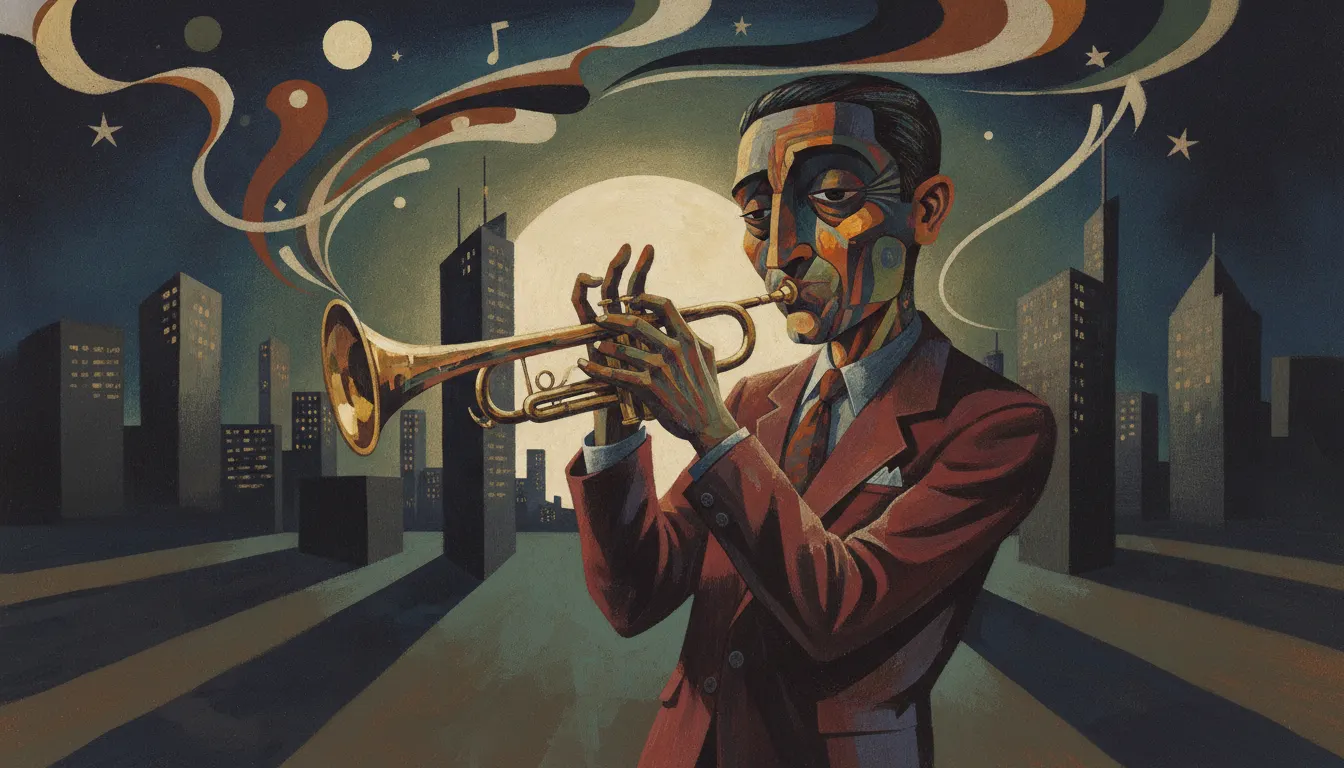
Polish jazz poster flat color aesthetic. Polish school of posters jazz festival lineage, hand-painted surreal portrait of musician, expressive flat color brushwork.
The moves a human crew would use to get here. Cue applies them for you, and knowing their names is how you ask for a change.
Each hue applied without gradient or shading; color interactions carry all the visual weight.
Figures and instruments broken into organic, near-abstract shapes rather than representational outlines.
Title type drawn to rhyme with or grow from the figurative elements rather than placed on a separate typographic baseline.
Black used as a flat ink area that defines negative space and creates visual punch alongside chromatic hues.
Portrait faces reduced to minimal flat-color planes - three to four color zones suggesting features without describing them.
Single dominant figure or instrument fills the format edge-to-edge, maximizing impact at billboard or gallery scale.
From the late 1950s through the 1980s, Poland produced a jazz poster tradition that was simultaneously a product of Soviet-era cultural politics and a radical experiment in graphic freedom. Jazz itself arrived in Poland through contraband American recordings and the cultural thaw of 1956, when Stalinist restrictions loosened briefly. The Warsaw Jazz Jamboree, founded in 1958, needed promotional graphics, and the assignment fell to designers who had been trained in the painterly, expressionistic tradition of the Polish Poster School.
Jan Lenica (1928-2001) was among the earliest designers to find the flat-color, fragmented-form aesthetic that would define the genre. His posters used large flat areas of unmixed color - a single cadmium yellow, a flat cobalt, an unmodulated black - interrupted by organic, almost biomorphic silhouettes. Where American jazz poster design in the same period was moving toward photographic abstraction or clean modernism, Lenica's work remained rooted in the hand.
Waldemar Świerzy (1931-2013) became the single most prolific and celebrated name in Polish jazz poster design. His Jimi Hendrix portrait poster (1973) achieved global recognition: a face built entirely from flat ink areas of green, purple, orange, and black, the features barely indicated, the expressiveness entirely in the color architecture. His Louis Armstrong poster (1983) used the same economy - a golden trumpet bell as a flat semicircle, a blue face, four flat colors total. Świerzy made approximately 180 jazz posters over his career.
Franciszek Starowieyski (1930-2009) pushed the style toward darker surrealism, introducing distorted anatomy and dreamlike imagery while maintaining the flat-ink print aesthetic of silkscreen and lithography.
The flat-color character of Polish jazz posters arose from the constraints of lithographic and silkscreen printing. Each color required a separate plate or screen, so economy forced clarity. Designers used 3-5 flat colors, often without gradients, relying on the interaction of unmodulated hues to generate energy. Letterforms were frequently hand-drawn, integrating with the imagery rather than sitting above it in a typographic grid. The combination of flat color with hand-rendered organic form created a visual tension that no computer-generated equivalent has fully reproduced.
Jazz in communist Poland was ideologically complicated: officially tolerated as anti-American culture, unofficially celebrated as the sound of freedom. This ambiguity gave the poster designers unusual latitude. The posters were officially art objects, displayed in state-approved galleries and distributed internationally, which insulated them from the kind of censorship that would have hit overtly political imagery. The result was a commercial art form that functioned as a protected enclave of aesthetic freedom during the Cold War.
Waldemar Świerzy · 1973
Globally reproduced flat-color portrait in green, purple, orange, and black
Waldemar Świerzy · 1983
Four-flat-color economy - golden trumpet bell, blue face - iconic economy of means
Jan Lenica · 1958-1980s
Foundational series establishing flat-color biomorphic language for Warsaw Jazz Jamboree
Waldemar Świerzy · 1970s
Dark blue and ochre flat planes with fragmented trumpet form
Waldemar Świerzy · 1970s
Cheek-inflated silhouette as geometric flat form
Franciszek Starowieyski · 1970s-80s
Surreal anatomical distortions maintaining flat-color print discipline
A Look is not a filter. It is a set of stored decisions the pipeline reads before it makes a single frame, so two videos in the same Look actually match.