Tiffany & Co. digital product visualization
Tiffany & Co. / Archetype / Pixelz · 2020
Industry-benchmark luxury render pipeline for engagement rings and jewelry collections
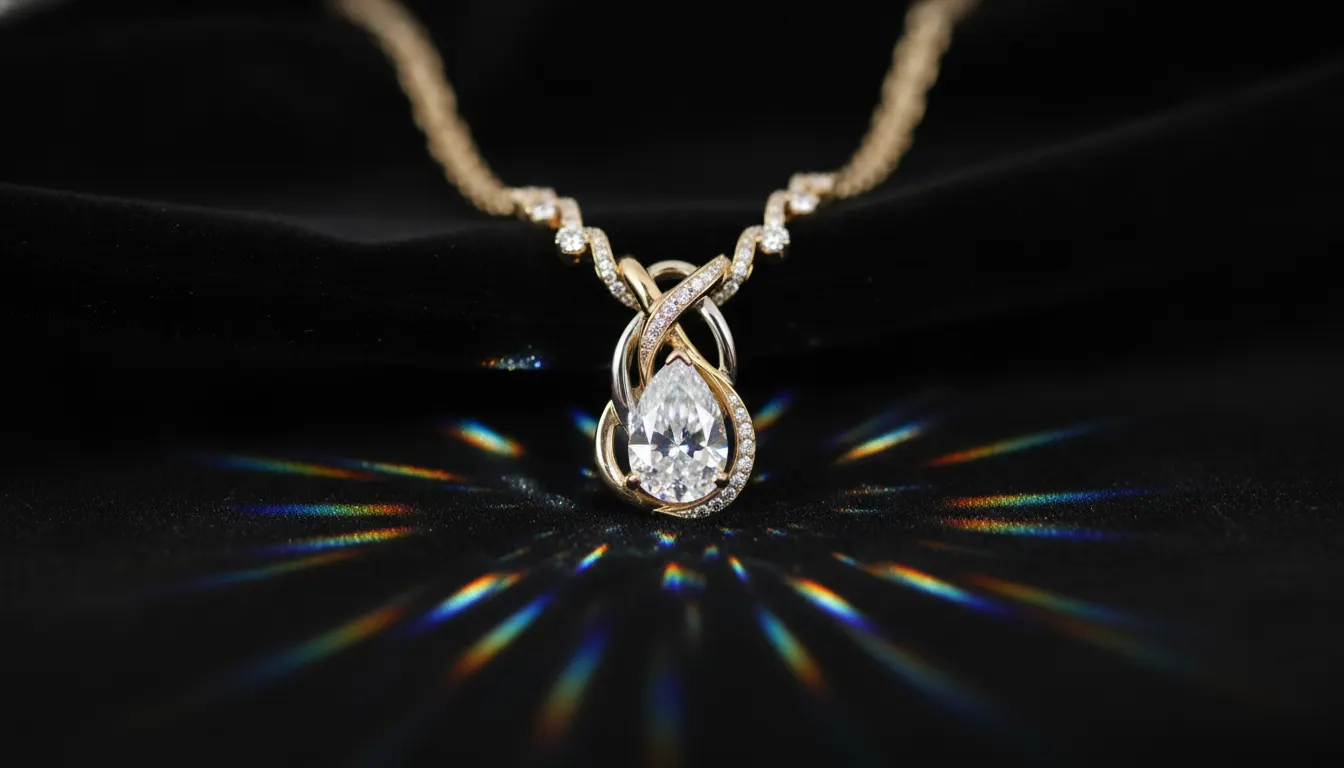
Luxury jewelry product render. Diamond caustic light, gold and platinum reflection, black velvet backdrop, macro precision.
The moves a human crew would use to get here. Cue applies them for you, and knowing their names is how you ask for a change.
Physically accurate total internal reflection and spectral IOR values producing diamond fire -- the splitting of white light into spectral colors -- within facet geometry
Cut-specific facet count and geometry: 58-facet round brilliant, princess, emerald, and pear cuts rendered with mathematically correct pavilion angles
Yellow gold, rose gold, platinum, and silver rendered using spectrally measured optical constants rather than approximated Fresnel values
Single large soft key mimicking north-facing studio window combined with positioned fill cards, the industry-standard jewelry photography lighting logic translated to CG
Hero shots on pure black, white, or material-neutral surfaces to isolate the piece's optical behavior from competing environmental reflections
When placing jewelry on hands or necks, accurate skin subsurface scattering provides warm biological contrast against the cool precision of metal
The jewelry luxury render aesthetic is a specialized subset of product visualization where physical accuracy of light interaction with precious materials -- diamond refraction, gold specular, pearl luster -- is combined with the compositional vocabulary of high-end jewelry photography. Studios like Pixelz, the render teams at Tiffany & Co., Cartier's digital production house, and luxury CGI specialists Archetype use physically based rendering (PBR) pipelines with spectral light simulation to achieve results indistinguishable from, and often superior to, studio photography.
Diamond rendering requires accurate simulation of total internal reflection, spectral dispersion (the fire effect where white light splits into spectral colors), and the specific geometry of common cuts -- round brilliant, princess, oval, pear, emerald. A correctly rendered round brilliant at 58 facets will produce the characteristic 'hearts and arrows' refraction pattern visible from the pavilion view. PBR renderers like V-Ray, Redshift, and Arnold handle this via spectral IOR (index of refraction) values and bidirectional scattering distribution functions calibrated to gemological data.
Gold (yellow, white, rose), platinum, and silver each have distinct specular behavior measured as IOR + extinction coefficient pairs. Yellow gold's warm reflectance is physically distinct from rose gold's copper-shifted tint; both are distinct from platinum's cold, low-reflectance mirror. Luxury renders use these distinctions to establish material authenticity, with brushed versus polished finish variations adding a second dimension of surface identity.
Jewelry luxury renders typically use a single, large soft key source (mimicking a north-facing studio window) combined with fill cards and controlled fill reflectors placed in specific positions relative to the piece's geometry. The goal is to bring out each facet's individual light behavior while maintaining global environmental coherence. HDR environment maps sourced from luxury photography studios (specifically tuned for jewelry) are industry standard.
High-end jewelry renders place pieces on neutral surfaces -- white marble, black velvet, brushed steel -- or suspend them in void against pure gradients. Context shots reference editorial photography: rings on polished fingers, necklaces near skin that shows subsurface warmth. Both approaches serve different purchase-funnel positions: void for hero shots, context for emotional aspiration.
The shift toward 3D jewelry configurators -- tools allowing customers to select metal color, stone, and setting in real time on a product page -- created demand for luxury render quality at interactive frame rates. Studios like Cylindo and Tangent developed WebGL and WebGPU pipelines capable of delivering jewelry-quality diamond refraction in a browser tab without pre-rendering. The aesthetic challenge is that real-time approximations of spectral dispersion (using pre-baked environment cubemaps rather than true spectral tracing) can produce slightly off results -- too-uniform dispersion, too-bright fire -- that train-spotters in the fine jewelry industry immediately identify.
Turntable renders -- slow 360-degree rotations of a jewelry piece -- are the standard video deliverable for e-commerce jewelry. The temporal dimension creates specific challenges: the fire effect in a diamond must distribute over the rotation so that different facets catch light at different moments, creating a constantly changing spectral display rather than a single static sparkle. Turntable animation pacing is calibrated to allow each facet's fire moment to be individually seen -- typically 15-30 seconds per revolution at the speeds that perform best for product video engagement metrics.
Tiffany & Co. / Archetype / Pixelz · 2020
Industry-benchmark luxury render pipeline for engagement rings and jewelry collections
Cartier / digital production partners · 2021
High-profile jewelry CGI where panther-set diamond pieces required both gemstone and animal texture accuracy simultaneously
Bulgari / CGI studio · 2022
Snake-motif jewelry pieces demonstrating the aesthetic's capacity for complex articulated metal forms
De Beers / BBDO / CGI studio · 2019
Diamond-focused luxury render campaign establishing spectral dispersion as a primary visual identity element
Rolex / Demodern / CGI partners · 2020
High-end watch rendering requiring simultaneous accuracy of gemstone, metal, and dial texture materials
Swarovski / in-house CGI · 2021
Mass-luxury crystal rendering at high volume, demonstrating the aesthetic's scalability from bespoke to catalogue production
A Look is not a filter. It is a set of stored decisions the pipeline reads before it makes a single frame, so two videos in the same Look actually match.