Porsche online configurator (2015–present)
Porsche Digital / Luxion KeyShot pipeline
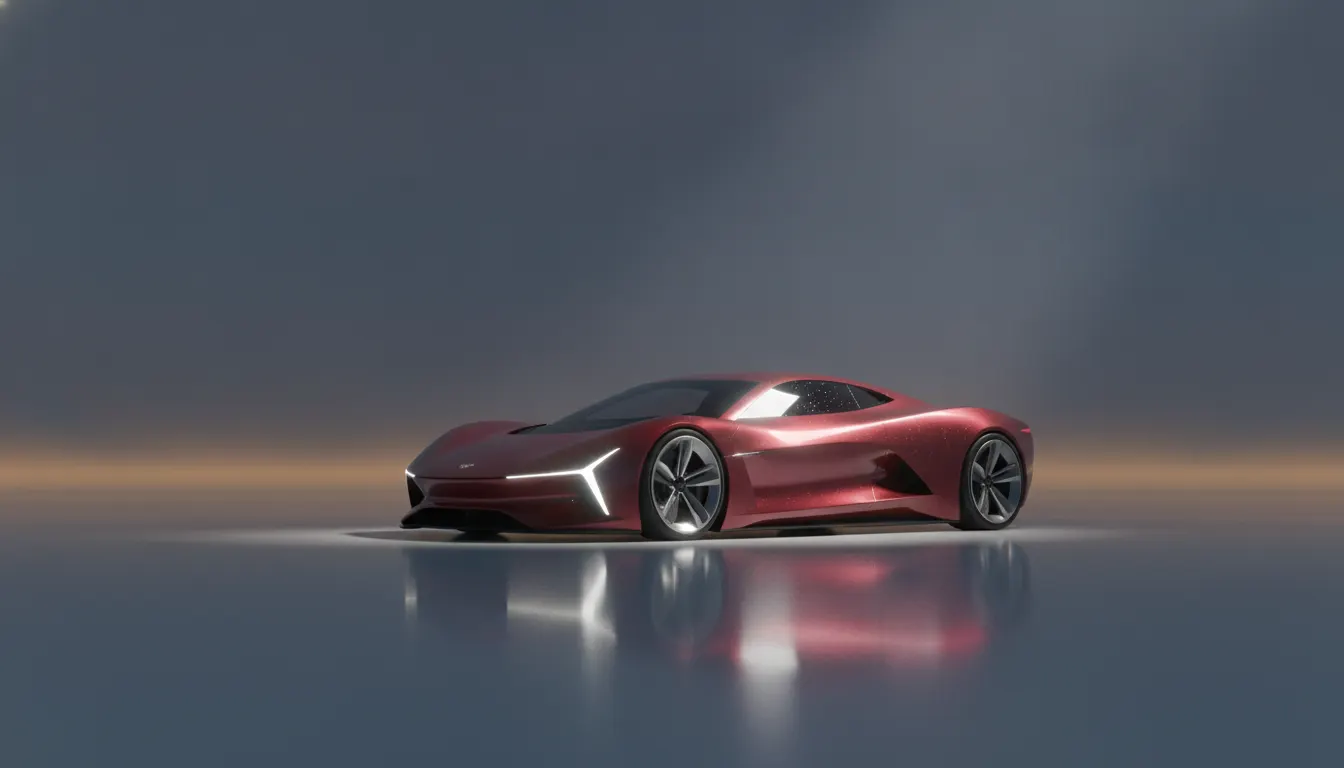
KeyShot automotive product render. Studio cyclorama with painted-gradient backdrop, paint reflection, wheel macro, automotive marketing.
The moves a human crew would use to get here. Cue applies them for you, and knowing their names is how you ask for a change.
based all-direction illumination from overcast sky or custom studio panorama (no hard shadows)
geometry flake simulation at varying orientation distributions
surface scattering on rubber, gasket, and plastic components for material differentiation
frame or 72-frame 360-degree rotation) for configurator delivery
car motion-blur composites blending photogrammetry environments with CGI vehicles
KeyShot-developed by Luxion and released commercially in 2009-became the dominant real-time ray-tracing tool for automotive and industrial product visualization over the 2010s. Its combination of physics-accurate material libraries, HDRI lighting integration, and GPU-accelerated rendering made it the de facto standard for automotive CGI studios including Bright3D, 3DVIZZ (Munich), Visualise (London), and in-house teams at OEMs including Porsche, BMW, Audi, and Mercedes-Benz Design.
Automotive KeyShot renders follow a grammar descended from physical automotive photography studios developed in the 1950s and 1960s-particularly the 'car tent' or 'white cyc' studio where vehicles are photographed under large, diffuse overhead lighting to reveal body line and panel curvature. KeyShot's HDRI environment approach digitizes this exactly: a single high-dynamic-range panoramic image of an overcast sky or custom-designed studio environment illuminates the vehicle from all angles simultaneously, with no hard shadows that would obscure panel geometry.
Three material categories define automotive render credibility. Metallic paint requires accurate flake simulation-not just color tint but actual micro-geometry of aluminum or mica flakes at varying orientations, which change the paint's apparent color based on viewing angle (effect known as 'goniochromatic'). Chrome surfaces (bumpers, wheels, trim) must resolve reflections without aliasing. Glass must balance internal reflections with transmission. KeyShot's material library includes hundreds of automotive-calibrated presets developed in collaboration with automotive color labs.
The two canonical automotive CGI deliverable types are the turntable (360-degree rotation on a neutral ground plane, used for configurators and showroom kiosks) and the hero shot (three-quarter front or rear composition, elevated camera, dramatic lighting gradient). BMW's configurator (launched 2010s) and Porsche's online configuration tool both run KeyShot or equivalent real-time engines.
Beyond static renders, automotive CGI increasingly includes 'cinemagraphic' content: the vehicle in motion blur on a mountain road, shot with a virtual camera rig replicating a camera car at 80mph. Studios like The Mill and UNIT Image produce these for OEM launch campaigns, blending photogrammetry-scanned environments with CGI vehicles.
Porsche Digital / Luxion KeyShot pipeline
BMW Group Design, 3DVIZZ Munich
UNIT Image / The Mill
2021
Bright3D / Audi Design
2022
Rolls-Royce Bespoke visual team
A Look is not a filter. It is a set of stored decisions the pipeline reads before it makes a single frame, so two videos in the same Look actually match.