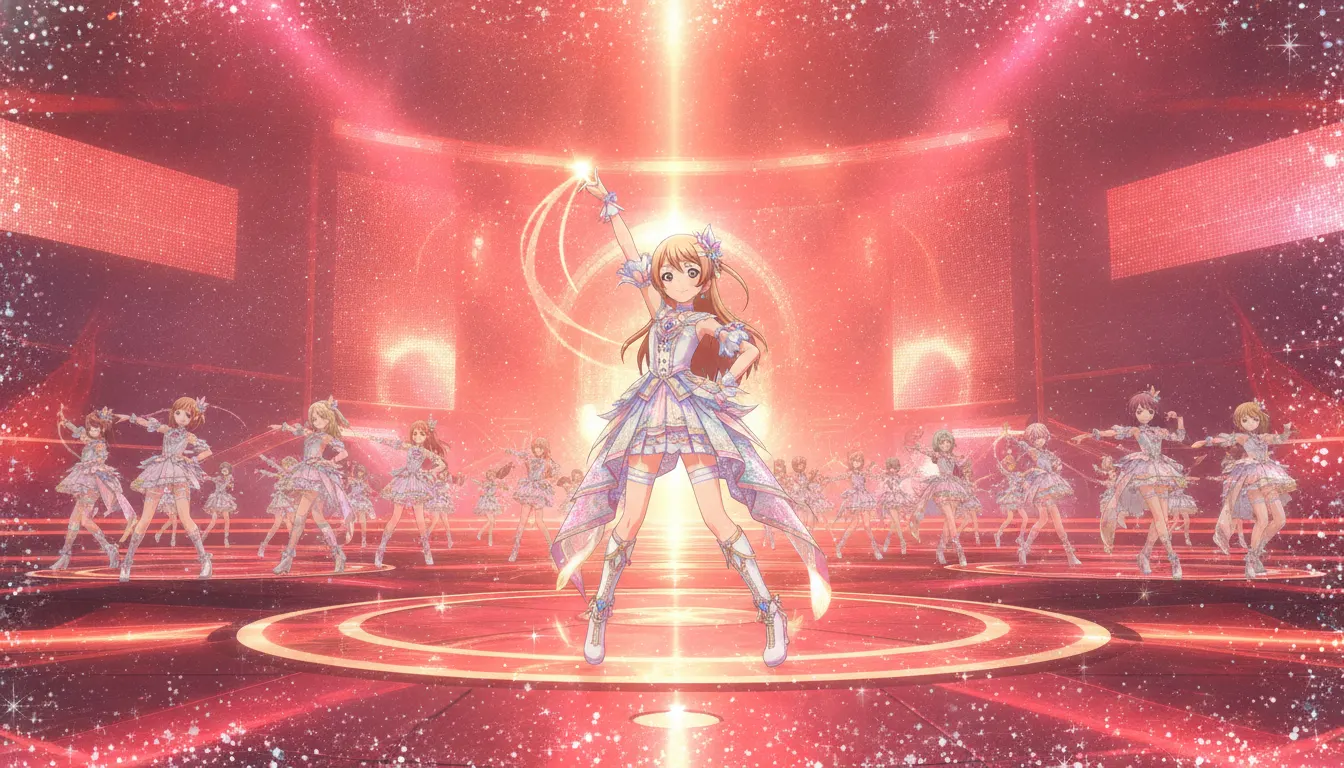
Love Live! School Idol Project
Sunrise / Hajime Yatate · 2013
Originating series establishing the stage glow and 2D/CG hybrid conventions for the genre
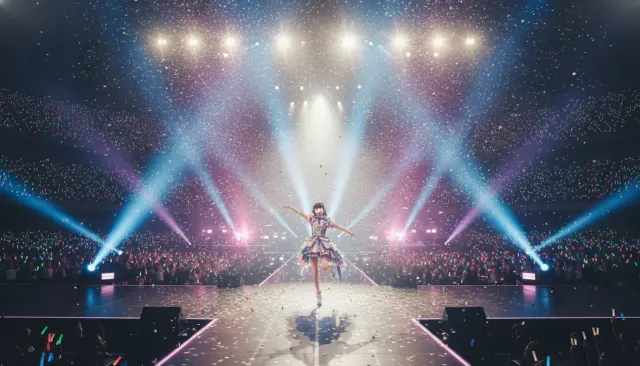
Expanded idol anime register (Love Live Sunshine, Aikatsu, Pripara, Show by Rock). Hot stage-glow palette, glitter-particle frames, choreographed group dance, costume-detail close-ups.
The moves a human crew would use to get here. Cue applies them for you, and knowing their names is how you ask for a change.
Entire-frame color tints synchronized with music sections shift the emotional register of performance sequences -- cyan for longing, gold for triumph
Hard-edged beam of white or colored light cutting through artificial stage fog, a direct translation of concert lighting into animation
Dynamic geometric pattern displays behind performers function as an animated environmental layer that intensifies during choruses
Full-CG character models used specifically for complex synchronized group dance formations that 2D hand-animation cannot maintain consistently
Stage costumes extend each character's signature color into elaborate ruffled, layered designs that read distinctly in group formation shots
Audience glow sticks shifting color in sync with the performance serve as an external emotional meter reflecting the song's energy back at the performers
Close-up on sweating, panting characters with soft smiles after a climactic performance -- the human scale counterweight to spectacle
The idol anime stage glow aesthetic represents one of anime's most technically sophisticated sub-genres, built around the 2013-2015 Love Live! School Idol Project (Sunrise studio) and its sequels Love Live! Sunshine!! (2016), Love Live! Nijigasaki Academy (2020), and Love Live! Superstar!! (2021). The look synthesizes 2D character animation with concert-stage lighting design, pyrotechnics visualization, and music video production conventions.
Performance sequences are defined by colored stage wash lighting that tints the entire frame -- cyan, magenta, golden -- shifting with the music's emotional arc. Follow spots create hard-edged cone beams through artificial atmospheric haze. LED video wall backgrounds display dynamic geometric patterns and the group's visual identity system, functioning as a second animated layer behind the characters.
Love Live! pioneered the use of CGI character models for dance sequences, deploying them for precisely choreographed group formations that 2D key animation cannot achieve consistently. The visible stylistic seam between 2D story scenes and CG performance became a genre convention. Later productions like Oshi no Ko (2023) and The Idolmaster series refined the hybrid to reduce the seam.
Stage costumes receive extraordinary design complexity -- layered ruffles, LED-inspired trim, thematic color-coding matching each member's character identity. These costumes are distinct from the characters' school uniforms and signal mode-shift from civilian to performer. Hair dynamics during performance sequences receive special treatment: individual strands animated separately for flowing motion.
Performances are staged as emotional climaxes that resolve narrative tension. Close-ups of individual members at peak vocal moments, crowd glow-stick color responses (wotagei), and post-performance exhausted smiles create a three-act structure within each song sequence.
Sunrise / Hajime Yatate · 2013
Originating series establishing the stage glow and 2D/CG hybrid conventions for the genre
Sunrise · 2016
Sequel expanding the formula with beachside outdoor performances alongside arena-scale productions
A-1 Pictures / Bandai Namco · 2011
Parallel idol franchise that influenced Love Live's visual approach to performance sequences
Doga Kobo / Aka Akasaka · 2023
Deconstruction of idol culture with some of the most technically accomplished 2D performance animation to date
Issen · 2017
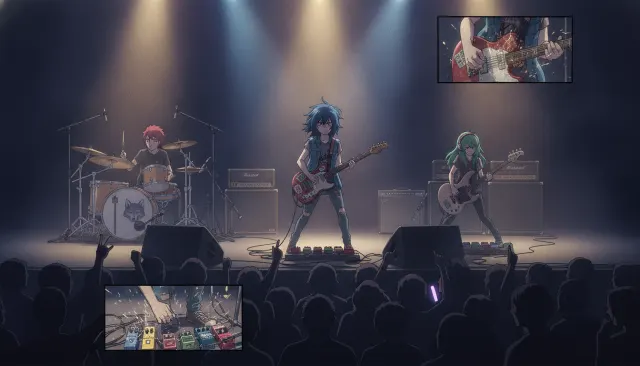
Idol-adjacent band anime using similar stage glow vocabulary for live music performance sequences
Satelight · 2016
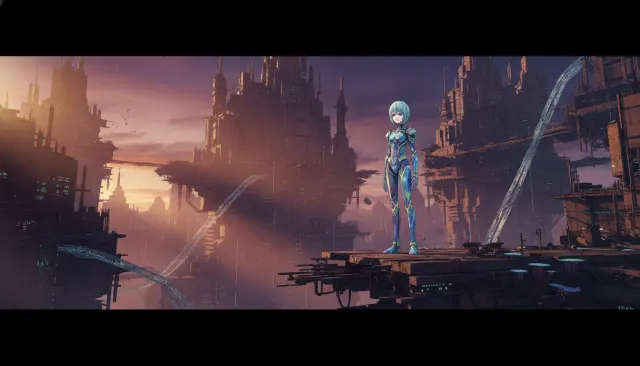
Sci-fi mecha series integrating idol performance aesthetics as in-universe battlefield broadcasting
A Look is not a filter. It is a set of stored decisions the pipeline reads before it makes a single frame, so two videos in the same Look actually match.