Pink Floyd
1973
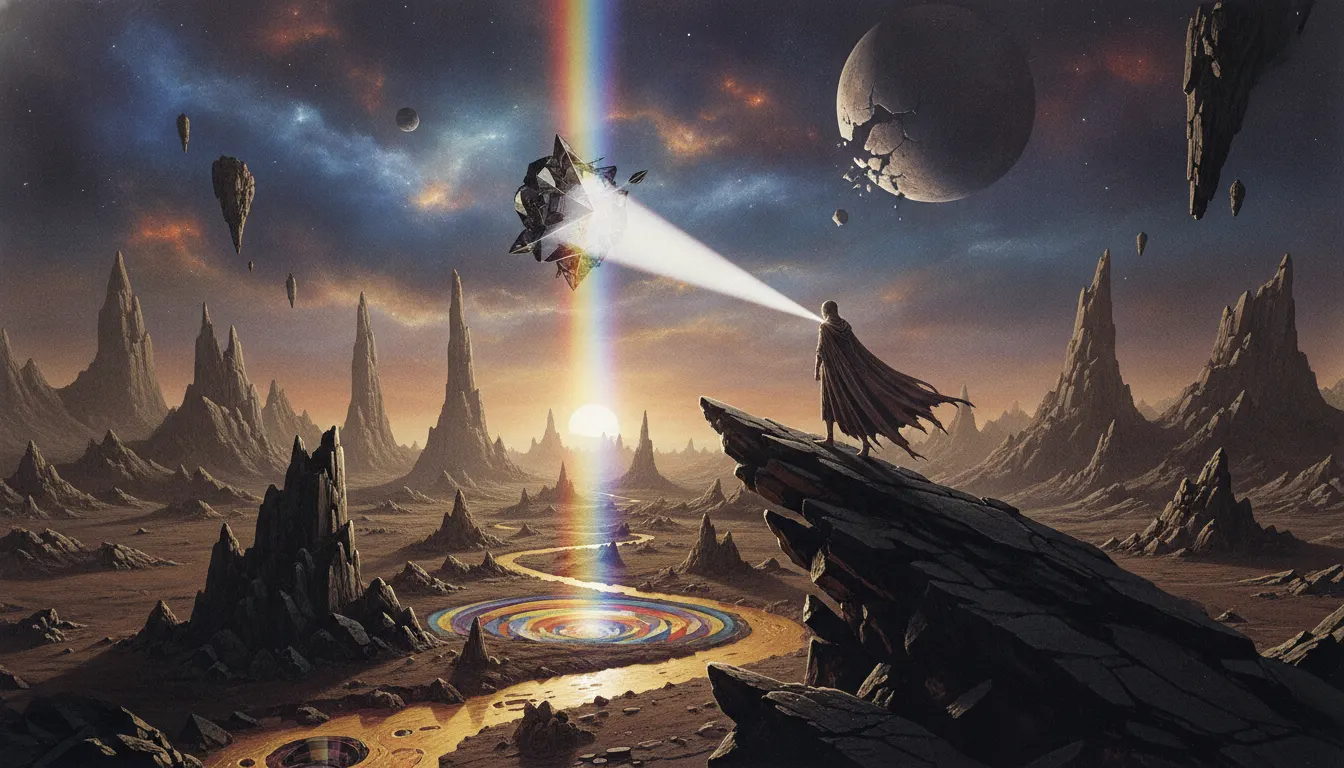
The Dark Side of the Moon : prism spectrum on black
Hipgnosis prog-rock cover design. Storm Thorgerson surreal photography, Pink Floyd Dark Side prism, Led Zeppelin In Through the Out Door, prismatic imagination.
The moves a human crew would use to get here. Cue applies them for you, and knowing their names is how you ask for a change.
format analog photography (4x5, 8x10) with extremely high tonal detail
camera and darkroom compositing: sandwiched negatives, multiple exposure, hand retouching
giant outdoor constructions, real fire, real weather
angle or ultra-wide perspective emphasizing monumental scale and spatial distortion
gatefold format exploited as a panoramic canvas, with interior spreads continuing the concept
Hipgnosis was a British graphic design partnership founded in 1968 by Storm Thorgerson and Aubrey Powell, operating out of London until 1983. They defined the visual language of progressive and art rock for over a decade, creating album covers that functioned as surrealist art objects rather than promotional material. Their working method was almost anti-commercial: no band logo on the front, no title typography if they could avoid it, just a single mind-bending photographic concept executed with extraordinary craft.
Thorgerson and Powell met at Cambridge and formed Hipgnosis on the recommendation of childhood friend Syd Barrett (Pink Floyd). Their name was scrawled on a door and stuck. From the start they positioned album sleeves as an autonomous art form, commissioning large-format studio photography, elaborate outdoor constructions, and retouched composite images years before digital tools existed. Every element was physically built or shot in camera.
Their most celebrated output came between 1973 and 1979. Pink Floyd's The Dark Side of the Moon (1973) reduced the concept to a prism refracting white light into spectrum - geometrically perfect, instantly iconic. Wish You Were Here (1975) showed a businessman shaking hands while on fire in a Hollywood back lot. Led Zeppelin's Houses of the Holy (1973) composited naked children climbing the Giant's Causeway in Northern Ireland, printed in an otherworldly amber wash. Peter Gabriel's first solo album (1977) used melting-face photography by Hipgnosis collaborator Gered Mankowitz. 10cc, Genesis, Paul McCartney, and UFO all passed through their studio.
Hipgnosis worked almost exclusively in large-format film, using 4x5 and 8x10 cameras. Compositing was achieved through darkroom sandwiching, hand retouching, and multiple exposure. Colors were often pushed into unnatural territory through filtration and developer manipulation. The double-gatefold sleeve format gave them 24 inches of canvas and they used every inch.
After dissolving in 1983, Thorgerson continued under the Hipgnosis name solo until his death in 2013. Their archive has been extensively documented and their influence is visible in every generation of art-directed album work, from the 1990s CD booklet era through modern vinyl reissues.
1973
The Dark Side of the Moon : prism spectrum on black
1975
Wish You Were Here : burning businessman handshake
1973
Houses of the Holy : amber children on basalt
1976
Presence : black object in suburban tableaux
1977
Peter Gabriel I : melting face
1977
Deceptive Bends : underwater swimmer composite
1976
A Trick of the Tail : fantasy creature in suburban setting
1974
Phenomenon : silver disc over countryside
A Look is not a filter. It is a set of stored decisions the pipeline reads before it makes a single frame, so two videos in the same Look actually match.