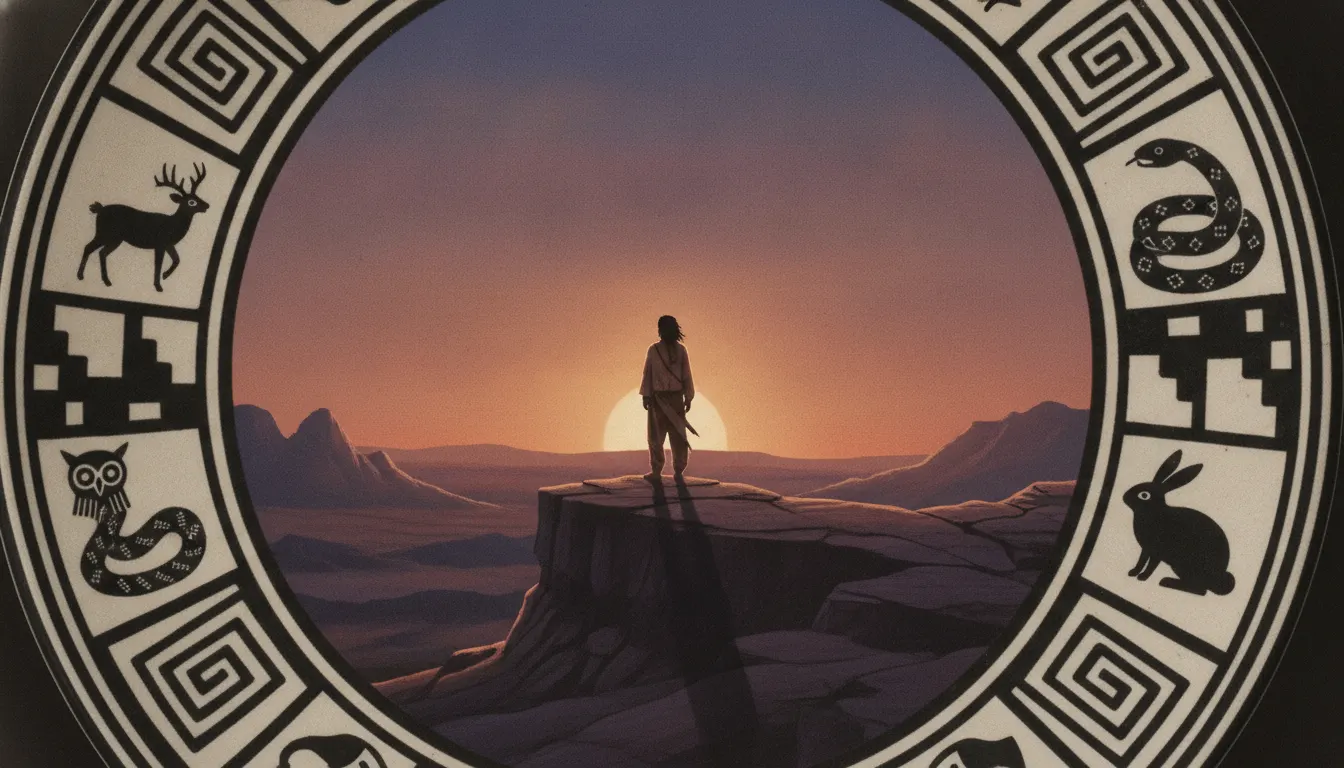
Mimbres fish bowl with geometric infill
Unknown Mimbres potters · c. 1000-1130 CE
Classic example of figurative-geometric hybridisation; widely reproduced in survey texts
Inspired by Mimbres black-on-white pottery tradition of the ancestral Pueblo southwest. Stylized animal silhouettes inside concentric geometric frames.
The moves a human crew would use to get here. Cue applies them for you, and knowing their names is how you ask for a change.
All imagery rendered in a single iron-manganese mineral paint against a kaolin white or cream slip ground.
Designs fill the circular vessel interior, respecting the curved ground with radial or bilateral symmetry.
Many funerary vessels have a deliberate perforation at the centre; compositions sometimes acknowledge this void as a formal element.
Figurative subjects (fish, insects, humans) are infilled with geometric hatching, uniting the two design modes within a single form.
Interlocking right-angle spirals (Greek-key variants) executed in hairline brushwork are the dominant geometric motif.
Figurative imagery uses outline and interior patterning without perspective, modelling, or ground lines - pure two-dimensional graphic language.
Mimbres pottery represents one of the most visually sophisticated ceramic traditions in the pre-Columbian Americas. Produced by the Mimbres branch of the Mogollon people in the upper Mimbres River valley of present-day southwestern New Mexico between approximately 1000 and 1130 CE (Classic Mimbres phase), these black-on-white vessels combine geometric precision with figurative imagery of extraordinary inventiveness.
The Mogollon culture occupied the mountainous borderland of New Mexico and Arizona from roughly 200 CE. The Mimbres sub-group's Classic period (1000-1130 CE) coincides with a phase of sedentary village life when population density supported specialised pottery production. Sites including Swarts Ruin, NAN Ranch Ruin, and the type-site of Mimbres itself have yielded thousands of intact vessels, most recovered from burial contexts. Funerary bowls were ritually "killed" - pierced with a hole at the base - before being placed over the face of the deceased, a practice unique to the Mimbres tradition.
Mimbres painted designs fall into two categories: geometric and figurative. Geometric pieces use fine mineral-paint black lines on a white or cream slip ground to create interlocking stepped frets, triangular chevrons, scrolls, and hatched bands that fill the interior bowl surface with optical precision. The figurative tradition - rarer and more celebrated - depicts animals, insects, fish, humans, and hybrid creatures with a flat, silhouetted quality. A fish's interior might be filled with geometric patterning; a rabbit might carry symbolic markings. The compositions almost always fill the circular bowl interior with a bilateral or rotational symmetry that respects the vessel's curved geometry.
Because the Mimbres people left no written records and most villages were abandoned by 1130 CE (possibly due to drought), iconographic interpretation remains contested. Many scholars read the figurative imagery as cosmological and ritual narrative; others emphasise genre scenes of daily life - hunting, fishing, insect observation - rendered with documentary precision. The Mimbres tradition had no direct descendants after the Classic period dispersal, making it a closed corpus that resists extrapolation.
Mimbres patterns entered 20th-century American decorative arts after systematic archaeological excavation in the 1920s-1930s (notably by Jesse Walter Fewkes). Contemporary Pueblo potters from other traditions, including Acoma and Hopi, have incorporated Mimbres-inspired geometric vocabularies into their work. The imagery has been extensively reproduced in textiles, wallpaper, and graphic design, though often stripped of its funerary and cosmological context.
Unknown Mimbres potters · c. 1000-1130 CE
Classic example of figurative-geometric hybridisation; widely reproduced in survey texts
Excavated by Harriet and C. Burton Cosgrove, 1924-1927 · c. 1000-1130 CE
One of the largest single-site Mimbres assemblages; now at Peabody Museum of Archaeology, Harvard
Various Mimbres potters · c. 1000-1130 CE
Major site in Silver City area yielding high-quality figurative bowls
Various · ongoing
University of New Mexico; strong research collection with published catalogs
J.J. Brody · 1983
Definitive art-historical survey of Mimbres painted pottery; standard reference
Unknown Mimbres potters · c. 1050-1130 CE
Multi-figure hunting narrative; demonstrates figurative storytelling within circular bowl format
A Look is not a filter. It is a set of stored decisions the pipeline reads before it makes a single frame, so two videos in the same Look actually match.