Igreja de Santo Ildefonso façade panels
Jorge Colaço · 1932
11,000 tiles depicting scenes from the life of Saint Ildefonso and biblical narratives, Porto
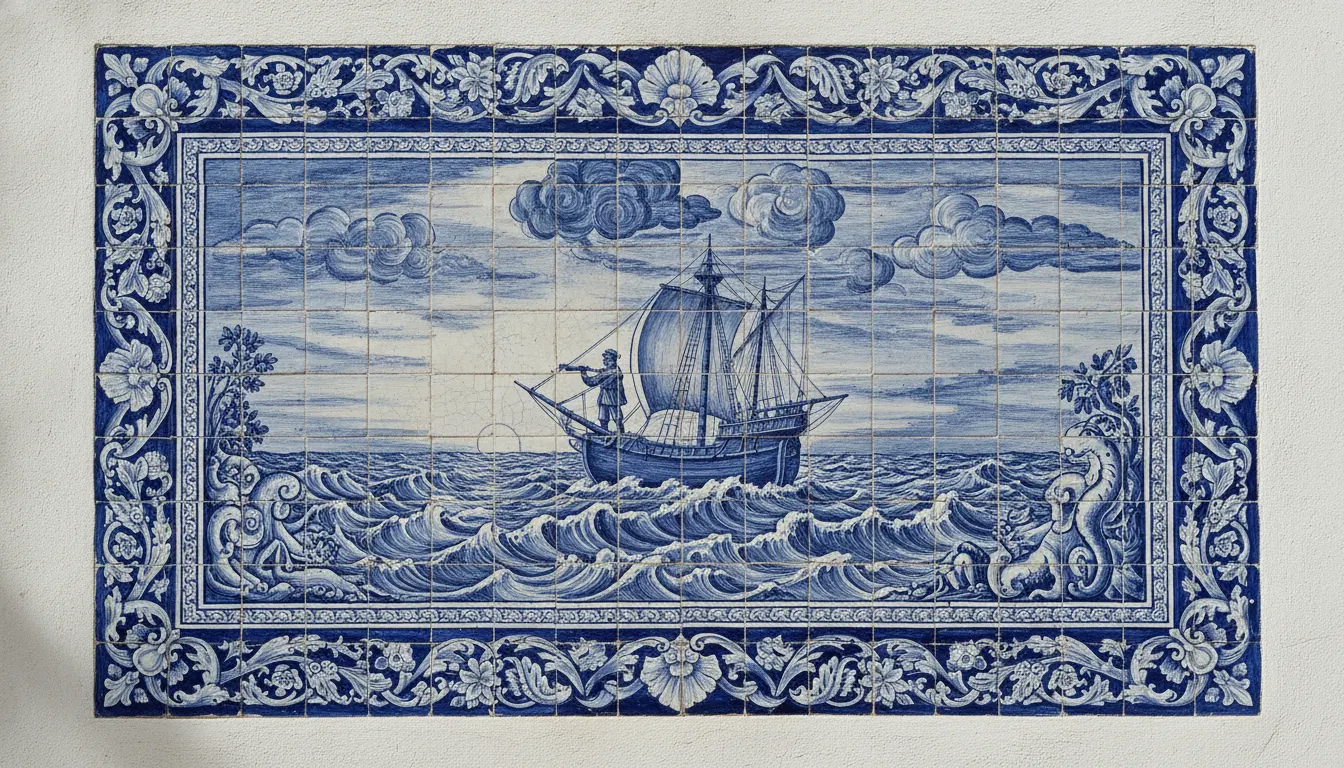
In the tradition of Portuguese azulejo blue-and-white glazed tile murals from Lisbon and Porto. Tin-glazed panels depicting historical scenes, sea voyages, and floral arabesque borders.
The moves a human crew would use to get here. Cue applies them for you, and knowing their names is how you ask for a change.
All imagery rendered in a single cobalt-blue tone against a pure tin-white ground; no additional colours.
Multiple individual tiles aligned to form continuous pictorial scenes spanning walls, staircases, or entire façades.
Fine crosshatching and stippling within blue areas mimicking 17th-century Dutch and Flemish engraving sources.
Each panel or pictorial tile is enclosed by repeating geometric or floral border tiles that demarcate composition edges.
Compositions are designed to wrap corners, follow staircases, and fill arched lunettes rather than exist as discrete framed images.
Human figures retain a graphic flatness while architectural backgrounds use recession to create spatial depth.
Azulejo (from the Arabic az-zulayj, meaning polished stone) is the tradition of painted tin-glazed ceramic tilework that has decorated Iberian architecture for more than five centuries. Though the technique was introduced to Portugal from Moorish Andalusia in the late 13th century via Seville, the Portuguese blue-and-white canon that the world now recognises emerged in the 17th century under direct influence from Chinese porcelain and Dutch Delftware.
Early Portuguese azulejos (15th-16th century) were polychrome - interlocking geometric Moorish patterns in green, white, yellow, and blue - applied in the enxaquetado technique of repeating offset squares. King Manuel I brought Seville-manufactured tiles to the Palácio Nacional de Sintra around 1503, establishing royal patronage.
The cobalt-blue-on-white aesthetic peaked between roughly 1680 and 1750, a period known as the Grande Produção. Painters such as António de Oliveira Bernardes and his son Policarpo covered entire church interiors and palace staircases with monochromatic narrative panels depicting battles, hunting scenes, biblical episodes, and allegorical landscapes. The Igreja de Santo Ildefonso in Porto (façade completed 1932 by Jorge Colaço) is the most-photographed example; the Palácio dos Azulejos (Casa do Alentejo) and the National Tile Museum (Museu Nacional do Azulejo, Lisbon) hold canonical collections.
The classic blue-on-white palette derives from cobalt oxide pigment painted onto a white tin-opaque glaze before a second firing fuses colour and surface. Line weight varies from fine engraving-like crosshatching to bold architectural outlines. Compositions use one-point perspective drawn from Dutch and Flemish engraving sources, yet figure style retains a flat, graphic quality that reads as distinctly Portuguese. Individual 13 × 13 cm or 14 × 14 cm tiles are assembled into panels that can span hundreds of square metres.
Azulejos remained central to Portuguese urban identity through the 19th-century Romantic Revival, covering railway stations (Estação de São Bento, Porto, 1916-1930), hospitals, and domestic façades. Contemporary artists including Júlio Resende and Nuno de Siqueira continue the tradition, and Lisbon city council commissions public murals that reference the canon while addressing modern themes.
Jorge Colaço · 1932
11,000 tiles depicting scenes from the life of Saint Ildefonso and biblical narratives, Porto
Jorge Colaço · 1916-1930
20,000-tile panorama of Portuguese history on the main concourse of Porto's railway station
Manuel I commission (Seville manufacture) · c. 1503
Earliest surviving Portuguese azulejo installation; polychrome Moorish geometric patterns
Unknown atelier · c. 1670-1690
Landmark blue-and-white allegorical and battle panels defining the Grande Produção aesthetic
Various · ongoing
Housed in the former Madre de Deus convent; most comprehensive survey of azulejo history
Various ateliers · 18th century restored
Moorish Revival interior in Lisbon featuring elaborate blue-and-white panel programmes
A Look is not a filter. It is a set of stored decisions the pipeline reads before it makes a single frame, so two videos in the same Look actually match.