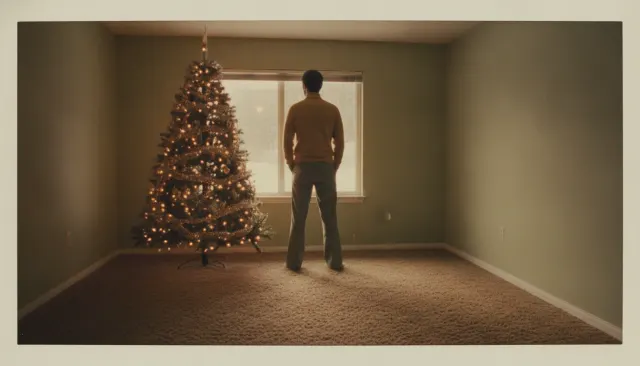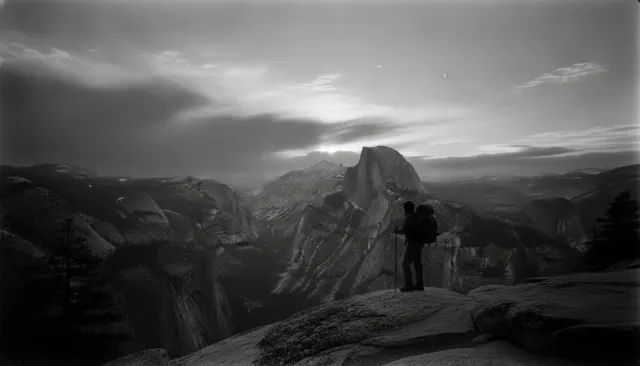
Kodak Gold 200 consumer film
defining warm-tone stock of millions of 1990s family snapshots
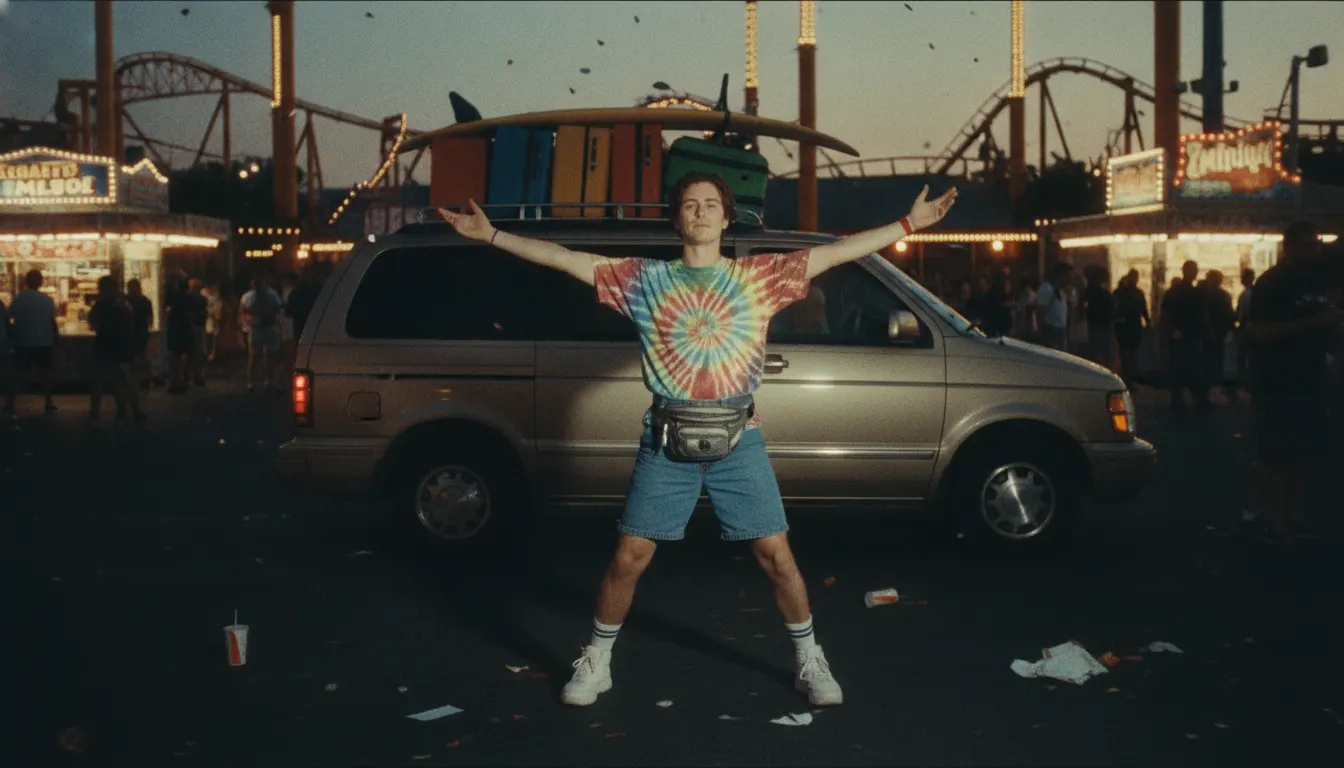
1990s family vacation snapshot. Minivan loaded, Disney World pose, fanny-pack era, Kodak Gold flash, oversaturated theme-park.
The moves a human crew would use to get here. Cue applies them for you, and knowing their names is how you ask for a change.
in flash or flash simulation: orange-warm fill that slightly overexposes faces within 8 feet
orange or yellow digital date in lower right corner (mm/dd/yy or dd/mm/yy)
Kodak Gold 200 warm cast, or Fujifilm Superia's green-shifted daylight rendition
ISO 200-400 consumer grain pattern, especially visible in shadow areas and skies
sharp, corner-soft lens rendition from plastic 32-35mm fixed lenses
figures cut at frame edge, horizon not level, partial body inclusions
eye artifact from direct on-camera flash in low-light indoor settings
The family vacation snapshot aesthetic of the 1990s represents consumer photography at its most democratic and emotionally resonant. Before smartphones, the family vacation was documented almost exclusively with consumer 35mm point-and-shoot cameras (Canon Sure Shot, Nikon One Touch, Kodak Star series) and later APS format cameras (Canon ELPH, Kodak Advantix) - compact, affordable devices with fixed focal-length lenses, built-in flash, and completely automatic exposure.
Fujifilm's QuickSnap (1986) and Kodak's FunSaver (1988) popularized the single-use disposable camera, which became a ubiquitous presence at beach vacations, theme parks, and family events throughout the 1990s. The disposable camera's optical limitations - a 32mm plastic lens, no aperture control, fixed 1/100s shutter - created a distinctive look: sharp in the center, soft at the corners, with the strong orange-red color cast of built-in flash on warm-tone consumer film (Kodak Gold, Fujifilm Superia).
The 1990s snapshot look is defined by several consistent characteristics: slight overexposure (consumer cameras favored bright output), strong built-in flash casting a characteristic orange warmth on faces at social gatherings, red-eye from direct flash, film grain from ISO 200-400 consumer stock, slight color saturation, and a composition casualness that places subjects off-center or at the edge of the frame. Date stamps in orange or yellow digital text appear in the lower right corner of millions of vacation photographs from this era.
The look has experienced intense nostalgia-driven revival since approximately 2015, accelerated by Instagram's early film-filter aesthetics and later by apps like VSCO, 1998 Cam, and Huji Cam which simulate point-and-shoot film characteristics including flash, date stamp, grain, and color shift. The aesthetic signals authenticity, pre-digital intimacy, and a relationship to memory that smooth digital photography cannot replicate.
The 1990s snapshot aesthetic is inseparable from the economics of drugstore one-hour photo labs (Walgreens, CVS, Wolf Camera). Consumer film - Kodak Gold 200, Fujifilm Superia 200/400, and Agfa Vista - was formulated for skin tones and bright outdoor light, producing characteristic warm shadows and slightly greenish daylight exposures depending on brand. The processing was automated and calibrated for average exposure: slightly thin negatives printed with a warm, slightly flat tonality. The resulting images were both consistent and generic in a way that is now read as deeply nostalgic.
defining warm-tone stock of millions of 1990s family snapshots
the disposable aesthetic standard
ubiquitous at American vacation destinations
1988
the defining consumer point-and-shoot of the era
2017
leading modern simulation of 1990s film snapshot aesthetic
mainstream revival of consumer film looks in digital post-processing
A Look is not a filter. It is a set of stored decisions the pipeline reads before it makes a single frame, so two videos in the same Look actually match.