ESPN The Magazine
Body Issue (2009-2019), annual fine-art sports portraiture
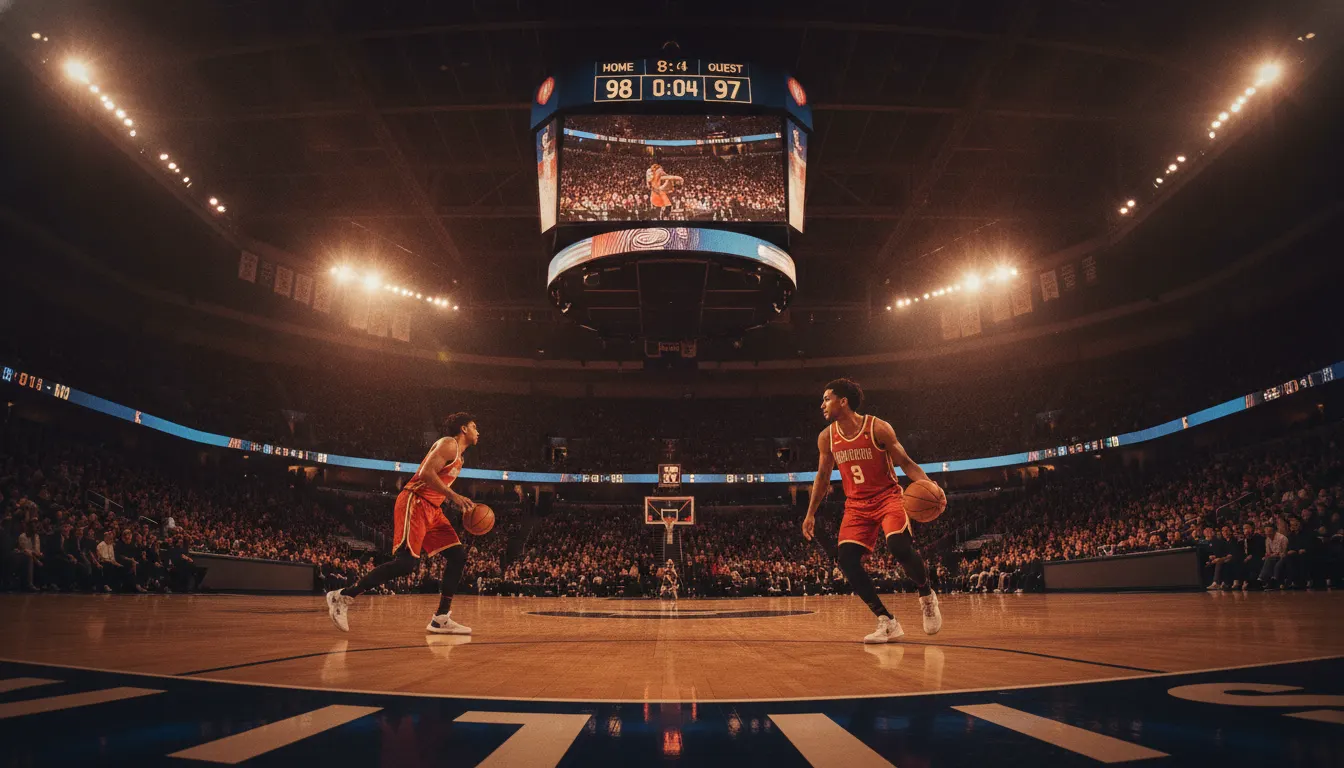
ESPN broadcast-style game-action stills. Multi-angle scrimmage, on-screen score graphic, broadcast-color crispness, primetime arena saturation.
The moves a human crew would use to get here. Cue applies them for you, and knowing their names is how you ask for a change.
600mm) at wide aperture (f/2.8-f/4) for subject isolation from background
1/2000s) to freeze peak athletic motion without blur
angle or floor-level positioning to maximize subject height and drama against the sky or arena ceiling
blurred crowd or field texture that frames the sharp subject
of-action selection in edit: the single frame where body position, expression, and geometry peak simultaneously
processing: punchy contrast, warm skin-tone saturation, clean highlight retention
ESPN's photography aesthetic - established through its magazines (ESPN The Magazine, 1998-2019) and digital platforms - defines what American sports photography looks like at its most polished. The style balances journalistic credibility with a level of technical refinement and dramatic impact that lifts game documentation into something closer to athletic portraiture.
ESPN-quality game action photography requires equipment capable of freezing fast-moving subjects at distance: telephoto lenses (300mm, 400mm, 600mm f/2.8 or f/4 primes) combined with bodies capable of 20+ frames per second and autofocus systems that track erratic motion across a playing field. The canonical shots - a basketball player at the apex of a dunk, a wide receiver extending in full stretch, a pitcher mid-release - require shutter speeds of 1/1000s to 1/2000s with enough depth of field to retain subject sharpness while separating from background blur.
Modern sports arenas use LED lighting systems calibrated for broadcast, which has significantly improved the quality of available indoor sports photography since roughly 2015. Outdoor sports benefit from golden hour or side-lit midday light that rakes across athletic form. ESPN's color grading tends toward punchy saturation, slight warm cast on skin tones, and high local contrast - images that hold up on both print and screen.
From 2009 to 2019, ESPN The Magazine published its annual Body Issue: a celebration of the athletic body using environmental portraiture rather than game-action photography. Photographers like Eric Ogden and Brian Bowen Smith created images that reframed sports photography as fine-art portraiture. The issue was one of the most visible annual editorial photography events in American publishing during its run.
The decisive moment in sports photography is more reliably predictable than in street photography: photographers anticipate play development, position for lanes of sight, and burst continuously through the critical fraction of a second. The edit selects the single frame within a burst of 50 where peak action aligns with ideal expression, body position, and compositional clarity.
Body Issue (2009-2019), annual fine-art sports portraiture
Sports Illustrated basketball and football coverage (1966-2000s)
1978
*Sports!* and Ali v. Liston overhead shot (1965), Sports Illustrated
multi-sport Olympics and international sports coverage (Getty Images, 1980s-present)
Getty Images professional sports photography, NBA and NFL (1990s-present)
A Look is not a filter. It is a set of stored decisions the pipeline reads before it makes a single frame, so two videos in the same Look actually match.