Kodak consumer photography campaigns (1960s-1990s)
'Memories' series featuring birthday moments
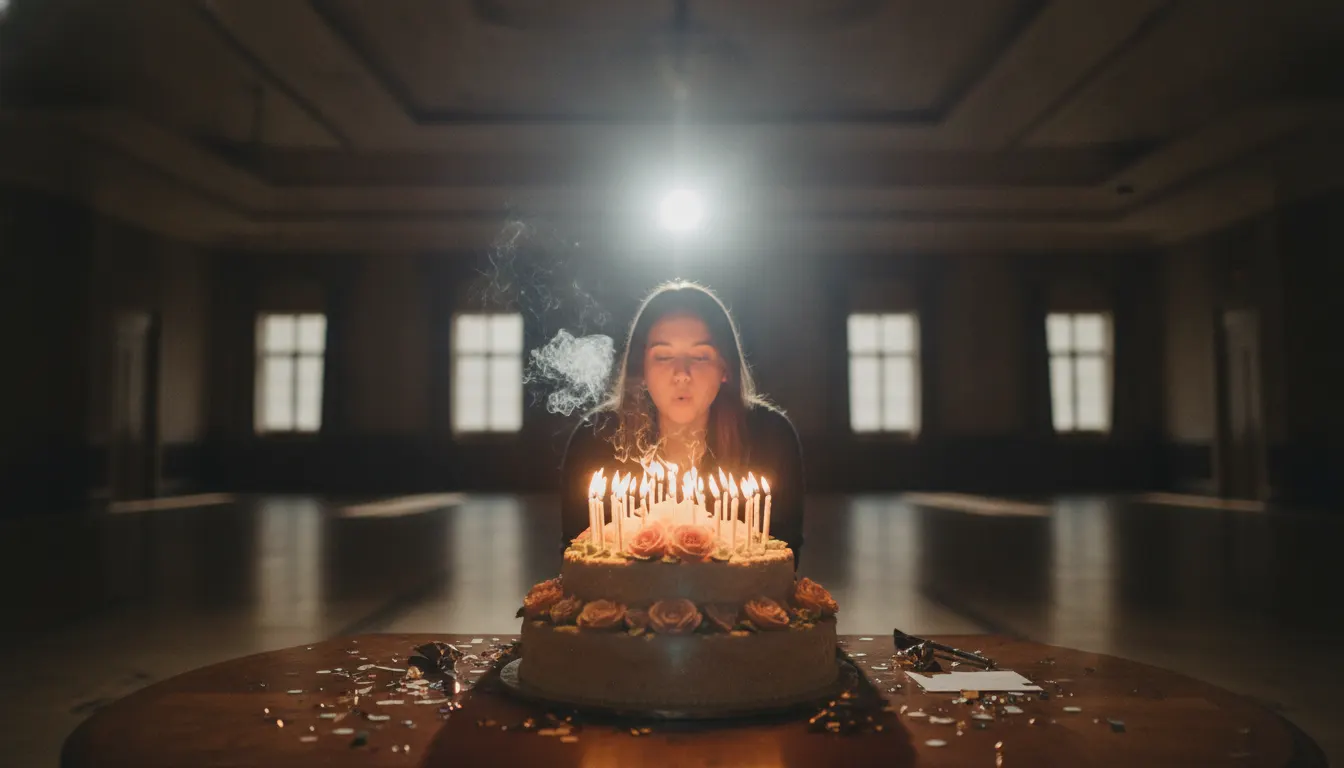
Birthday candle blow-out flash snapshot. Direct on-camera flash kills ambient, candle-glow fights flash, kid mid-blow, cake centerpiece.
The moves a human crew would use to get here. Cue applies them for you, and knowing their names is how you ask for a change.
warm candle amber (1800-2000K) as primary light, flash fill as secondary
and-front fill creating upward shadow modeling under chin and brow
eye reduction light preceding the main flash - small pupils, direct eye contact
cream rather than white rendering
100cm) - intimate, direct, slightly off-axis from camera
The birthday candle photograph is among the most reproduced images in domestic photography history - a genre-level visual convention so deeply embedded in consumer snapshot culture that it functions as cultural shorthand for celebration, age, and the passage of time. Its visual characteristics derive from the specific technical challenges of photographing candle-lit subjects with consumer flash equipment, and those constraints have become the defining aesthetic of the form.
Birthday candle photography presents a challenging mixed-light problem. The candles themselves produce warm incandescent light at approximately 1800-2000 Kelvin - very orange-amber in the context of daylight-balanced film or digital sensors. Consumer flash units output at roughly 5500-6000 Kelvin - close to daylight. The camera's auto white balance, set for ambient or flash, renders one source correctly and the other as a color cast.
The characteristic birthday candle photograph keeps this tension: faces and cake frosting illuminated from above and in front by warm, flickering candlelight; a fill-flash from the camera axis throwing a flatter, cooler light that prevents faces from going fully dark. The result is a warm-amber primary light source with a slightly cooler flash fill, creating the specific glow that separates birthday candle photographs from all other domestic photography.
The aesthetic emerged in its recognizable form in the 1960s and 1970s, when consumer snapshot photography moved from black and white to color and compact cameras with built-in flash units became widely available. Kodacolor negative film's warm latitude, combined with the 110 and 126 format cameras' fixed-focus lenses and automatic flash, produced the canonical birthday party photograph that millions of families assembled in photo albums.
The birthday candle photograph functions within what Susan Sontag in On Photography (1977) described as photography's role in family ritual - the camera enforcing and documenting ceremonial moments. The birthday cake-with-candles photo appears in virtually every family archive from the 1960s onward, representing an unbroken visual tradition that has persisted through the digital transition.
Smartphone cameras handling the mixed-light challenge differently than film: computational photography pipelines attempt to neutralize the warm candle cast or blend multiple exposures. Some photographers deliberately disable auto-correction to preserve the warm, atmospheric quality of the original mixed-light condition.
'Memories' series featuring birthday moments
contextualizes snapshot ritual
1987
academic study of consumer photography ritual
visual standard for commercial licensing
birthday candle mixed-light examples
A Look is not a filter. It is a set of stored decisions the pipeline reads before it makes a single frame, so two videos in the same Look actually match.