The Hand-Me-Down Edit: Rebuilding Intent in Post When You’re Editing Other People’s Footage
Inherited footage can be technically solid and still fight you in the timeline. When you’re editing other people’s footage, the real problem is often not missing coverage but inherited framing habits, movement defaults, and unclear sequence intent. Here’s a practical way to diagnose the problem, rebuild intention in post, and leave better handoff notes for the next shoot.
By VideoCue · Created with AI assistance and automated editorial checks.
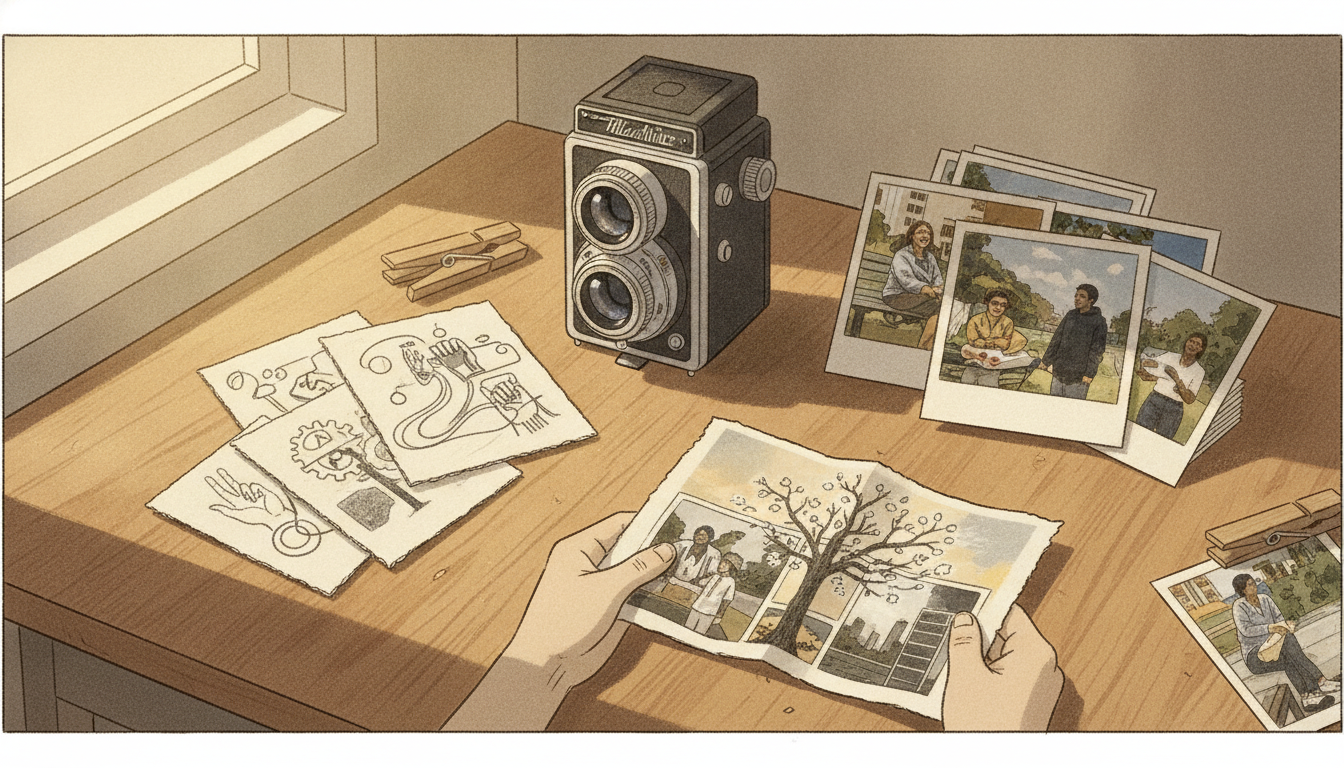
Why inherited footage feels harder than it should
Most advice on editing other people's footage focuses on logistics: organize the media, build selects, make a radio cut, patch holes with B-roll, ask for pickups if you can.
That advice helps. But it misses a common post problem: the footage is usable, yet the sequence still won’t behave.
You may receive material that is technically competent and fully “covered” on paper, but shaped by another shooter’s instincts:
- every pan resolves politely
- every interview sits at the same emotional distance
- every wide shot explains place instead of making a point
- every move has the same calm temperament
- no frame leaves useful negative space
- no shot holds long enough to create pressure
In that situation, you are not just inheriting clips. You are inheriting habits.
That is why some edits feel rigid even when nothing is obviously wrong. You are trying to build a sequence with visual decisions you did not make on set.
There is solid operational guidance for handling collaboration around that problem. LucidLink’s guide to a remote video editing workflow is useful on shared storage, documented conventions, structured feedback, and keeping remote collaborators aligned. That helps the handoff. It does not solve the creative issue by itself.
The creative issue is simpler to describe than to fix: inherited footage often arrives without a sequence-level intention you can feel.
One useful practitioner response is to invent that intention in post.
I call that the phantom director approach.
This is not a formal doctrine or proven theory. It is a working editor’s heuristic: write the directorial intention the footage seems to lack, then make your choices obey it. The aim is not to pretend you directed the shoot. It is to stop cutting clip-to-clip and start cutting toward a coherent point of view.
That kind of explicit rule-making also travels well. If your team repeatedly inherits footage from freelancers, remote shooters, or archived projects, leaving behind a one-page Video Style Guide can turn “what we had to rescue in post” into concrete notes for the next shoot.
A better way to diagnose the actual problem
Before you start fixing the timeline, diagnose what kind of failure you’re dealing with. Editors often lump everything into “bad footage,” but the remedy changes depending on the source.
Coverage problem
This is the obvious one: you simply do not have the shot variety, durations, angles, inserts, reactions, or clean sound bridges needed to build the scene.
Signs:
- no usable cutaways
- no clear beginning, middle, and end for an action
- every option repeats the same shot size or axis
- transitions depend on material you do not have
Best response: simplify the sequence, lean on narration or interview structure, and document pickup needs clearly.
Directorial habit problem
Here, there is enough footage, but it all carries the same visual behavior.
Signs:
- repeated framing habits across subjects
- identical move patterns across scenes
- scenic orientation always arriving too early
- shots feeling polished but emotionally flat
Best response: this is where the phantom-director method is most useful. You are reshaping emphasis, rhythm, and hierarchy from existing material.
Scripting problem
Sometimes the footage is fine and the sequence still feels wrong because the script is asking the scene to do the wrong job.
Signs:
- the visuals keep “illustrating” instead of advancing the point
- the voiceover carries all the meaning while the picture repeats itself
- you are forcing footage to deliver argument it was never meant to deliver
Best response: rewrite the scene’s function. Shorten it, re-order it, or let it be connective tissue rather than dramatic proof.
This distinction matters. If the issue is coverage, style tricks will not create missing information. If the issue is scripting, a more aggressive cut will only make the mismatch louder.
The phantom director method
The basic sequence is:
watchdown notes -> habit list -> intention sentence -> edit rules -> safety check -> revision pass
That order matters. If you start “saving” shots before diagnosing the material, you usually end up solving isolated moments instead of building a sequence grammar.
1. Watchdown notes
Do one uninterrupted watch and write only two kinds of notes:
- where the footage gives you pressure, contradiction, vulnerability, texture, or energy
- where it keeps defaulting to the same visual behavior
Example note fragments:
- “every street move travels the same way”
- “best moments happen after the operator settles”
- “interviews all feel equally distant”
- “machine sound is better than the scenic inserts”
2. Habit list
Reduce that into the shooter’s three to five repeated habits.
Typical examples:
- all scenes open with orientation first
- contributors are framed identically
- pans start too early and finish too neatly
- camera drifts instead of holding
- scenic inserts cool off the hard material
This step separates technical quality from editorial usefulness. A shot can be clean and still work against the scene.
3. Intention sentence
Write one sentence that states how the sequence should feel or what it should argue.
Useful examples:
- The office should feel efficient but emotionally cold.
- The process should feel bigger than the people inside it.
- This neighborhood should feel compressed, not celebratory.
Weak examples:
- Introduce the city.
- Show the process.
- Explain the issue.
If the sentence does not affect framing, rhythm, or emphasis, it is too bland.
4. Edit rules
Turn the diagnosis into constraints.
For example:
- no section opens on the widest shot
- enter motion late and leave before scenic completion
- reserve tighter crops for contradiction or consequence
- let repeated framing establish a pattern, then break it once
- use obstruction, machinery, or interruption as punctuation
Rules help you cut with intent instead of reacting emotionally to each clip.
5. Safety check
This is where strong editing stays honest.
Ask:
- Does this reorder imply false cause and effect?
- Does the crop hide context the audience needs?
- Does the audio prelap make separate moments feel simultaneous?
- Does the sequence now suggest a factual claim the material cannot support?
If you are reusing third-party or archival material, the Code of Best Practices in Fair Use for Online Video is useful for the legal and cultural framing of transformative quotation, commentary, and recombination. That code supports fair-use interpretation for online video. It is not a documentary ethics manual, and it does not validate shot-design theory.
6. Revision pass
Only after the structural pass should you polish.
That means:
- smoothing transitions
- balancing sound energy
- restoring one orientation beat if clarity has collapsed
- checking whether your visual pattern is clear without turning into a gimmick
A slightly rough cut with a clear point of view is usually more promising than a smooth cut with none.
Worked example: Jax rebuilds the sequence
Here is a developed fictional example.
Jax is cutting a documentary piece about informal recycling. He receives four hours of B-roll from a Nairobi-based shooter. The footage is technically solid: focus is consistent, exposure is reliable, the frames are stable, and there is nominal coverage for the script.
But the footage has strong habits:
- every establishing shot pans left to right
- every interview subject has almost identical headroom
- no static shot lasts more than about four seconds
- the material feels observant and polished, but not investigative
Jax’s first rough cut reads like a tourism montage. The script wants structural pressure. Reshoots are impossible.
A real-world version of this problem shows up often in collaborative post. In LucidLink’s discussion of remote editing, one core point is that once teams lose the informal fixes of working side by side, alignment has to become explicit: access, conventions, and feedback can’t be assumed. That same reality applies creatively. If the shooter’s intention was never made concrete, the editor often has to reconstruct it after the fact rather than discover it waiting in the bins.
So Jax makes the missing intention explicit.
Jax’s notes
Watchdown notes
- landfill wides are attractive but too explanatory
- best worker moments start halfway through movement
- interview framing is emotionally neutral across everyone
- truck obstructions feel more useful than scenic streets
- music is smoothing the sequence too much
Habit list
- every scene opens with orientation first
- every person is framed from the same emotional distance
- motion resolves gracefully
- scenic relief dilutes pressure
Intention sentence
The city is eating these workers, not employing them.
That sentence does not invent a new fact. It gives Jax a sequence-level argument.
Jax’s phantom rule sheet
This is the one-page artifact worth copying on real jobs.
PHANTOM RULE SHEET
Project: Informal recycling sequence
Editor: Jax
Sequence: Landfill + worker testimony

1) Sequence intention
The city is eating these workers, not employing them.

2) What the current footage keeps doing
- Opens wide before tension exists
- Frames every interview at the same emotional distance
- Uses smooth left-to-right pans as neutral orientation
- Rarely holds long enough for pressure to build

3) Repeated habits to account for
- Scenic first, meaning second
- Motion resolves neatly
- Similar headroom across all contributors
- Too little negative space for overlays or emotional isolation

4) Allowed manipulations
- Enter shots after movement has already begun
- Use only the last beat of a pan if the earlier section is scenic setup
- Punch in moderately on lines of consequence
- Delay the widest shot until after pressure is established
- Let machinery and traffic replace music where possible
- Use repeated interview framing as a pattern, then break it once

5) Forbidden manipulations
- No reversals where signage, handedness, or traffic direction matters
- No crops that hide relevant geography or nearby people
- No audio prelap that implies false simultaneity
- No action pairing that suggests cause and effect not supported by footage

6) Handoff notes for next shooter
- Hold at least 8-10 seconds before and after action resolves
- Capture one true static wide per location
- Vary interview distance: one medium, one tighter option
- Get obstruction shots intentionally, not accidentally
- Shoot process details with pauses, not only continuous movement
- Leave negative space in some frames for graphics or reframes
Before and after sequence logic
BEFORE
00:00 Full landfill pan for orientation
00:04 Interview starts on standard medium shot
00:10 Scenic street insert covers a cut
00:14 Worker sorting plastic begins at natural in-point
00:19 Truck pass used as neutral transition
00:23 Wide city shot resets the sequence
00:27 Music smooths everything together

AFTER
00:00 Interview audio prelaps: "When the truck comes, you move or get hit."
00:01 Cut to worker already mid-motion
00:04 Use only the last beat of the landfill pan
00:06 Tighten crop on the phrase about consequence
00:08 Truck blocks the worker; cut out before the frame clears
00:10 Repeat the same interview composition on a second subject to establish the pattern
00:13 Break the pattern on the strongest line with a tighter crop and no music
00:16 Delay the widest city shot until the pressure is already felt
00:20 Let machinery and traffic carry the sequence instead of score
What changed? Not the facts on the card. The hierarchy changed.
As a matter of practitioner judgment, this kind of recut can alter how a sequence feels by changing when orientation arrives, how long movement is allowed to resolve, and which visual patterns are treated as baseline versus exception. You do not need to claim a universal theory of screen direction to use that responsibly. You just need to make the logic visible and run an honesty check.
Techniques that genuinely help when footage is inherited
Reframe for hierarchy, not just repair
A crop is useful when it changes what matters in the frame.
Use it to:
- prioritize eyes over environment during admissions
- isolate hands when process matters more than identity
- create negative space for text or emotional distance
- turn a generic medium into a consequential detail
Enter late, leave early
Inherited footage often includes too much operator setup and too much graceful exit.
Trim away:
- settling into position
- scenic wind-up before the point
- tidy tails after the moment lands
Use sound as your first rewrite tool
When picture options are limited, sound often gives you the fastest control over emphasis.
Try:
- testimony before the image appears
- machinery or traffic bridging cuts
- silence before a line that changes the next image
- less score when ambience makes the point better
If you want a cleaner refresher on sound-led transitions, The J-cut and the L-cut is still one of the most practical tools to revisit.
Turn repetition into motif
If every interview is framed the same way, hiding that sameness is not always the smartest move.
Sometimes the better choice is to let the repeated composition become the rule, then break it once. The deviation reads louder because the pattern existed first.
Delay orientation
The widest shot does not automatically belong first.
If pressure matters more than geography at the start of a scene, introducing place later can make the sequence feel more authored. Just make sure clarity eventually arrives.
Pitfalls, tradeoffs, and when not to use this method
This approach is useful, but not magical.
Common pitfalls:
- over-cropping: the frame turns mushy or feels falsely intense
- over-patterning: every interruption starts reading like a trick
- false urgency: hot cutting everywhere makes nothing special
- lost orientation: withholding the wide too long creates confusion, not pressure
- ethical drift: the stronger the editorial hand, the more carefully you must protect factual meaning
When not to use it:
- when geography itself is the evidence
- when the footage is so generic that no meaningful contrast exists
- when the script is asking the sequence to prove something the material cannot prove
- when simple clarity would serve the project better than stylization
If the problem is repeated across projects, fix it upstream too. A simple Shot List Planner can help the next shooter vary distance, holds, inserts, and orientation shots before post has to rescue them.
Short checklist for your next inherited-footage cut
- Write one intention sentence for the sequence
- List the shooter’s top three repeated habits
- Identify whether the issue is coverage, habit, or scripting
- Mark which shots can survive reframing
- Find two places to enter later and exit earlier
- Test one sound-led version of the hardest section
- Run a safety check on reversals, prelap, and reordering
- Leave behind a rule sheet for the next shooter
Conclusion: who this is for, when to skip it, and the first experiment to try
This method is for editors and producers who inherit decent footage with weak sequence intention: freelancers cutting remote shoots, in-house teams working with hired crews, documentary editors dealing with archive-heavy assemblies, and anyone trying to recover authorship in post without reshoots.
It is not the right tool when the scene mainly suffers from missing coverage or when factual geography must remain completely literal.
If you want one first experiment, do not apply this to the whole film. Pick one stubborn 20- to 40-second section and make a second version using only three rules:
- no opening wide
- enter movement late
- remove music under the key line
Then compare the two cuts side by side and ask one question: which version has a clearer point of view?
If the answer becomes obvious, you have your next move. Not a theory. Not a magic fix. Just a practical way to rebuild intent when the footage arrived with somebody else’s eye already inside it.
More from the field
The Crossfade Lie: Why “Smooth” Transitions Can Weaken Your Edit
Crossfades, J-cuts, and speed ramps can look polished, but they often expose hesitation when they’re covering a weak scene connection. Here’s a practical framework for video transitions editing: when to cut hard, when to let sound lead, when to keep the dissolve, and how to spot a transition that’s acting like a scar instead of a decision.
The Micro-Pause Method: Directing Breath Breaks and Silences Without Rushing the Scene
When you cut every pause out of an interview, the result often gets shorter but less believable. This practical framework helps you separate useful breath breaks from slack, so you can keep tension, clarity, and fairness in nonfiction edits.