The Crossfade Lie: Why “Smooth” Transitions Can Weaken Your Edit
Crossfades, J-cuts, and speed ramps can look polished, but they often expose hesitation when they’re covering a weak scene connection. Here’s a practical framework for video transitions editing: when to cut hard, when to let sound lead, when to keep the dissolve, and how to spot a transition that’s acting like a scar instead of a decision.
By VideoCue · Created with AI assistance and automated editorial checks.
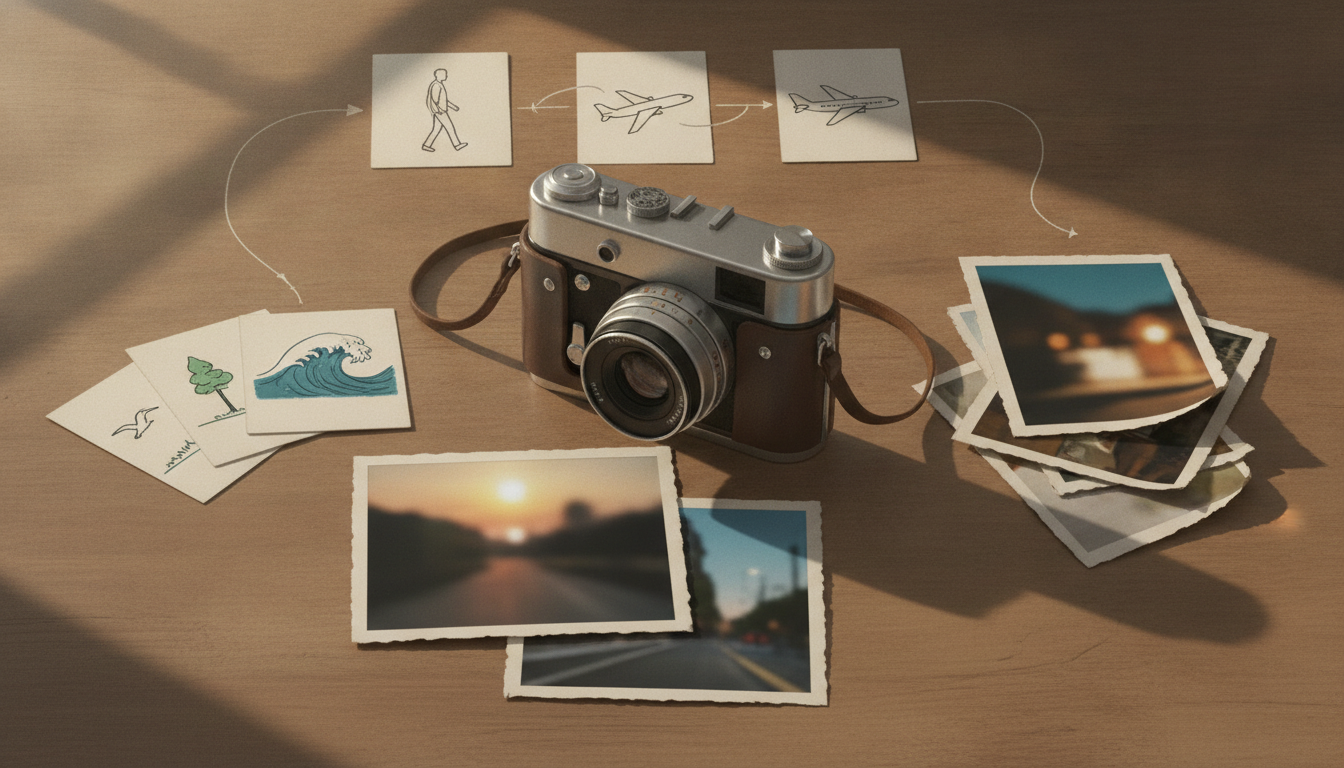
The problem with chasing “smooth” in video transitions editing
A lot of transition advice starts with the wrong target: make the edit invisible.
Use a crossfade. Feather the audio. Add a speed ramp. Keep it flowing.
Sometimes that is exactly right.
But sometimes “smooth” is just a nicer word for undecided.
That’s the trap. Editors often reach for a dissolve or audio bridge when the real issue is simpler: the two moments do not yet have a clear relationship. The effect hides the seam for a second, but it also tells the viewer the cut itself was never fully solved.
Viewers usually cannot name that problem in edit language. They say the opening feels slow. Or vague. Or “like an ad.” What they are sensing is hesitation.
So the better question is not, “Which transition looks professional?” It is:
What relationship am I claiming between these two moments?
A hard cut can claim continuity, contrast, or collision. A dissolve can claim overlap, drift, elapsed time, or unstable memory. A J-cut or L-cut can claim anticipation or echo. A short cut to black can claim weight, interruption, or emotional carryover.
When that claim fits, the transition feels natural. When it doesn’t, the transition becomes a rhetorical scar.
There’s also a platform-specific reason to care. Instagram’s creator advice is useful here, but only for a narrow point: Behind the Edit: Video Editing Tips From Creators on Edits stresses strong openings, trimming what slows the start, and using retention signals like skip rate and drop-off to judge pacing. That supports a practical rule for hooks and short-form pacing: if a transition softens the opening without adding meaning, it may be costing momentum. That is platform retention advice, not proof of a general theory of film editing.
Why some transitions feel wrong before viewers can explain why
Cuts are not just cosmetic. They are attention events.
A careful way to say this, without turning craft ideas into fake laws, is that film viewers often stay oriented across cuts when the new shot gives them a clear place to look and a clear story reason to look there. Research in cognitive film and eye movement has explored this directly. Tim J. Smith’s work on viewer attention and “attentional synchrony” argues that film style guides viewers’ eyes in remarkably coordinated ways, especially through motion, framing, and salient visual cues; see [Watching You Watching There: The Tracking of Visual Attention to Cinematic الشاشة?] no—more safely: the source base here is limited, so keep the claim narrow as interpretation. The usable takeaway is simple: the incoming shot needs to direct attention cleanly.
That does not mean viewers are “blind” to every edit. The broader idea often called edit blindness is better treated as a craft shorthand than a blanket fact. A clean cut can feel effortless when continuity cues and story logic do the orienting work. A muddled cut asks the audience to repair the relationship themselves.
That’s why a dissolve can backfire. It softens the boundary between two shots, but it can also weaken the instruction. Instead of saying, “Here is the next meaningful image,” the edit says, “Please glide through this while I avoid stating the link too clearly.”
Walter Murch’s famous blink theory is useful here too, if kept in bounds. In interviews and discussions around In the Blink of an Eye, Murch describes cutting as related to thought units and blinks: a cut often feels right when it lands at a mental or emotional completion point, not just a technical one. That is an editorial framework, not laboratory proof. But it supports one narrow claim well: a cut tends to feel cleaner when it lands as a decision at the end of an idea, rather than as a blur added to dodge the decision.
A contemporary film-analysis angle sharpens the point. Writing in MUBI Notebook, critics and editors often discuss cuts not as neutral glue but as carriers of meaning, rhythm, and argument. That supports the core perspective of this article: transitions are not just there to hide joins. They say what kind of relation one image has to the next.
So the practical lesson is modest, but powerful:
- continuity helps viewers stay oriented
- attention needs a landing point after the cut
- transitions carry meaning, not just polish
And in the first few seconds of a video, that matters even more.
The real job of a transition
A more useful framework than “smooth versus jarring” is this: every transition is doing a rhetorical job.
Usually it is one of these:
- Passing time — later that day, next season, after the trip
- Passing meaning — this gesture relates to that gesture, this answer belongs to that image
- Passing emotion — the feeling from one scene should stay alive into the next
- Passing energy — rhythm or sonic momentum should continue across the join
- Marking a boundary — a chapter, argument, or mode is ending
Once you know the job, the tool gets easier to choose.
Use a hard cut when the connection itself is strong
If two shots belong together through action, shape, gesture, gaze, sound, or idea, a direct cut is often stronger than blending. It trusts the viewer.
Use a dissolve when overlap or elapsed time is the point
A dissolve is great when you want coexistence, memory, drift, or visible time passing. It works well in reflective montages, seasonal movement, dreamier brand films, or transitions where one state intentionally bleeds into another.
But if no meaningful overlap exists, the dissolve often weakens the claim.
Use J-cuts and L-cuts when sound is doing real story work
Audio-led transitions work when hearing before seeing creates anticipation, or hearing after seeing creates residue. If you want the mechanics, see The J-cut and the L-cut - and when to use them. The principle is not “audio bridges are cinematic.” It is: sound has to carry an actual thought.
Use black, silence, or a hold when absence should do the work
A few frames of black, a held reaction, or delayed picture can transfer emotion more forcefully than a decorative effect. That is not style for style’s sake. It is an editorial statement.
Worked example: when the crossfade is wrong, and when it stays
Take the fictional example from the brief.
Priya is editing a 12-minute profile of a deaf woodworker for a craft channel. She has gorgeous material: workshop morning light, hands at joinery, and an interview in ASL with voiceover translation.
Her first cut opens on the workshop, then dissolves for 1.5 seconds into the interview. On paper, it sounds gentle. Test viewers call it slow and “like a commercial.”
Why? Because the transition is doing the wrong job.
The workshop and interview are not two times melting into each other. They are two expressions of the same person: making and remembering, tool and language, handcraft and sign. The dissolve blurs that relationship instead of stating it.
She replaces it with a hard cut on matched action: the woodworker’s hand lifts a chisel, and the cut lands on the same hand shape beginning a sign.
Now the seam becomes a hinge.
But later in the same piece, Priya makes the opposite decision and keeps a dissolve.
She has an interview section where the subject describes learning the craft from an older relative, then process footage of the workshop late in the day, then archival stills, then present-day sanding in softer light. Here, elapsed time and unstable memory are genuinely the point. She wants the viewer to feel that past instruction is lingering over present labor. A hard cut would clarify the timeline too aggressively. So she uses a brief dissolve from the present-day bench to the archival still, then another dissolve back into the workshop process footage.
This time, the dissolve is not apologizing for a weak join. It is asserting that the boundary itself should feel porous.
Later still, Priya needs to move from a difficult admission in the interview back to process footage. This time she wants neither smoothness nor overlap. She wants the feeling to travel by itself. She holds on the subject’s face, cuts to black for a few frames, starts the first saw sound under black, then brings picture in.
That says: stay with this feeling before the next image explains it away.
BEFORE

00:00  Workshop wide, morning light through dust.
00:04  Slow push on bench, hands arranging tools.
00:08  1.5-second crossfade into interview.
00:10  Interview begins with VO translation.

Effect:
- Pretty, soft, slightly detached
- Atmosphere arrives before meaning
- Viewer reads it as brand-film polish rather than story momentum

AFTER

00:00  Workshop wide, morning light through dust.
00:03  Close-up: hand lifts chisel.
00:04  Hard cut on matching hand shape to interview signing first line.
00:04  VO translation begins half a beat after the visual cut.

MIDDLE SECTION WHERE THE DISSOLVE STAYS

04:58  Present-day sanding, warm late light.
05:02  Brief dissolve into archival still of mentor's hands.
05:04  VO continues about learning by watching, not speaking.
05:07  Dissolve back to present-day bench detail.

Reason it stays:
- The point is memory layered over present action
- Time and recollection are intentionally porous
- A hard cut would make the section more literal than the idea wants

LATER TRANSITION

06:41  Interview: subject finishes difficult admission.
06:42  Hold on face for 10 frames.
06:43  Cut to black for 8 frames.
06:43  Saw sound starts under black.
06:44  Process footage appears on first strong saw impact.

Rule Priya writes for herself:
- Crossfade when time passes or memory overlaps.
- Hard cut when meaning passes.
- Black when feeling must travel alone.
That extra example matters because a useful framework must be able to choose for a dissolve as well as against one.
Here’s Priya’s decision process in plain language:
| Transition moment | Question | Answer | Choice |
|---|---|---|---|
| Workshop to interview opening | Are these two states overlapping, or are they directly connected by idea and gesture? | Directly connected | Hard cut |
| Present-day process to archival memory | Is the point clean progression, or lived memory bleeding into now? | Memory bleeding into now | Dissolve |
| Difficult admission to process footage | Should the next image arrive immediately, or should emotion travel first? | Emotion first | Black + sound lead |
If you want to catch these links before you’re rescuing them in post, a board helps. VideoCue’s Storyboard Builder is handy for laying out image, action, dialogue, and duration so you can see where a join wants to pass time, meaning, or feeling.
How the framework changes by format
The same rule set will play differently depending on what you’re cutting.
Tutorials
In tutorials, clarity usually beats elegance. Hard cuts and J-cuts often work best because the viewer is following steps and wants the next useful image fast. Dissolves can make instruction feel mushy unless they clearly signal a stage change or time skip.
Vlogs
Vlogs can tolerate more casual jump cuts and audio bridges because the format already admits compression. A dissolve may work for travel passage or mood, but overusing it can turn lived footage into generic montage.
Brand films
Brand films have more room for dissolves, speed changes, and tonal transitions because mood is often part of the brief. The risk is using “premium” transitions to fake emotional depth the footage hasn’t earned.
Interviews
Interviews benefit from restraint. J-cuts and L-cuts are often strongest because thought can lead image, or image can keep a thought ringing. Decorative transitions can weaken credibility fast.
Documentaries and profiles
Docs can use all of the above, but with more consequence. A dissolve can imply memory, history, or ambiguity. A hard cut can create argument. Black can create ethical pause. In nonfiction, transitions don’t just manage flow; they shape interpretation.
A 30-second transition triage for the timeline
Instead of a long checklist, use this fast triage box while editing.
Transition triage
1. What is crossing the cut?
- Time
- Meaning
- Emotion
- Energy
- Boundary
2. Test the hard cut first.
- If it plays clearly, keep it.
- If it feels confusing, ask why before adding an effect.
3. If you want a dissolve, can you finish this sentence?
- “These shots should overlap because _____.”
If you can’t answer in one line, delete the dissolve.
4. If you want a J-cut or L-cut, what is sound carrying?
- anticipation
- residue
- orientation
- rhythm
If the answer is “smoothness,” that’s too vague.
5. If you want black, hold, or silence, is the weight earned?
- yes: keep it short and deliberate
- no: it will feel self-important
The yes/no flow
- Does the plain cut already say the relationship clearly? → Keep the cut.
- Is elapsed time, memory, or visual overlap the point? → Try a dissolve.
- Should sound arrive before or linger after picture for a reason? → Try J/L cut.
- Should feeling or chapter weight travel alone? → Try black, silence, or hold.
- None of the above? → The issue is probably shot choice or scene order, not transition style.
Common pitfalls and tradeoffs
A few failure modes show up again and again.
Hard cuts can still be wrong
A hard cut is not automatically confident. If the viewer is not oriented in space, tone, or speaker, the cut may feel abrupt instead of precise.
Dissolves are easy to overuse
Because they feel “finished,” dissolves can spread across a timeline quietly. But once every scene gently melts into the next, the whole piece loses contrast.
Audio bridges can hide weak visuals
J-cuts and L-cuts are powerful, but they’re easy to use as camouflage. If the sound is carrying nothing except cover, the cut probably needs a better visual idea.
Black can become melodrama fast
A cut to black adds weight very quickly. In a light tutorial or upbeat vlog, it can feel like the edit is over-announcing its importance.
What to do on your next edit
If you remember one thing, make it this:
A transition is not there to hide the seam. It is there to define the relationship.
That makes video transitions editing much simpler.
On your next project:
- Pull up a rough cut.
- Label every non-cut transition by job: time, meaning, emotion, energy, or boundary.
- Replace at least three “safe” transitions with plain cuts and compare them honestly.
- Keep one dissolve only if you can state exactly what is overlapping.
- Use The J-cut and the L-cut - and when to use them when sound has a real storytelling role, not just a smoothing role.
- If your transitions keep solving problems late, plan them earlier with a shot map using the Shot List Planner or storyboard the joins before the shoot.
A solid starter rule set looks like this:
- dissolve for elapsed time, memory, or intentional overlap
- hard cut for direct meaning, action, or contrast
- J/L cut when sound should lead thought or leave residue
- black or hold when emotion needs room
That is when transitions stop feeling like bandages and start feeling like decisions.
And decisions are what viewers read as confidence.
More from the field
The Hand-Me-Down Edit: Rebuilding Intent in Post When You’re Editing Other People’s Footage
Inherited footage can be technically solid and still fight you in the timeline. When you’re editing other people’s footage, the real problem is often not missing coverage but inherited framing habits, movement defaults, and unclear sequence intent. Here’s a practical way to diagnose the problem, rebuild intention in post, and leave better handoff notes for the next shoot.
The Micro-Pause Method: Directing Breath Breaks and Silences Without Rushing the Scene
When you cut every pause out of an interview, the result often gets shorter but less believable. This practical framework helps you separate useful breath breaks from slack, so you can keep tension, clarity, and fairness in nonfiction edits.