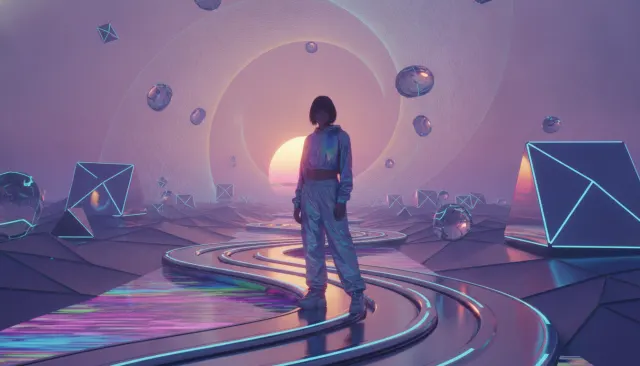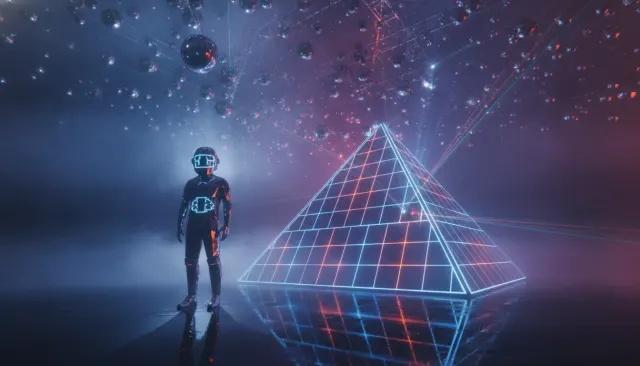
Can't Get You Out of My Head music video
Kylie Minogue / Dawn Shadforth (director) · 2001
Defining Y2K aesthetic music video with white space-suit, chrome environments, and futurist choreography
Y2K chrome shiny web aesthetic. Beveled chrome buttons, lens-flare logos, blue gradient bars, frosted icons, Razr and MSN era polish.
The moves a human crew would use to get here. Cue applies them for you, and knowing their names is how you ask for a change.
Chrome effects with both the fine parallel lines of brushed aluminum and the sharp specular reflections of polished chrome.
Surface colors that shift from silver through gold to pink and purple depending on viewing angle, mimicking holographic foil.
Sharp white reflection bands (not soft gradients) that track across metallic surfaces, simulating a hard directional light source.
Near-black grounds that maximize the visual contrast of metallic elements and create the club-culture darkness association.
Letterforms rendered with full metallic surface treatment - beveled edges, specular highlights, and surface reflections.
Electric blue, hot pink, or acid green neon accents against chrome and black, creating the specific cyberpunk-adjacent color relationships.
The Y2K chrome aesthetic designates a specific visual register that emerged from the intersection of late 1990s web design, consumer technology advertising, and club/rave visual culture in the period approximately 1998-2004. Where Web 2.0 glossy design (2004-2012) used soft gradients and candy-color translucency, the Y2K chrome aesthetic was harder, colder, and more directly metallic - chrome and silver surfaces, iridescent holographic effects, hard specular reflections, and the specific color relationships of brushed aluminum, reflective silver, and neon accent colors against black.
The Y2K chrome aesthetic drew from multiple sources simultaneously. The consumer electronics design of the period - the first iMac G3 (1998) with its translucent candy-colored plastic, the TiBook (2001) with its titanium casing, and the wave of silver/chrome consumer electronics that followed Sony and Apple's leads - established chrome and metallic translucency as markers of technological modernity. Club culture's visual language, rooted in the industrial and cyberpunk aesthetics of the mid-1990s, contributed chrome-on-black color relationships and the association between reflective surfaces and futurism.
The internet aesthetic of the period was shaped by what was technically achievable in early web design: animated GIFs could simulate metallic sheen; Flash (Macromedia Flash Player, 1996, popularized 1999-2003) enabled smooth animations and elaborate visual effects that static HTML couldn't approximate. The 'intro' pages of major websites during this period often featured chrome-effect logos animating over black or dark gradient backgrounds.
Fashion and music video culture contributed the specific iridescent holographic aesthetic: the early 2000s saw a wave of metallic fabrics, holographic foil finishes, and space-age visual references in music videos and fashion editorials. Christina Aguilera's Stripped era (2002), Kylie Minogue's Can't Get You Out of My Head (2001, director Dawn Shadforth), and early Destiny's Child videos used reflective surfaces, silver costumes, and chrome environmental design.
The Y2K chrome look is identifiable by: brushed or polished metallic surfaces with multiple specular highlight layers; iridescent color shifts from silver through gold through purple and pink (the holographic foil palette); hard-edged reflections rather than soft gradients; high-key lighting that amplifies specular qualities; and typography either rendered in chrome/metallic effects or in bold geometric sans-serifs set against the reflective backgrounds. Black or very dark backgrounds are common, creating maximum contrast for the metallic elements.
The Y2K aesthetic experienced a major revival beginning approximately 2018-2020, driven by millennial nostalgia and Gen Z cultural interest in late 1990s and early 2000s visual culture. Artists including Doja Cat, Dua Lipa (Future Nostalgia, 2020), and Rina Sawayama (SAWAYAMA, 2020) drew on Y2K visual codes explicitly. Fashion brands including Blumarine and David Koma produced chrome and metallic collections that referenced the period.
Kylie Minogue / Dawn Shadforth (director) · 2001
Defining Y2K aesthetic music video with white space-suit, chrome environments, and futurist choreography
Jonathan Ive / Apple Design Team · 1998
Translucent candy-colored plastic that triggered the consumer Y2K design aesthetic
Various directors and stylists · 2002-2003
Music video and promo content that used chrome, metallic fabric, and hard-surface aesthetics
Various web designers · 1999-2003
The animated chrome-logo website entry pages that defined the early internet Y2K aesthetic
Dua Lipa / various art directors · 2020
Contemporary revival of Y2K chrome aesthetics in a major commercial pop context
Rina Sawayama / various directors · 2020
Explicit Y2K aesthetic revival across album cover, music videos, and promotional content
A Look is not a filter. It is a set of stored decisions the pipeline reads before it makes a single frame, so two videos in the same Look actually match.