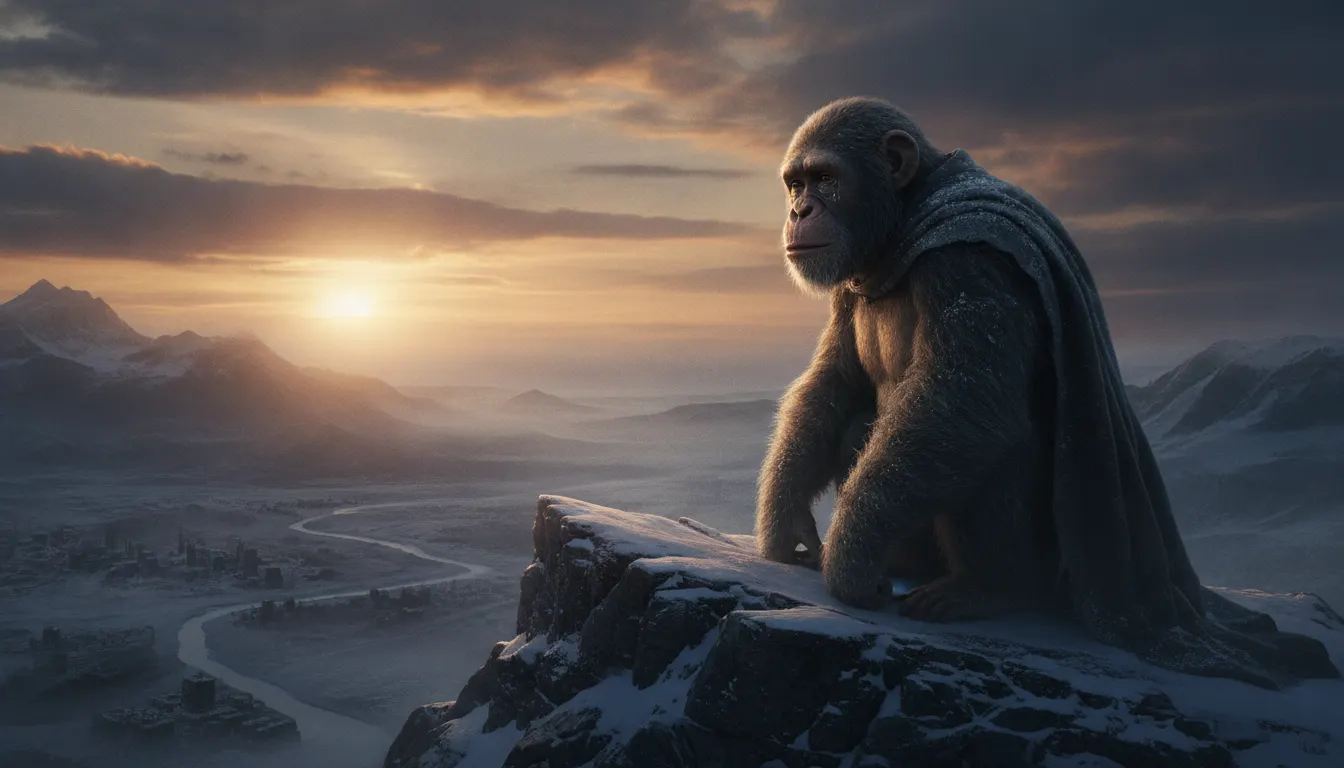
War for the Planet of the Apes
dir. Matt Reeves, Weta Digital, 2017 (performance capture apex, primary reference)
War for the Planet of the Apes mocap VFX. Andy Serkis Caesar performance capture, photoreal ape characters, weighty emotional close-up.
The moves a human crew would use to get here. Cue applies them for you, and knowing their names is how you ask for a change.
set facial reference camera capture allowing actors to perform on location rather than in capture stages
accurate musculoskeletal digital anatomy for each ape species driving realistic skin and facial movement
based fur simulation with wind, rain, and directional light physical response
eye rendering capturing tear duct moisture and corneal reflection in extreme close-up grief sequences
expression preservation from actor performance: Andy Serkis eyebrow sub-millimeter movement driving Caesar's equivalent
War for the Planet of the Apes (dir. Matt Reeves, Weta Digital, 2017) concludes Andy Serkis's Caesar trilogy and represents the sustained high-water mark of performance capture for non-human digital characters. Over the three films (Rise, 2011; Dawn, 2014; War, 2017), Weta Digital developed and refined the facial performance capture pipeline to the point where Caesar's eyebrows, lip micro-movements, and tear ducts could convey dramatic range matching - or exceeding - human actors in comparable prestige drama roles.
Andy Serkis began his performance capture career as Gollum in Peter Jackson's The Lord of the Rings: The Two Towers (Weta Digital, 2002). By War for the Planet of the Apes, the pipeline had evolved from the helmet-mounted camera approach of early Gollum to a free-set capture system where Serkis and other actors performed on location sets while facial reference cameras captured their performances. Weta's animators then used the captured data as a driving layer for the digital ape characters' face rigs, retaining the actor's performance intention rather than keyframe-animating replacement.
Each ape character (Caesar, Maurice, Rocket, Koba, Bad Ape) required a fully custom facial rig: chimps, gorillas, and orangutans have different bone structures, muscle layouts, and lip geometries. Weta's digital anatomy team built species-accurate underlying musculoskeletal models, then layered simulated skin and fur systems on top. The fur rendering system in Dawn and War uses a proprietary strand-based simulation that responds to wind, rain, and directional light with physically accurate flyaway behavior.
The final sequence of War for the Planet of the Apes - Caesar's death and the community's grief response - is widely cited in VFX analysis as the most emotionally effective use of digital character performance capture achieved. The sequence cuts between Serkis's original performance reference and the rendered digital Caesar without the emotional transaction breaking.
dir. Matt Reeves, Weta Digital, 2017 (performance capture apex, primary reference)
dir. Matt Reeves, Weta Digital, 2014 (rain battle sequence, intermediate benchmark)
dir. Rupert Wyatt, Weta Digital, 2011 (trilogy origin, Caesar as infant-to-adult)
dir. Peter Jackson, Weta Digital, 2002 (Gollum, origin of Andy Serkis performance capture)
dir. Wes Ball, Weta FX, 2024 (fourth-generation Apes film, updated Weta pipeline)
dir. James Cameron, Weta Digital, 2009 (contemporaneous performance capture benchmark for Na'vi)
A Look is not a filter. It is a set of stored decisions the pipeline reads before it makes a single frame, so two videos in the same Look actually match.