Transformers
dir. Michael Bay, ILM VFX supervisor Scott Farrar, 2007 (first film, established the pipeline)
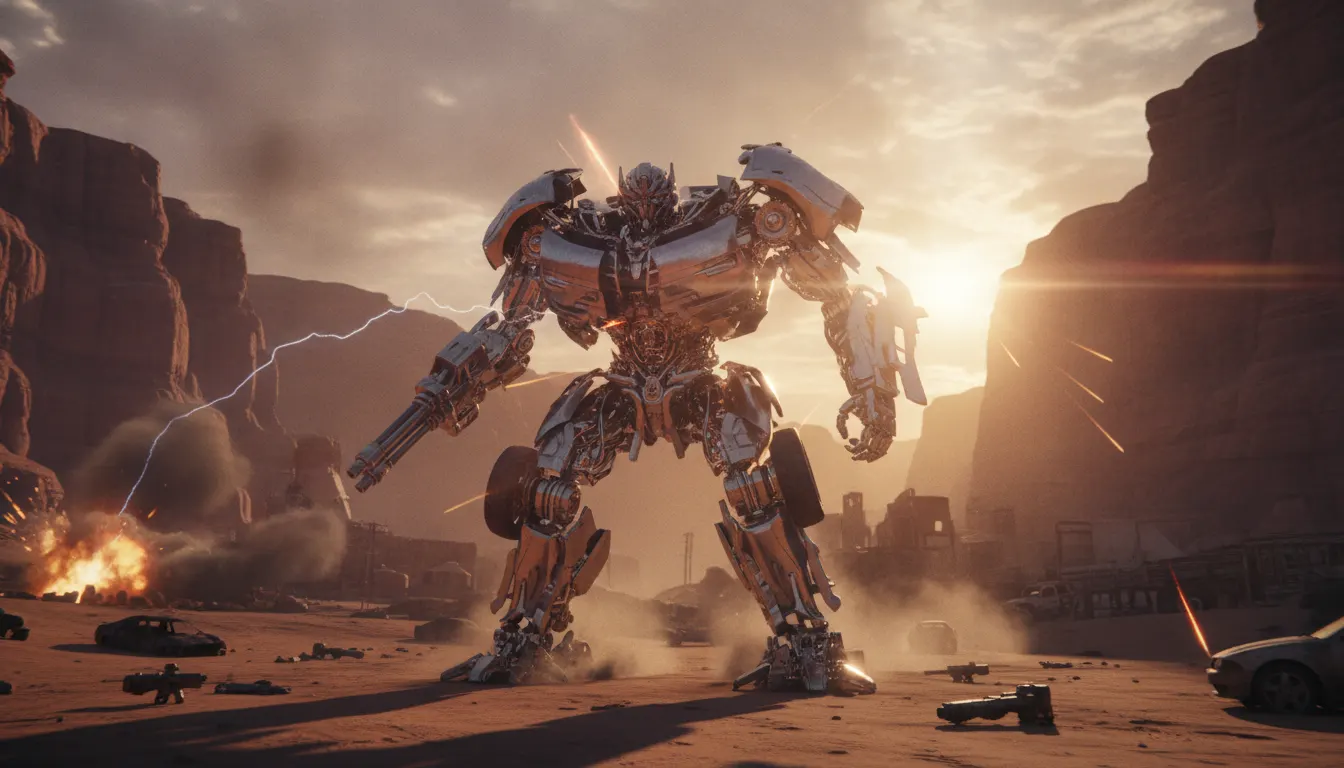
Michael Bay Transformers photoreal mech VFX. ILM transforming-vehicle CGI, chromed gear-spaghetti complexity, golden-hour lens-flare battle spectacle.
The moves a human crew would use to get here. Cue applies them for you, and knowing their names is how you ask for a change.
driven secondary kibble motion
part-as-character-anatomy design: literal headlights, wheel arches, engine blocks as body segments
based paint clearcoat over aluminum substrate with battle-damage scratch propagation
angle 360-degree golden-hour tracking cinematography maximizing surface specularity
to-live-action integration with digital doubles for extreme close-up contact moments
no clipping, correct mechanical causality in part fold order
Industrial Light & Magic's work on Michael Bay's Transformers franchise (2007-present) represents the highest sustained investment in photoreal mechanical character VFX in film history. The Autobots and Decepticons in Bay's films are among the most complex digital characters ever built: Optimus Prime at the height of the franchise contained over 10,000 individual moving parts.
Prior to Transformers (2007), digital mech characters were either stylized (animated films) or presented at a scale and distance that allowed complexity to be implied rather than rendered. Bay's visual style required robots fighting at human scale in daylight, often within centimeters of real actors. ILM's visual effects supervisor Scott Farrar and his team developed new subdivision surface-based rigging systems that could handle the mechanical transformation sequences - a vehicle converting to a biped form with thousands of folding, sliding, and rotating parts - without visible clipping or interpenetration.
The Transformer designs use a philosophy of 'everything is a vehicle part': headlights become chest details, wheel arches become shoulder pads, engine blocks become torsos. Surfaces carry vehicle-quality paint, chrome, scratched metal, battle damage, and weathering. Oil, hydraulic fluid, and dust accumulate realistically in crevices. The material rendering requires physically-based metal BRDF models with scratched clearcoat paint layers and underlying aluminum substrate.
Michael Bay's cinematographic approach - low-angle, 360-degree tracking shots, golden-hour sunlight raking across mechanical surfaces, extreme close-up detail cutaways during transformation - places maximum demand on the ILM renders. Frames frequently contain 40-60 Transformers in simultaneous action with motion blur and atmospheric depth haze.
dir. Michael Bay, ILM VFX supervisor Scott Farrar, 2007 (first film, established the pipeline)
Bay/ILM, 2009 (Devastator, largest single CG character then built)
Bay/ILM, 2011 (Chicago battle, 40+ Transformers simultaneous render)
Bay/ILM, 2014 (Dinobots, new character design language)
dir. Travis Knight, ILM, 2018 (cleaner G1-inspired design contrast to Bay's complex approach)
A Look is not a filter. It is a set of stored decisions the pipeline reads before it makes a single frame, so two videos in the same Look actually match.