The Legend of Zelda: Tears of the Kingdom
Nintendo EPD, Switch, 2023, dir. Hidemaro Fujibayashi (primary reference)
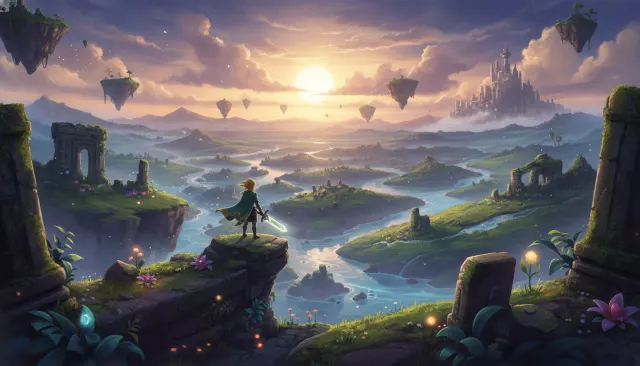
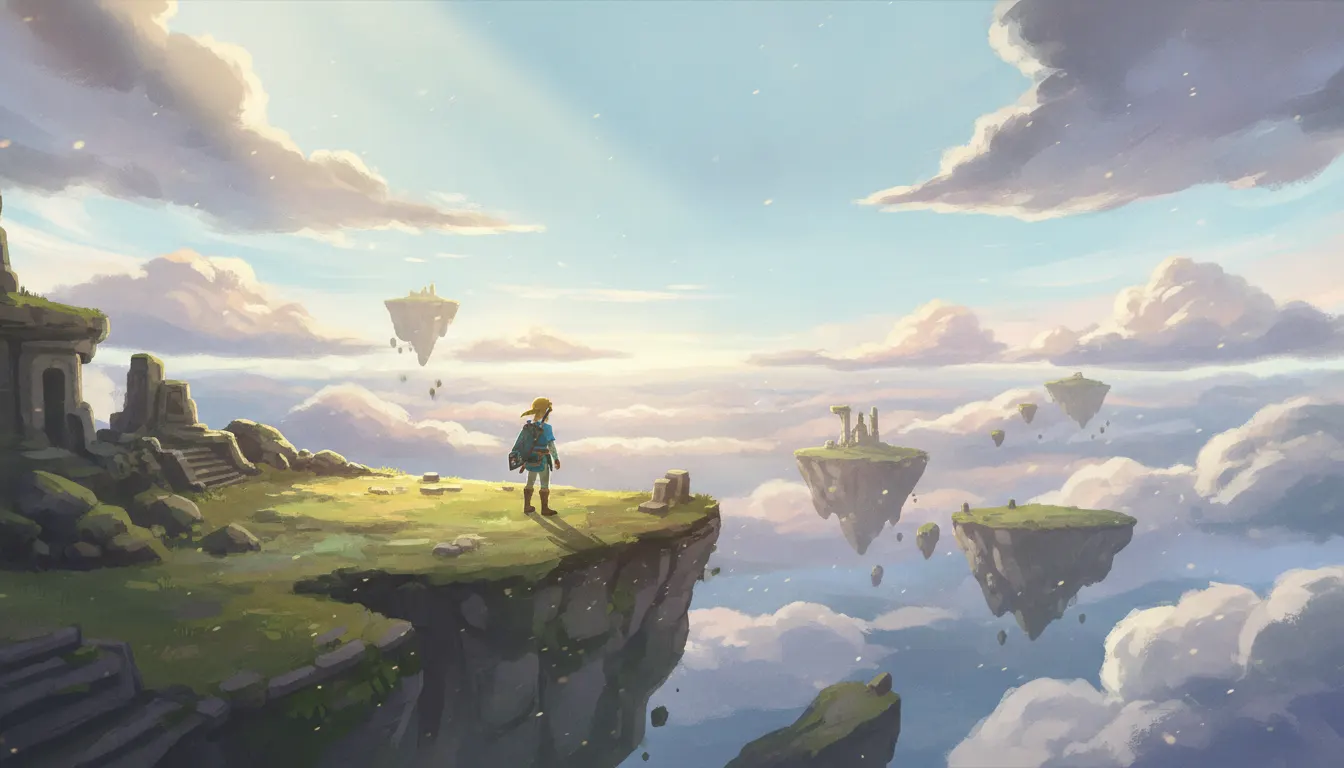
Nintendo Switch Zelda Tears of the Kingdom painterly cel-stylized 3D. Hyrule sky islands, watercolor-bloom horizon, gentle saturated Ghibli-adjacent palette.
The moves a human crew would use to get here. Cue applies them for you, and knowing their names is how you ask for a change.
to-three tone cel-shading with flat fill zones evoking Japanese watercolor and gouache
texture foliage maps showing leaf volume without high polygon geometry
crosshatch normal maps on rock surfaces visible at mid-distance
to-dusk sky palette inspired by en plein air watercolor color shift sequences
teal-patinated stone with gold geometric ornament and jade material quality
time shadow on surface world below
The Legend of Zelda: Tears of the Kingdom (Nintendo EPD, May 2023), directed by Hidemaro Fujibayashi, represents the most visually sophisticated entry in Nintendo's cel-shading Zelda tradition. While Breath of the Wild (2017) established the visual language, Tears of the Kingdom deepened it with more complex sky environments, ancient ruin aesthetics, and a broader dynamic range between the sunlit surface world and the underground Depths.
Nintendo's cel-shading approach for the Zelda series uses a two-to-three tone shading model - lit, mid-shadow, deep shadow - with diffuse color fills that evoke Japanese watercolor and gouache illustration traditions. The technique traces back to The Legend of Zelda: The Wind Waker (Nintendo, GameCube, 2002) where producer Shigeru Miyamoto and director Eiji Aonuma deliberately chose cel-shading to achieve 'a world like moving Japanese animation'.
Tears of the Kingdom evolved this approach: foliage renders with visible brushstroke-style texture maps that catch directional light to show leaf volume without high polygon counts. Rock faces use layered normal maps that read like pencil crosshatching from mid-distance. The sky at different times of day shifts through color palettes drawn from en plein air watercolor painting - the warm haze of dawn, the deep indigo of night over Hyrule Field.
A new visual layer in TotK is the Zonai ruin palette: teal-green patinated stone, gold geometric ornament, and the floating island architecture influenced by Mesoamerican and Southeast Asian temple traditions. Art director Satoru Takizawa drew on Aztec and Angkor Wat references, rendered through the cel-shade pipeline to give ancient stone a jade-and-gold jewel quality unlike any previous Zelda environment.
The sky islands and Thunderhead storm system in TotK required sky rendering more complex than any previous Nintendo title: volumetric cloud systems casting real-time shadow on the surface, lightning rendering through the cloud mass, and the ascending perspective from surface to sky requiring seamless LOD transitions at altitudes no previous Zelda visited.
Nintendo EPD, Switch, 2023, dir. Hidemaro Fujibayashi (primary reference)
Nintendo EPD, Switch, 2017 (visual language foundation)
Nintendo, GameCube, 2002 (cel-shading Zelda origin, Miyamoto and Aonuma)
Nintendo, Wii, 2011 (Impressionist painting influence on the cel-shade look)
Giant Squid, 2016 (painterly underwater exploration aesthetic adjacent to Zelda's approach)
HoYoverse, 2020 (cel-shaded open-world that cited Breath of the Wild as a visual reference)
A Look is not a filter. It is a set of stored decisions the pipeline reads before it makes a single frame, so two videos in the same Look actually match.