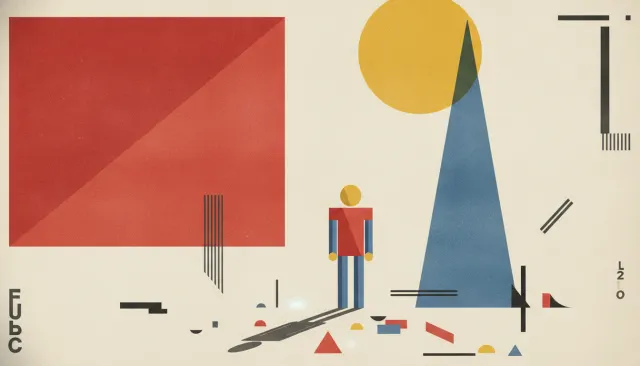
Neue Haas Grotesk / Helvetica
Max Miedinger and Eduard Hoffmann · 1957
The typeface that embodied and enabled the International Style globally
Swiss International Style. Helvetica, asymmetric grid, flush-left ragged-right, Muller-Brockmann poster discipline, objective photography.
The moves a human crew would use to get here. Cue applies them for you, and knowing their names is how you ask for a change.
Page divided into a precise mathematical grid of columns and baseline units; all elements aligned to grid intersections.
The 1957 Miedinger/Hoffmann typeface set at weights that maximize legibility rather than display impact.
All text aligned to a shared left edge; right margins fall naturally without justification, improving legibility and rhythm.
Black-and-white or controlled-color photography used to document rather than dramatize, aligned to the grid's image zones.
Unprinted areas are allocated by the grid, not left as accidental margins; they define visual breathing room systematically.
Color used functionally - one accent color maximum, applied to carry information hierarchy rather than decorative pleasure.
The International Typographic Style - colloquially the Swiss Style or International Style - was developed at the Basel and Zurich schools of design in Switzerland in the late 1940s and codified through the 1950s and 1960s. It became the dominant visual language of corporate and institutional communications worldwide by the 1970s, displacing American commercial illustration and European decorative typography in favor of mathematical grids, photography, and above all, sans-serif type.
Max Miedinger (1910-1980) and Eduard Hoffmann designed what they called Neue Haas Grotesk for the Haas Type Foundry in Münchenbuchsee, Switzerland in 1957. The brief was to create a neutral, optically balanced grotesque typeface that improved on Akzidenz-Grotesk's inconsistencies while maintaining its essential transparency. The name was changed to Helvetica (from Helvetia, the Latin name for Switzerland) in 1960 to facilitate international sales. Helvetica was licensed to Stempel and then to Mergenthaler Linotype, which gave it global distribution through the phototypesetting boom of the 1960s and 1970s.
Helvetica's visual character - its almost complete absence of individual personality, its even stroke weight, its generous x-height, its closed apertures - made it uniquely appropriate for institutional and corporate contexts where the type was expected to carry information without commentary. It became the typeface of the New York City subway signage system (Unimark International redesign, 1966-1970), NASA graphics, the American Airlines identity (Massimo Vignelli, 1967), and hundreds of other major institutional identities.
Josef Müller-Brockmann (1914-1996) was the designer who most fully articulated and demonstrated the grid-based visual system that the International Style used Helvetica to inhabit. His poster series for the Zurich Tonhalle concert hall (beginning 1951) showed how mathematical grids could organize type and geometric forms into compositions that were simultaneously rigorous and emotionally powerful. His Beware the Car road-safety poster (1960) placed bold sans-serif type and simplified geometric forms on an angular grid, achieving maximum impact with minimum elements. His 1961 book Grid Systems in Graphic Design became the canonical text of the movement.
Armin Hofmann (1920-2020) at the Basel School of Design taught the principles of Swiss typography to an international generation of designers, including Steff Geissbühler, April Greiman, and Dan Friedman.
The International Style is defined by: mathematical grid structures that determine the placement of every element; photography rather than illustration as the primary imaging mode; flush-left, ragged-right or centered-axis type settings; generous leading and white space; and the avoidance of decorative ornamentation. Helvetica (or similar grotesque faces) is set in regular or light weights at sizes that prioritize legibility over display impact. The overall effect is of information organized by a rational, transparent system rather than by aesthetic whim.
Max Miedinger and Eduard Hoffmann · 1957
The typeface that embodied and enabled the International Style globally
Josef Müller-Brockmann · 1951-1972
Poster series that demonstrated the emotional power achievable within mathematical grid systems
Unimark International (Massimo Vignelli) · 1966-1970
The most widely seen application of Helvetica and International Style grid principles
Josef Müller-Brockmann · 1961
Canonical textbook that codified the movement's mathematical approach
Massimo Vignelli / Unimark International · 1967
Corporate identity that applied International Style to a major brand at continental scale
Josef Müller-Brockmann · 1960
Road-safety poster showing maximum impact achievable with sans type and geometric form on a grid
A Look is not a filter. It is a set of stored decisions the pipeline reads before it makes a single frame, so two videos in the same Look actually match.