Yuri!!! on Ice
2016
MAPPA, dir. Sayo Yamamoto, 12 episodes + planned film
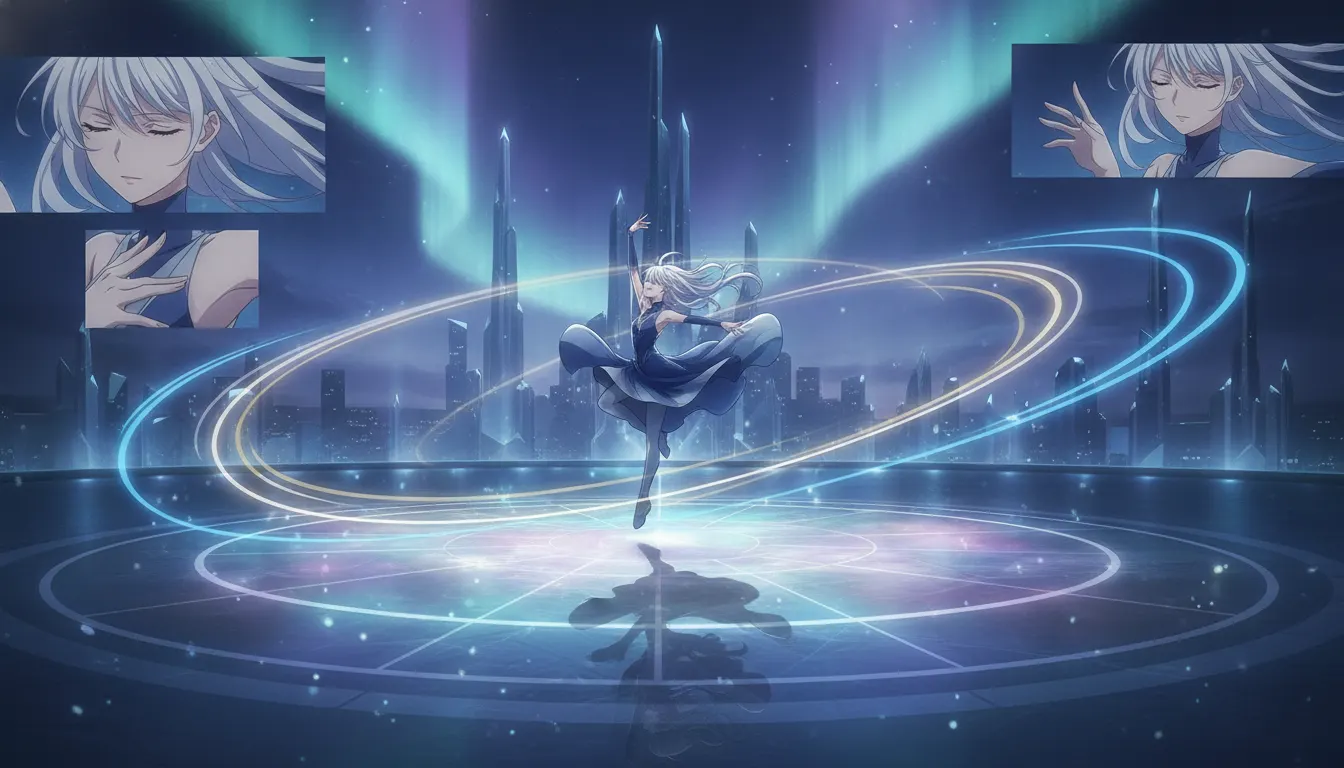
Graceful sports anime register (Yuri on Ice, Welcome to the Ballroom, Ping Pong the Animation). Flowing motion lines, performance-art staging, expressive choreography close-ups.
The moves a human crew would use to get here. Cue applies them for you, and knowing their names is how you ask for a change.
tone costume color against blue-white ice rink lighting -- high contrast, high saturation focal point against cold neutral environment
- fingers splayed and curved expressively to convey artistic intention
motion rotation frames during jump peaks, emphasizing height and horizontal extension
up eye and face shots cut into performance sequences, reading emotional state against physical virtuosity
cuts and camera moves timed to musical phrase peaks in the skating programs
Yuri!!! on Ice aired in the fall of 2016, produced by MAPPA (directed by Sayo Yamamoto, series composition by Mitsurō Kubo). It became one of the most critically acclaimed sports anime of the decade, winning the Tokyo International Anime Award for Best TV Animation and generating intense international fan response. The series follows figure skater Yuri Katsuki and his complex relationship with legendary Russian champion Victor Nikiforov.
Yuri on Ice is built around the animation of ice figure skating -- a challenge that pushed MAPPA's production to use reference from real skating performances and motion capture data. The skating sequences were animated with unusual fluidity, emphasizing the sweeping curves of jumps, the arc of spins, and the way skaters carry momentum through their whole body from blades upward. Character animator Noriko Itō was central to achieving this quality. The aesthetic result is animation that feels genuinely three-dimensional in a genre often reliant on action shortcuts.
The arena setting provides Yuri on Ice's distinctive visual environment: the hard edge of rink ice under spotlight creates deep blue-white light against warm-toned spectator areas. Costume design is treated with extraordinary care -- each character's competitive costume functions as character biography and emotional arc made visible, with jewel tones (cobalt, garnet, emerald) against the cold ice environment. Victor's free-skate costume, Yuri's Eros and Agape programs, and Yurio's Agape/Onsen on Ice outfits are each cohesive visual statements.
The series integrated a romantic relationship between male protagonists with unprecedented sincerity for the genre. Visually, this translated into the grammar of josei romance (eye-contact close-ups, hand-holding staging, negative space isolation of two characters) applied within a competitive sports narrative. The visual language constantly mediates between public performance and private emotion.
Yuri on Ice sits within a tradition of aesthetically ambitious sports anime that includes Haikyuu!! (2014-2020, Production I.G.), Free! (2013, Kyoto Animation), Ping Pong The Animation (2014, Tatsunoko Production, dir. Masaaki Yuasa), and Run with the Wind (2018, Production I.G.). Each of these elevated the sports anime form through distinctive visual choices beyond conventional motion depiction.
Yuri on Ice was produced by MAPPA (Maruyama Animation Produce Project Association), founded by Masao Maruyama (formerly of Madhouse). The production is remarkable because figure skating animation requires the same challenges as dance -- natural-looking fluid motion through complex three-dimensional space. MAPPA used reference skating footage and collaborated with real figure skaters to develop the visual programs for each character. Lead character designer Tadashi Hiramatsu and animation director Noriko Itō led the character performance animation. The production created distinct 'skating programs' for every character -- each with a unique musical piece, choreography theme, and visual approach -- representing an unusual level of creative investment in a 12-episode series.
2016
MAPPA, dir. Sayo Yamamoto, 12 episodes + planned film
Production I.G., volleyball sports anime with strong emotional animation
2013
Kyoto Animation, swimming sports anime with similar graceful aesthetic
2014
Tatsunoko, dir. Masaaki Yuasa, avant-garde sports animation
2018
Production I.G., running team drama with atmospheric beauty
2017
Production I.G., competitive ballroom dancing
Madhouse/Brain's Base, competitive karuta with similar josei-sports blend
2021
Bones Studio, skateboarding sports anime with flair aesthetics
A Look is not a filter. It is a set of stored decisions the pipeline reads before it makes a single frame, so two videos in the same Look actually match.