POP AND STREET ART · 1980S · USA
Keith Haring Bold Line
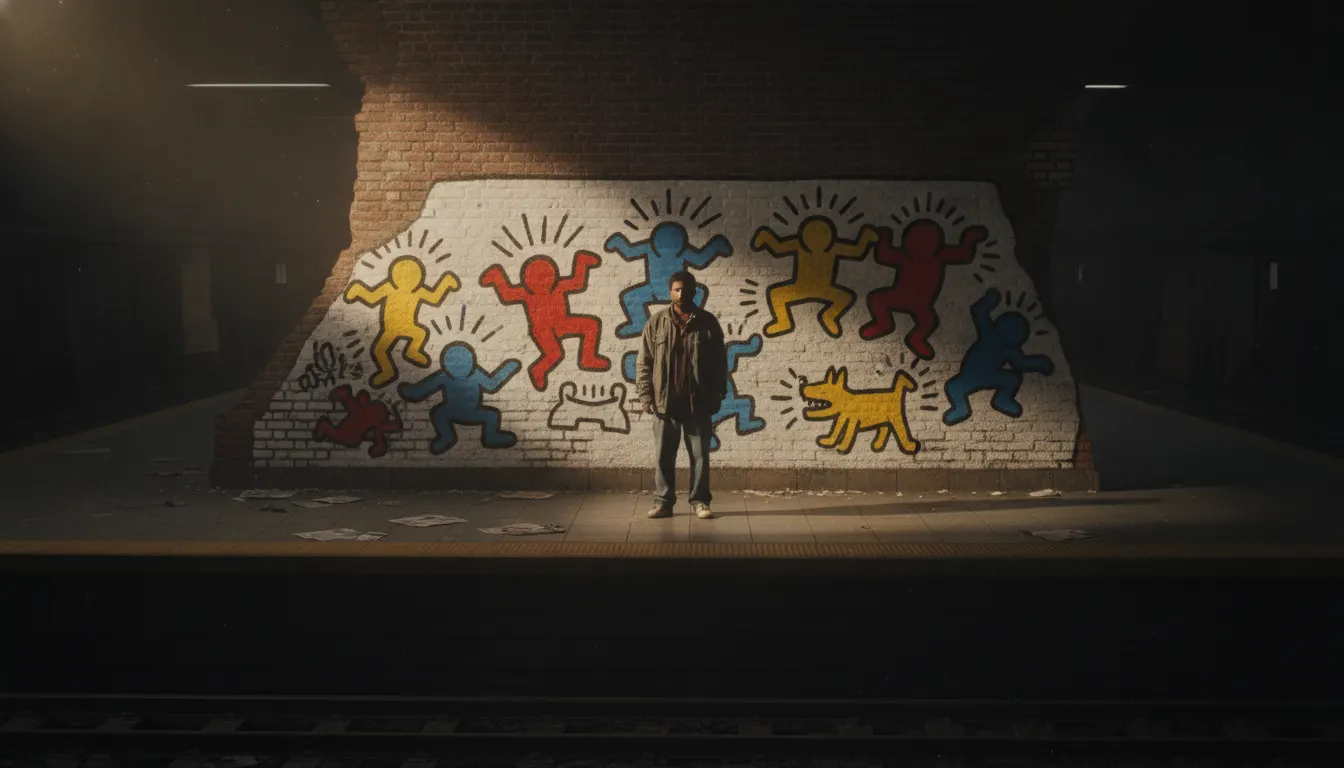
Keith Haring subway chalk and bold-line murals. Dancing figures with radiating motion lines, barking dog, primary color fill.
haringbold-linedancingstreet
WHEN TO USE
- Activism, social-justice, or cause-marketing videos that need bold, inclusive visual energy
- Youth-oriented or educational content - the flat figures and bright palettes read across age groups
- Urban lifestyle, streetwear, or street-art adjacent brand content from the 1980s-revival era
- Music video or event graphics that need kinetic, dancing-figure motion possibilities
- Children's programming or family event branding where simple joy is the goal
- Non-profit campaigns addressing health, education, or social equity
WHEN NOT TO USE
- Luxury or premium positioning where the deliberately crude line risks reading as low-effort
- Corporate financial or legal content where the playful street-art tone undercuts credibility
- Photorealistic product showcases requiring spatial depth and detail
- Historical or documentary contexts outside of 1980s NYC culture
SIGNATURE TECHNIQUES
How the look is made.
The moves a human crew would use to get here. Cue applies them for you, and knowing their names is how you ask for a change.
- 01Uniform thick black outline with no taper or variation in line weight
- 02Radiant lines emanating from figures or objects to indicate energy, light, or importance
- 03Flat color fills
no gradients, shading, or perspective modeling
- 04Simple, abstracted anatomy
faceless or dot-eyed figures in dynamic, universal poses
- 05All
over composition: figures interlocked, stacked, or filling the entire frame with no empty ground
- 06Primary and secondary palette
red, yellow, blue, green, black, white - high contrast at distance
- 07Symbol repetition
the same barking dog or radiant baby appearing dozens of times in a single work
HISTORY & CONTEXT
Where it comes from.
Keith Haring: Radiant Baby, Subway Drawings, and the Grammar of the Street
Keith Haring (1958-1990) developed one of the most immediately recognizable visual vocabularies in late twentieth-century art, emerging from the New York City subway system and East Village underground scene of the early 1980s before his premature death from AIDS-related complications at 31.
The Subway Drawings
From 1980 to 1985, Haring drew with chalk on the black paper that the MTA used to cover expired advertising panels throughout the New York subway. He produced over five thousand of these unauthorized drawings in stations across the system - a self-imposed challenge to draw quickly and publicly without preparation. The subway was his laboratory: works were seen by millions of commuters, existed only until the papers were replaced, and demanded visual immediacy over complexity.
The symbols he refined there became his permanent vocabulary: the Radiant Baby (a crawling infant surrounded by radiating lines, adopted as his personal logo), the Barking Dog (a four-legged creature whose mouth contains a smaller barking dog), the flying saucer, the Angel, and anonymous human figures in dynamic motion - dancing, running, jumping, copulating, suffering. All are drawn with a thick, uniform line weight, no shading, and primary or bold secondary colors on flat grounds.
Pop Art Activism
Haring was deeply influenced by Jean-Michel Basquiat and Andy Warhol, and equally by the graffiti writers working the same subway cars. He saw accessibility as a political and artistic value: art should not be locked inside galleries. His Pop Shop, opened in SoHo in 1986, sold affordable posters, pins, and clothing bearing his imagery - a move critics attacked as commercialization that Haring defended as democratization.
He used his visual language to address the AIDS crisis, drug abuse, apartheid in South Africa, and nuclear disarmament. Ignorance = Fear (1989) - featuring three figures covering eyes, ears, and mouth in red and black - was produced as a free poster for ACT UP.
Legacy
Haring completed major public murals on six continents, including the Crack is Wack mural (Harlem, 1986) and Once Upon a Time (1989) in a men's bathroom at the New York Public Library. The Keith Haring Foundation, established shortly before his death, continues to support HIV/AIDS education and children's arts programs.
NOTABLE WORKS
Where you have seen it.
Crack is Wack mural, Harlem River Drive, New York
1986
Untitled
1984
large-scale tarpaulin painting, multiple museum collections
Ignorance = Fear
1989
ACT UP poster
Once Upon a Time
1989
mural, New York Public Library men's room
Tuttomondo
1989
public mural, Pisa, Italy (Haring's last major public work)
Pop Shop prints and merchandise (1986-1990)
Three Dancing Figures
1988
bronze sculpture editions
THE RECIPE
The exact knobs
the renderer turns.
A Look is not a filter. It is a set of stored decisions the pipeline reads before it makes a single frame, so two videos in the same Look actually match.
SettingValue
TransitionHow one shot becomes the next
hard cuts · 160ms · linearKen BurnsCamera move applied to stills
Slow push · 0.02 · centerTypographyDisplay / body / mono pairing
Bangers · Inter · JetBrains MonoMusic moodWhat the bed under the voice sounds like
hip-hop-old-school · disco-pulsePrompt suffixAppended to every shot prompt in this Look
Keith Haring bold black outline mural, dancing figures with radiating motion lines, barking dog, primary color fill, 1980s subway chalkPALETTE
Primary
#FFC72C
Secondary
#1FA8C9
Accent
#D62828
Text/Light
#0A0A0A
Text/Dark
#FFFFFF
BG 900
#0A0A0A
BG 800
#1A1A1A
RELATED LOOKS
Next to it on the shelf.



Your first cut
is on us.
+ New videoFree plan · no card · 1080p export