The Cutaway Contract: Using Reaction Shots to Support Unbelievable Claims
When you can’t film literal proof for a bold line, a reaction cutaway can help the claim land without pretending the shot is evidence. Here’s how to use cutaway shots in video editing as a credibility cue, time them on the trust-bearing verb, and keep the ethics clean.
By VideoCue · Created with AI assistance and automated editorial checks.
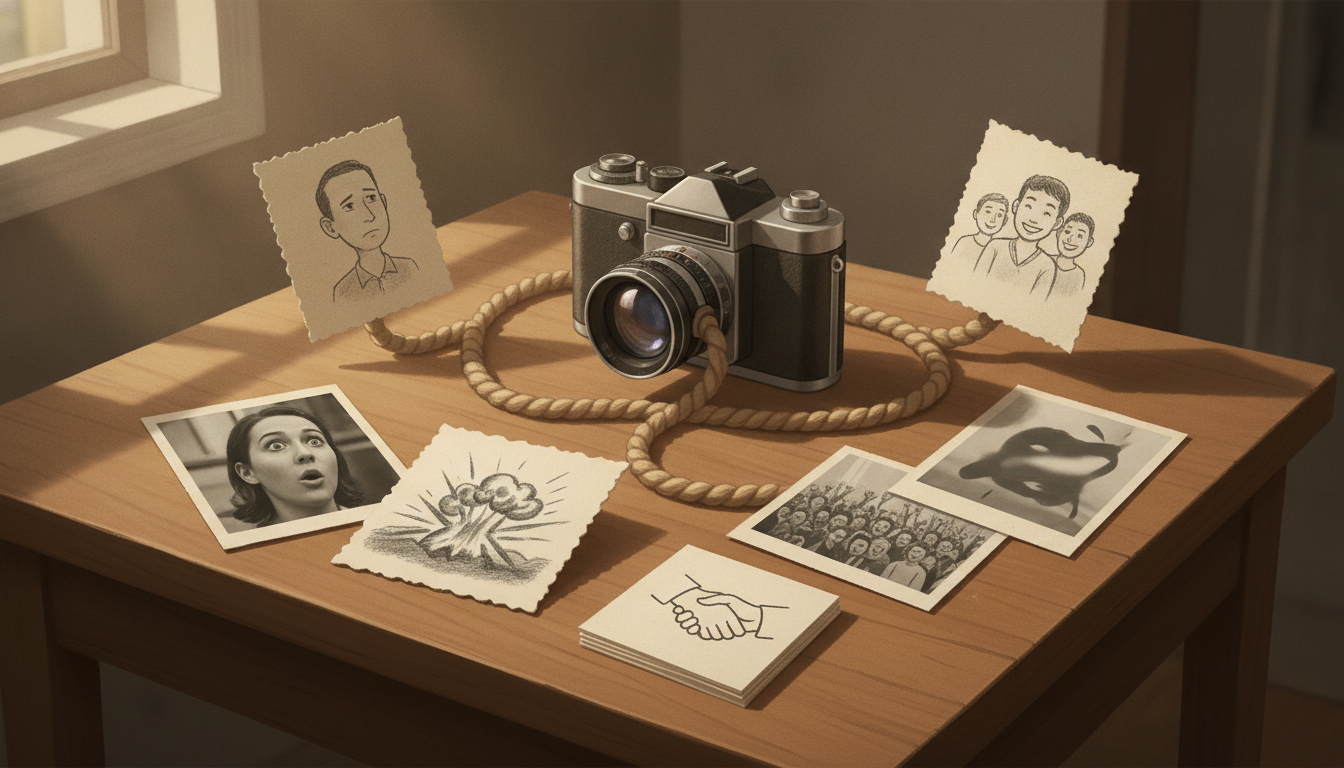
Bold claims create a familiar editing problem. Your narration says the interesting thing, but your footage only shows the topic. The line may be accurate and worth keeping, yet you have no archive, no access footage, no licensed images, and no budget for stock.
So you reach for the obvious visual: the object, the place name, the generic close-up.
That keeps the screen moving, but it often supports the wrong part of the sentence. If the claim is surprising because something was found, tested, preserved, confirmed, or measured, a topical shot of the thing itself may not help much. The viewer is not struggling to identify the noun. The viewer is deciding whether the statement feels examined.
That is where cutaway shots in video editing become more useful than many creators realize. Adobe defines a cutaway as a supplementary shot away from the main action and says it can show story elements without relying only on exposition in Adobe’s guide. Shootsta describes a cutaway as a brief shot other than the main subject, commonly used to add context, hide a cut, cover a jump in time, or give the viewer somewhere else to look while the main audio continues in Shootsta’s guide.
For explainers, commentary videos, educational shorts, and creator-led essays, that opens a practical move: instead of illustrating the noun, you can illustrate the moment of scrutiny.
The narration still carries the factual burden. The image carries a narrower job: a credibility cue or scrutiny cue.
What this technique does differently from normal B-roll advice
Most creator blog advice about cutaways falls into three buckets: generic B-roll matching, jump-cut coverage, or contradiction avoidance. All of that is useful. It tells you how to keep the edit smooth, how to avoid showing visuals that clash with the script, and how to cover trims in A-roll.
This technique is different because it works at the sentence level. The question is not just, “What image fits this topic?” It is, “Which word in this sentence is asking the viewer to trust me?” Instead of matching the noun, you place a human reaction on the verification verb or trust-bearing action.
That makes it less about decoration and more about emphasis. You are not using a cutaway just to hide a jump cut or add visual variety. You are using it to mark the precise moment where the script becomes accountable.
Why generic B-roll often underdelivers on bold claims
If your narrator says, “Honey can remain usable for an extremely long time,” the easy visual is a jar, a spoon dip, or a slow drizzle. Those shots tell the viewer what honey is. They do very little for the surprising part of the line.
That matters most in the opening. Instagram’s creator guidance says the first few seconds matter, recommends opening with the moment that makes someone stop scrolling, and frames visuals and text as reinforcement for clarity in Instagram’s creator article. If your hook is a bold claim, the support footage should engage with the surprise, not just the subject.
A reaction cutaway changes the editing question. Instead of asking, “What object belongs on screen?” ask, “What behavior belongs on screen?”
- A pause
- A note being written
- A skeptical eyebrow
- A glance from prop to camera
- A measured nod
None of those prove the line. That is not the job. Their job is to signal that this is the part of the sentence worth weighing.
More broadly, visual-media research and production studies often describe viewers as using authority and credibility shortcuts when interpreting on-screen people, settings, wardrobe, and presentation cues. In plain English: viewers do not only process the words; they also read the frame for signs of seriousness, expertise, and scrutiny. That is exactly why this technique needs ethical boundaries. The same cues that help a claim feel considered can also imply more verification than you actually have.
The cutaway contract: what the image is allowed to do
A good reaction cutaway makes a small promise to the viewer: “I am helping you process this claim,” not “I am the proof.”
That is the contract.
Once you think in those terms, several editing choices get easier. Your insert does not need to demonstrate the statement. It needs to shape how the statement lands. The shot is interpretive. It can signal caution, curiosity, surprise, seriousness, or skepticism. It can give the viewer half a beat to register the line.
This fits the normal grammar of cutaways. Adobe says cutaways enrich the story and can show essential elements instead of relying only on exposition in Adobe’s guide. Shootsta explains that cutaways often sit over continuous main audio, which lets speech feel uninterrupted while the viewer sees a different image in Shootsta’s guide. That is exactly why they work well for creator videos with limited footage.
The danger is obvious: a reaction insert can drift into fake authority. Wardrobe, props, lower thirds, and pseudo-technical dialogue all carry meaning. Used carefully, they suggest scrutiny. Used carelessly, they imply evidence that does not exist.
Documentary and nonfiction editors deal with a version of this problem all the time. Illustrative visuals are normal. Misleading viewers about what is document, reconstruction, or performance is not. If your cutaway is interpretive rather than evidentiary, the rest of the edit should keep that distinction legible.
Worked example: cut on the verification verb, not the topic noun
Here is the cleanest version of the honey example.
The claim you need to support is not really “honey.” The trust-bearing action is found.
A weak version lands the insert on the noun:
BEFORE
VO: Archaeologists found edible honey in Egyptian tombs.
VISUAL 00:00-00:02: Close-up of honey jar begins on the word “honey.”
RESULT: The viewer sees the topic, but the key claim has already started asking for trust.
A stronger version lands the insert just before the verification verb:
AFTER
VO: Archaeologists found edible honey in Egyptian tombs.

Timing guide:
- 00:00 Main talking head on “Archaeologists…”
- 00:08 Cutaway enters a beat before “found”
- 00:08-00:20 Reaction insert holds through “found edible honey”
- 00:20 Cut back near the end of “in Egyptian tombs” or on the pause

CUTAWAY ACTION:
Creator, framed chest-up, holding a replica clay vessel.
They glance at the vessel, then to camera, with one restrained eyebrow raise.
Optional line: “Storage is the point.”

RESULT: Audio carries the fact. Image carries scrutiny at the exact moment the sentence becomes accountable.
That version is stronger because it supports the part of the sentence the audience is evaluating.
Notice what changed:
- The prop points to age and storage, not just honey.
- The performance is small enough to read fast.
- The optional dialogue interprets the claim instead of certifying it.
- The cut lands on found, not honey.
Now compare that with the version you should avoid:
AVOID
VO: Archaeologists found edible honey in Egyptian tombs.
CUTAWAY: Creator in lab coat holding vessel.
DIALOGUE: “We tested it. The pH held.”
The problem is not the coat by itself. The problem is that the dialogue invents a test, a procedure, and a result. That crosses the line from scrutiny cue into fabricated verification.
How to script a reaction insert that reads instantly
Shootsta says cutaways are usually brief, often around one to three seconds in business video in Shootsta’s guide. That short runtime is helpful. It forces clarity.
A usable reaction insert usually needs four decisions.
1. Give the person one readable role
Host, skeptic, listener, explainer alter ego, or audience stand-in. Do not make the viewer decode a character biography in two seconds.
2. Choose one prop that narrows meaning
The prop should point to the idea inside the sentence, not just the topic.
- Honey jar = honey
- Clay vessel = age, storage, preservation
- Notebook = scrutiny
- Shipping label = logistics
3. Keep the performance restrained
Small reactions are faster to trust and easier to cut.
- Slight eyebrow raise
- Tiny pause
- Measured nod
- Quick note scribble
- Brief look to camera
Big reactions can turn an informational edit into a sketch.
4. Treat dialogue as commentary, not certification
Safer lines sound like interpretation:
- “That’s the key part.”
- “Storage matters here.”
- “That’s what makes it unusual.”
Risky lines sound like invented evidence:
- “We confirmed it.”
- “The test came back clean.”
- “I ran the numbers.”
If the insert could reasonably be mistaken for real documentation, add a small on-screen label such as visualization, dramatization, or host reaction. Instagram’s guidance supports using text and visuals to reinforce clarity in Instagram’s creator article. That is the right reason to label it.
Timing: a creator heuristic, not a hard rule
The brief asked for editing-manual support here, and the honest answer is this: the exact “cut two frames before the verb” formula is better treated as a practical heuristic than a settled rule from the supplied sources.
What the sources do support is the underlying mechanic. Shootsta says the main audio often continues beneath the cutaway in Shootsta’s guide. That gives you freedom to place the image where the sentence needs emphasis, not just where the noun is visually easy.
So use this as a working method:
- Find the word where the sentence becomes accountable. Usually that is the verification verb: found, proved, confirmed, discovered, measured.
- Enter the cutaway slightly before or right on that word.
- Hold through the object or outcome phrase.
- Exit on the sentence release or pause.
That is not doctrine. It is an editing heuristic that tends to work because it places the visual emphasis where the viewer’s skepticism spikes.
A simple three-pass review helps:
- Audio-only pass: hide the screen and mark the word where you mentally say, “Really?”
- Muted pass: watch the insert without sound and see whether it still reads as intentional.
- Half-speed pass: check whether the reaction arrives just before the pressure point, not after it.
If you want to map those beats before you shoot, the Storyboard Builder is useful for blocking the line, prop, action, and timing on separate cards. And if you are tightening narration first, Script Word Counter helps you see whether the sentence is doing too much before you ever add visuals.
Ethics callout for nonfiction creators
Use this technique as illustration, not impersonation.
Red lines:
- Do not invent an expert identity.
- Do not add fake lower thirds with false credentials.
- Do not fabricate test dialogue or imply procedures that never happened.
- Do not stage a reaction so specifically that viewers would reasonably read it as actual documentation.
When to label the shot:
Add an on-screen label such as visualization or dramatization when the insert includes role-play, costume, recreated process, or any framing that could be mistaken for reportage.
Safe default:
If a viewer paused on the frame and assumed it was evidence, the shot is too aggressive. Pull it back.
For adjacent craft, this same honesty question also applies to titles and lower thirds. If you are building supporting text, keep it readable and non-deceptive, as covered in lower-third typography that actually reads.
Pitfalls and tradeoffs
The first pitfall is fake authority. The more official the costume, set dressing, and language, the more likely viewers are to overread the shot.
The second is overuse. A reaction cutaway is strongest at genuine pressure points. If every sentence gets one, the move stops feeling meaningful.
The third is irrelevance. Shootsta emphasizes relevance and timing in cutaways in Shootsta’s guide. If the narration is about preservation conditions and your insert is just a cute gag, trust drops.
There is also a tradeoff between specificity and honesty. More detail can make the insert read faster. It can also push the image closer to documentary imitation. When in doubt, simplify.
And sometimes the right answer is no cutaway at all. If the line is already clear and strong, holding on the speaker may carry more conviction than adding another insert.
A quick practice drill you can do today
Pick one line from your latest script that makes a bold claim.
Then do this:
- Underline the burden-of-belief verb.
- Write one reaction role: skeptic, host, listener, or explainer alter ego.
- Choose one prop that supports the idea inside the line.
- Storyboard one insert lasting no more than three seconds.
- Cut it so it enters on or just before the trust-bearing verb.
- Run the three-pass review: audio-only, muted, half-speed.
- Ask the ethics question: would anyone mistake this for actual evidence?
If yes, simplify the shot or label it.
Reaction cutaway checklist
Before you lock the edit, check:
- What exact sentence lacks literal footage?
- Which word carries the trust load?
- Does the insert support the verb, not just the noun?
- Is the shot clearly editorial rather than evidentiary?
- Does one prop narrow the meaning fast?
- Can the reaction read in under three seconds?
- Does the narration still carry the factual claim?
- Would a label improve clarity?
- If you remove the insert, do you lose meaning or only movement?
That last question is the best filter. If removing the shot only makes the timeline less busy, it was filler. If removing it makes the sentence land with less clarity, emphasis, or scrutiny, then it was doing real work.
Conclusion: let the voice carry the fact, let the image carry the scrutiny
Reaction cutaways are most useful when your script says something hard to picture and generic B-roll only names the topic. In those moments, a human insert can work as a credibility cue without pretending to be proof.
The key is narrowness. Cut on the trust-bearing verb, keep the performance small, keep the dialogue interpretive, and keep the ethics obvious.
If you want an immediate next step, open your last script, find one unbelievable line, underline the verification verb, and build a single three-second insert around that word. That one drill will tell you very quickly whether your cutaway is adding scrutiny—or just adding footage.