The B-Roll Divorce: Rewriting Script to Match Footage When the Emotional Story Changes
The B-roll divorce happens when your planned narration says one thing but the footage keeps signaling a different emotional story. Here’s how to spot it, test whether the footage-first angle is real, and rewrite the script to match footage without forcing the original plan.
By VideoCue · Created with AI assistance and automated editorial checks.
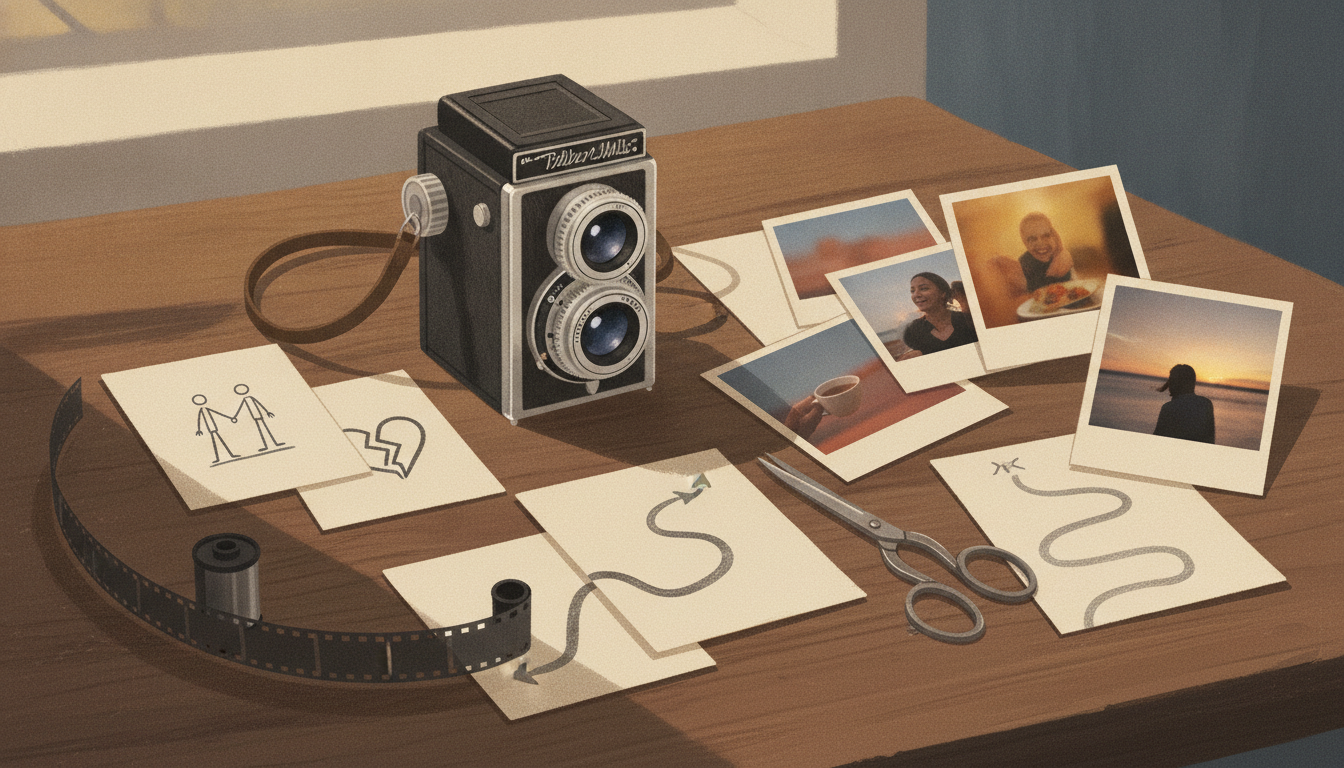
The B-roll divorce is not a factual error. It is an emotional mismatch.
You write the script, shoot the interviews, gather the B-roll, and expect the edit to be a matter of trimming and polishing.
Then the rough cut starts arguing with you.
The narration says urgency, danger, or disruption. The footage says routine, warmth, or trust. The script says breakthrough. The images say repetition. The words push one emotional frame while the pictures keep offering another.
That is the B-roll divorce: when your footage needs a different script than the one you shot.
This is different from a factual pivot.
A factual pivot is when reporting changes the claim. You planned to say X, but the interviews, numbers, or footage prove X is incomplete or wrong, so you rewrite the argument. That is a facts problem.
A B-roll divorce is an emotional-story problem. The facts may still be correct. What changes is the center of gravity. The footage reveals that the strongest honest story is not the one your original narration was built around.
That distinction matters because the fix is different. In a factual pivot, you correct the substance. In a B-roll divorce, you keep the substance but rewrite the framing so the voiceover stops fighting the picture.
Editors and documentary makers have long treated story as something discovered in post as well as planned in preproduction. Walter Murch describes editing as the stage where a film is finally found through selection, order, and rhythm in In the Blink of an Eye. Karen Pearlman likewise frames editing as a meaning-making process shaped by timing, juxtaposition, and emotional logic in Cutting Rhythms. Those are craft sources, not lab studies, but they directly support the working idea here: the material you captured can reveal a better story than the script you arrived with.
There is also a useful tool lesson. The paper Rewriting Video: Text-Driven Reauthoring of Video Footage is not evidence about viewer psychology. It does, however, support one practical point: when creators reshape existing footage, they care about coherence, control, and creative alignment, and human viewers value temporal-narrative coherence more than frame-accurate fidelity. That is exactly the territory where a B-roll divorce shows up.
Why mismatched narration and picture feels off
You do not need to pretend this is universal or fully measurable in every creator workflow. But there is a solid reason the mismatch is noticeable.
Film sound theory has treated image and sound as jointly constructing meaning for a long time. Michel Chion’s work on audio-visual relations argues that viewers do not process sound and image as separate lanes; they fuse them into one interpreted event, and that combination can either reinforce or complicate meaning in deliberate ways. See Audio-Vision: Sound on Screen.
That matters because a B-roll divorce is usually not a clever contradiction. It is an accidental one.
If calm, intimate footage is paired with overdramatic voiceover, the viewer is being asked to hold two competing readings at once. Sometimes that can be artful. More often in YouTube, branded, or explainer work, it just feels unconvincing. The issue is not that the words are false in a narrow sense. The issue is that the emotional claim is unsupported by what the eye keeps confirming.
A practical way to say it:
- the picture establishes the immediate felt reality
- the voiceover tells the viewer how to frame that reality
- if those frames keep colliding, trust drops
That is also why I would keep generic scripting advice in its proper lane. A trade-press guide like ChatCut’s How to Write a Script for a Video in 2026 is useful workflow guidance about structure, length, and fit. It is not proof of viewer psychology. Same with the OverseerOS post on turning a transcript into an original retention-first script: it is helpful as workflow advice because it stresses rewriting the angle and structure, not just swapping words. That principle applies here, but it should be labeled as guidance, not evidence.
Story discovered in editing: the examples worth citing carefully
This is not a new creator problem. It is a standard editing problem with a newer name.
A well-documented narrative-film example is Annie Hall. The movie began life as a much broader project, often referred to in reporting as Anhedonia, and was significantly reworked in the edit into a relationship-centered film. Richard Brody summarizes that reshaping in his New Yorker piece on the film’s making and legacy: The Existential Genius of Annie Hall. If you cite Annie Hall here, the supported point is not a romantic myth about editing miracles. It is the narrower one: the final emotional center was clarified in post.
A documentary example is Hoop Dreams. What began as a shorter project expanded as the filmmakers kept following the real lives unfolding in front of them. The Criterion notes and contemporaneous reporting make clear that the film’s eventual structure came from long-term accumulation and editorial shaping of footage, not from a fully predetermined final form. See The Criterion Collection essay on Hoop Dreams and Kartemquin’s production history at Hoop Dreams.
Those examples matter because they show the right principle: footage is not always just proof of a prewritten idea. Sometimes it becomes the source of the stronger story.
For creator work, the scale is smaller. You are not recutting a feature. But the same editorial question applies: what story does the material repeatedly support?
The footage-first pass for a B-roll divorce
When your cut feels wrong, do not start by polishing sentences. Start by watching what you actually have.
1. Watch the usable footage muted
Mute the timeline. No music. No interview. No scratch VO.
This strips away the authority of the draft for a moment and lets the visuals speak first.
Ask of each usable clip:
- What emotion does this naturally carry?
- What relationship does it imply?
- Does it feel careful, communal, tense, playful, private, proud, awkward?
- What would a neutral viewer infer from this shot alone?
If you want distance from the timeline, pull stills with the Video Frame Extractor. Reviewing frames as a set can make recurring visual patterns easier to spot.
2. Write emotional notes, not just shot labels
Bad note: “close-up of hands.”
Useful note: “careful routine, no panic.”
Bad note: “neighbor reaction.”
Useful note: “curiosity instead of fear.”
You are not logging coverage. You are translating footage into editorial meaning.
3. Cluster your notes into candidate themes
You will usually see two or three possibilities emerge:
- quiet competence
- unexpected community
- ritual and craft
- learning in public
- pressure under control
Pick the theme the footage supports most often, not the one that sounded best in the pre-pro deck.
4. Test whether the angle is truly recurring
This is where many creators guess. Use operational thresholds instead.
Treat a footage-first angle as real only if it passes at least one of these tests:
- it appears in 3 or more distinct moments that are not just alternate takes of the same beat
- it appears across opening, middle, and ending material rather than living in one pocket of the edit
- it shows up in 2 or more types of footage, such as action, reaction, and environment, not just one hero shot
If the theme appears once, it is an accent. If it appears repeatedly across the piece, it is probably the spine.
5. Isolate the clips that still support your original angle
Do not throw the old idea away on principle.
Often the first script is not wrong everywhere. It is just overclaimed. Keep the original angle for the sequence where the footage genuinely carries it.
That gives you a better structure:
- opening on the strongest honest visual truth
- development through repeated supporting moments
- one contrast section where the original tension or risk actually belongs
- closing on the meaning the viewer has now earned
6. Rewrite against picture, not against the old doc
Open a two-column script. Put visuals on one side and revised narration on the other.
That format is standard practical workflow advice, and it is useful here because it makes the conflict visible line by line. If you need a place to rough out scene order first, the Storyboard Builder is handy for rearranging beats before you commit to final VO.
Here is a short general before/after outside the main case study:
| Planned line | Conflicting shot |
|---|---|
| “Our team thrives on fast decisions and constant pressure.” | Slow, careful footage of a designer quietly iterating alone at a desk |
| Revised line: “What looks fast from the outside is mostly patient iteration.” | Why it works: the revision matches what the viewer sees, then reframes the broader point instead of denying the image |
That is the core move in a B-roll divorce. You do not make the footage serve the sentence. You make the sentence tell the truth about the footage.
Worked example: River Park Media’s fictional beekeeping rewrite
The following is a fictional example meant to show the method, not report observed test results.
River Park Media is cutting a 4-minute video about urban beekeeping. The planned angle is danger and drama: city beekeeping as a misunderstood, high-stakes pursuit.
On paper, that angle is workable. In the edit, it fights the footage.
The B-roll repeatedly shows:
- Marcus opening the hive calmly at sunrise
- neighbors leaning in with questions
- honey shared across apartment balconies
- children watching with curiosity from a safe distance
- slow, practiced motions that read as routine rather than extreme
In this fictional scenario, the team describes the first cut as feeling “off.” That reaction is part of the example, not cited audience data.
Footage-first notes
Producer Sam Rivera watches the B-roll muted and writes:
- part gardening, part caregiving
- neighbors are drawn in, not pushed away
- honey exchange feels communal
- the bees create conversation more than fear
- one short inspection beat is genuinely tense
Those notes cluster around unexpected community.
What gets changed
- the danger-heavy opening is cut
- neighbor and honey-sharing footage moves into the first minute
- calm routine footage stays early because it supports the new center
- the one active-hive sequence becomes a contrast beat later
- risk language is reduced and saved for the place viewers can actually see it
BEFORE

VISUALS
- Marcus calmly opening a hive at sunrise
- Neighbor smiling from the next rooftop
- Jar of honey passed over a balcony
- Children watching with curiosity

VOICEOVER
- Most people run from bees. Marcus runs toward them.
- In a city where danger hides in plain sight, urban beekeeping is not for the faint of heart.
- Every hive inspection is a calculated risk.

AFTER

VISUALS
- Marcus calmly opening a hive at sunrise
- Neighbor smiling from the next rooftop
- Jar of honey passed over a balcony
- Children watching with curiosity

VOICEOVER
- Marcus did not expect the bees to make him neighbors with people he had never met.
- What started as a rooftop hobby became a small routine of checking hives, answering questions, and sharing honey across the building.
- The bees still demand care. But the bigger story here is what happened around them.

CONTRAST SEQUENCE LATER

VISUALS
- Gloves tightened
- Faster hand movement near an active hive
- Close-up of bees swarming around the frame

VOICEOVER
- There are moments when the work tightens.
- Wind changes. A colony gets more active. Technique matters.
- That is when experience stops looking gentle and starts looking essential.
What changed was not the factual substance. Bees still require care, caution, and skill. What changed was the governing emotional story.
That is a clean B-roll divorce fix: let the footage lead, then place tension where tension is visible instead of pretending it owns the whole piece.
Pitfalls, tradeoffs, and stakeholder pushback
A footage-led rewrite is powerful, but it is not frictionless.
Overcorrecting into vague mood
Warm footage can tempt you into airy narration that says less. Keep one sentence pinned above the timeline: What should the viewer understand by the end?
Letting one beautiful shot hijack the story
If the angle does not meet the recurrence thresholds, do not rebuild the whole video around it.
Keeping the original intro out of loyalty
The first 20 to 30 seconds do the most damage when they are mismatched. If you only have time to rewrite one section, rewrite the opening.
Narrating what the image already proves
A better footage-led cut often needs fewer words. Let VO add interpretation, not duplication.
Stakeholder resistance
This is the big one.
A producer, founder, client, or channel partner may say, “But that is not the angle we approved.” The best response is not theoretical. Show them the sequence.
Try presenting three things side by side:
- Original line
- Current picture under that line
- Revised line that matches the picture
Then explain the gain in practical terms:
- stronger coherence
- less tonal strain
- a more believable story
- fewer lines needed to force the point
You are not saying the brief was bad. You are saying the footage refined the brief.
Quick checklist for rewriting script to match footage
Before you record new VO, run this pass:
- Mute the timeline
- Write one emotional note per clip or clip cluster
- Group notes into candidate themes
- Confirm the best theme appears in 3+ distinct moments or across beginning, middle, and end
- Save the original angle only for sequences that truly support it
- Rewrite the opening first
- Convert the script into a two-column visual/audio pass
- Cut lines that only describe what is obvious onscreen
- Recheck runtime with the Script Word Counter
- Play the revised narration against picture before you lock it
Next steps: use the B-roll divorce test on your next rough cut
The script gets you to the shoot. The edit tells you what the piece actually became.
That is why the B-roll divorce deserves its own category, separate from a factual pivot. A factual pivot asks, “Did the underlying claim change?” A B-roll divorce asks, “Did the emotional story change once we saw the footage together?”
If your rough cut feels strained, do one disciplined experiment before you defend the original draft:
- mute the timeline
- write emotional notes on the footage
- mark the theme that recurs most clearly
- rewrite only the first 30 seconds
- compare old and new against picture
If the new opening suddenly makes the whole cut breathe easier, you probably found the real story.
And once you notice that pattern, you stop treating B-roll as illustration. You start treating it as evidence of the emotional truth your final script needs to serve.