Lifetouch school portrait archives 1936-present
largest school photography company in the US
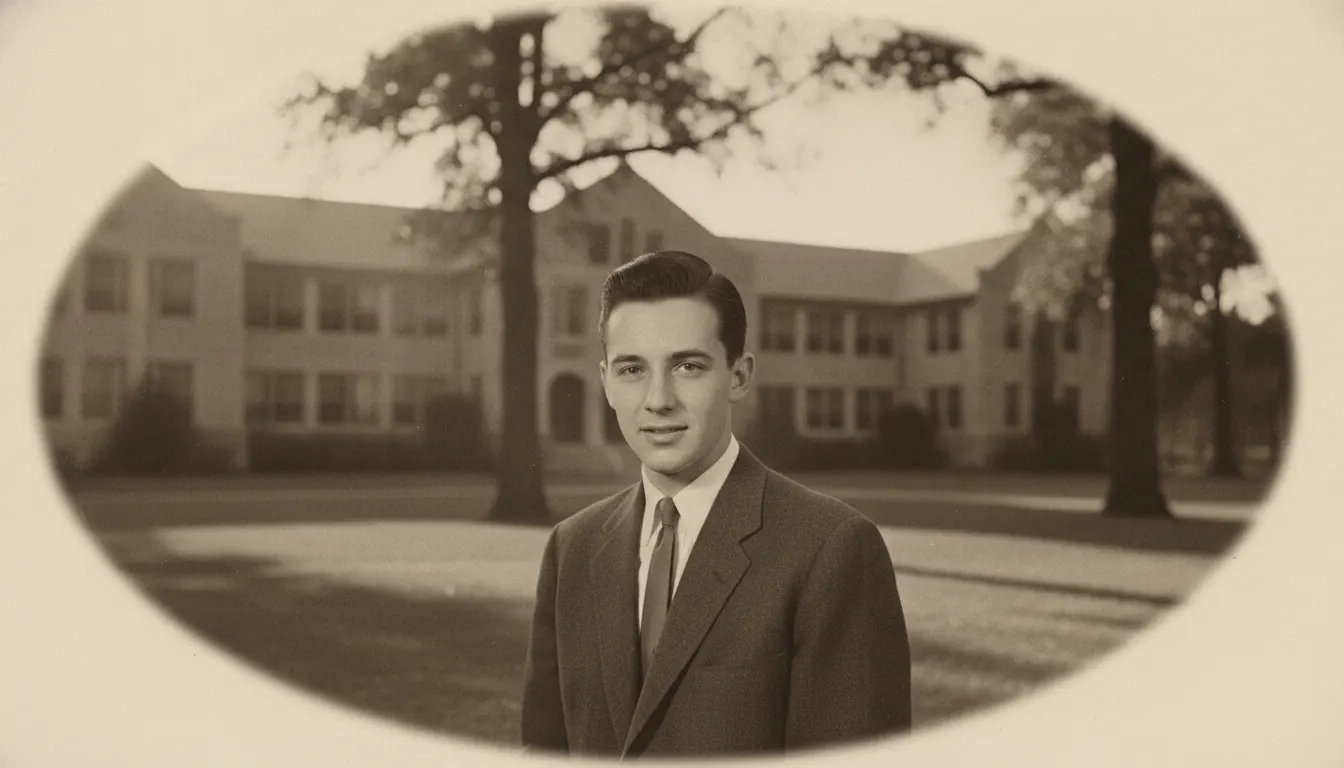
Mid-century high-school yearbook portrait. Soft-focus vignette, oval-mat cropping, Brylcreem hair, Eisenhower-era earnestness.
The moves a human crew would use to get here. Cue applies them for you, and knowing their names is how you ask for a change.
background transitions from light graduated gray to near-white at frame edges
flattering idealization without full overexposure
point studio light: 45-degree main, fill, and hair or rim light formula
pale blue, graduated gray, or warm beige
up or bust framing: three-quarter or frontal pose, subject centered
no casual smiling, slightly formal composure
smoothed skin, lightened dark circles, enhanced catchlights
The American school yearbook portrait aesthetic of the 1950s is one of the most precisely codified genres in photography history. Produced on an industrial scale across tens of thousands of schools by regional and national portrait companies - most famously Lifetouch (founded 1936), Olan Mills (founded 1932), and hundreds of smaller regional studios - these images developed a standardized visual grammar that persisted with minimal variation from the late 1940s through the early 1980s.
The defining characteristics of the 1950s yearbook portrait are: a soft vignette that fades the background from a graduated light gray or pale blue at center to near-white at the edges; slightly overexposed skin rendering that minimizes blemishes and gives a soft, idealizing quality; a frontal or three-quarter pose that shows the subject from approximately the waist up; and a closed, neutral expression that suggests composure rather than the casual smiling demanded by later portrait conventions.
Lighting was standardized across the industry: a main light from a 45-degree angle above, a fill light to soften shadows, and a hair light or rim light to separate the subject from the background. This three-point formula, derived from Hollywood glamour portrait conventions of the 1930s and 1940s, was reproduced at school gymnasiums and auditoriums across the country by photographers working with portable Graflex or Speed Graphic cameras and flashbulbs.
The 1950s yearbook portrait aesthetic emerged from the cultural optimism of the postwar period. The GI Bill had sent unprecedented numbers of Americans to college; suburban high schools were expanding rapidly; the photograph as a democratic middle-class possession was ubiquitous. Lifetouch s school portrait business scaled to serve millions of students annually by the mid-1950s, creating the visual record of the postwar generation.
The softness - the vignette, the slightly overexposed highlights, the careful retouching of glass plate negatives before printing - was not accidental but deliberate. The portrait was an idealized image of the subject, not a documentary record. Every subject was photographed under identical conditions and every portrait was processed to meet the same standards. The result was a kind of democratic beauty: every student received the same professional treatment.
The 1950s yearbook portrait aesthetic has undergone repeated nostalgic revivals in advertising, fashion, and social media. The warm, soft, idealized quality of these images reads as innocent, aspirational, and Americana in contexts where contemporary photography might feel either too casual or too technically aggressive.
largest school photography company in the US
Sears Portrait Studio model
standard school portrait tool 1940s-1960s
twin-lens school portrait camera used through 1960s
primary surviving archive of the aesthetic
postwar portrait industrialization model
standardized yearbook format requirements
A Look is not a filter. It is a set of stored decisions the pipeline reads before it makes a single frame, so two videos in the same Look actually match.