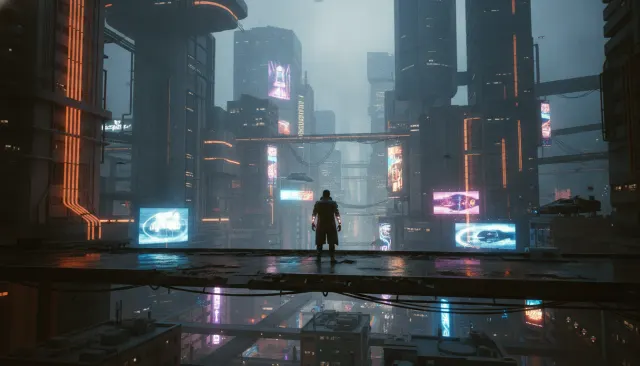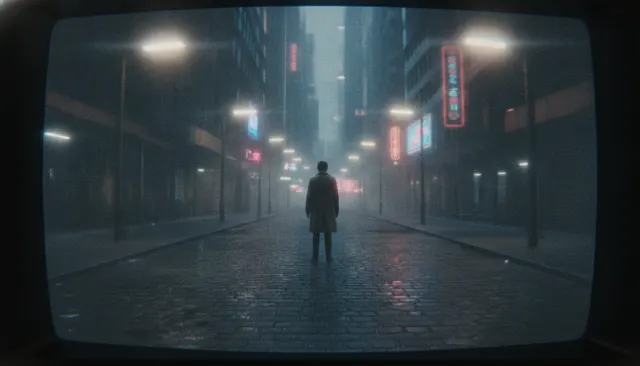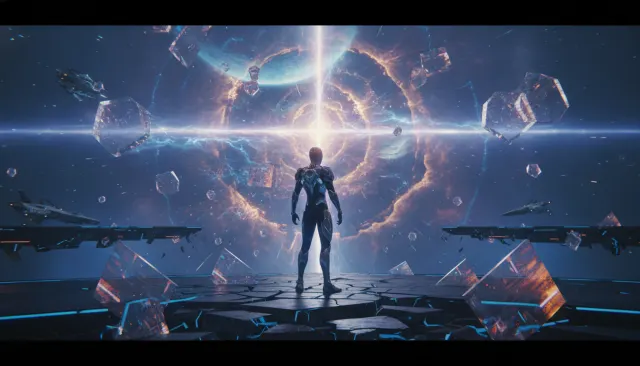
Halo 3
Bungie, Xbox 360, 2007 (definitive bloom-era Halo, outdoor environments with extreme sky glow)
Xbox 360 bloom-shader era. Gears of War brown-grey, Halo 3 sci-fi vista, oversaturated bloom and chromatic lens flare.
The moves a human crew would use to get here. Cue applies them for you, and knowing their names is how you ask for a change.
light sources glowing 20-40% of screen width in dark environments
luminance sources using streak filter post-processing
exposed sky rendering where outdoor HDR tonemapping clips highlight detail to white
The Xbox 360 (launched November 2005) introduced hardware HDR (High Dynamic Range) rendering to mainstream console gaming. The capability to render luminance values beyond display range and then tone-map them back to visible output created a specific visual artifact that became the defining aesthetic signifier of 7th-generation games: bloom - the halation of light sources bleeding into adjacent dark areas, creating glowing halos around lamps, sunlight, and explosions.
Developers in the Xbox 360/PS3 generation over-applied bloom because it was new, visually impressive, and covered texture quality limitations. A fluorescent office light in Halo 3 (Bungie, 2007) would create a glow radius spanning half the screen. Outdoor levels in Gears of War (Epic, 2006) used bloom and saturation boosting to give concrete and asphalt a warm, cinematic glow that real concrete doesn't have. Mass Effect (BioWare, 2007) is perhaps the most extreme case: the Citadel's white architecture glowed with bloom intensity that made the environment read as heavenly despite being a sci-fi space station.
Bloom in this era used a Gaussian blur applied to the bright regions of the HDR framebuffer, then additively composited back onto the base render. The strength and radius parameters were frequently pushed to artistic extremes. Combined with lens flare (a separate post-process effect simulating optical aberration), the look gave 360-era games a hyper-stylized 'cinema' quality that aging gracefully required resisting.
The lens flare in 360-era games was inspired by J.J. Abrams's use of practical lens flare in Star Trek (2009) and similar prestige film of the era. Developers used it as a shorthand for 'cinematic quality' - the same instinct that led Abrams to request flare rigs on actual anamorphic lenses. The result in games was anamorphic streak artifacts on any light source above a threshold luminance.
For millennials who grew up with the Xbox 360, the bloom aesthetic carries enormous nostalgic weight: it is the visual signature of Halo 3, Gears of War, Mass Effect, Call of Duty 4: Modern Warfare - the games that defined online competitive and cooperative gaming for a generation.
Bungie, Xbox 360, 2007 (definitive bloom-era Halo, outdoor environments with extreme sky glow)
Epic Games, Xbox 360, 2006 (concrete-and-bloom visual template, Cliff Bleszinski)
BioWare, Xbox 360, 2007 (Citadel architecture bloom excess, iconic for the look)
Infinity Ward, 2007 (military-realistic but with bloom on explosions)
Visceral Games, EA, 2008 (bloom in horror context, space station with industrial glow)
Irrational Games, 2007 (underwater city bloom on Art Deco neon and bioluminescent elements)
A Look is not a filter. It is a set of stored decisions the pipeline reads before it makes a single frame, so two videos in the same Look actually match.