Watership Down
BBC/Netflix miniseries, dir. Noam Murro, Lupus Films, 2018 (primary reference)
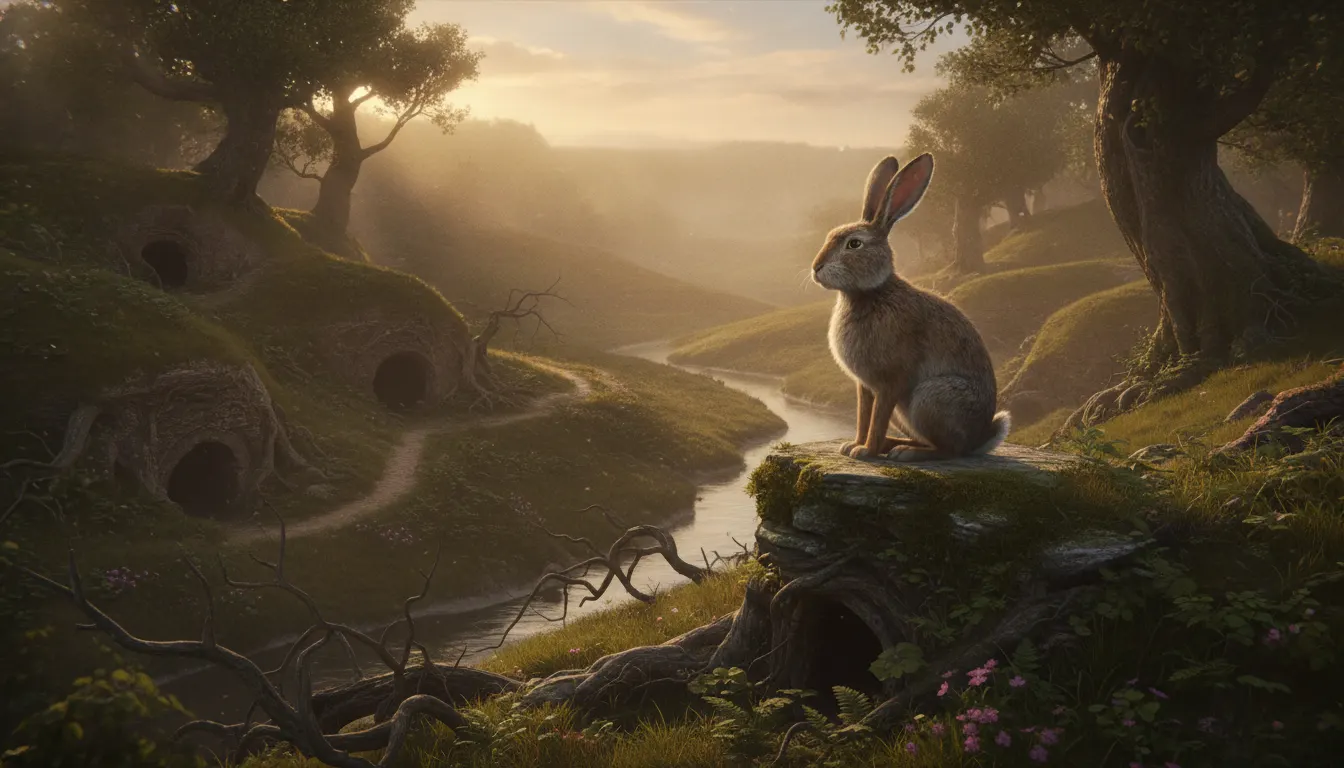
Netflix Watership Down 2018 CG. Stylized rabbit-warren naturalism, earthy English countryside palette, mature animal allegory.
The moves a human crew would use to get here. Cue applies them for you, and knowing their names is how you ask for a change.
based fur simulation with environmental response (wind, rain, terrain contact)
hour natural palette: English field greens, earth browns, river blue-greys
rabbit gait cycles distinguishing walk, run, and panic sprint gaits correctly
Martin Rosen's Watership Down (1978) was one of the most visually ambitious hand-drawn animated features of its era: an adult animated film based on Richard Adams's 1972 novel about a warren of rabbits fleeing the destruction of their home, rendered with a rotoscope-influenced naturalism and hallucinatory abstract sequences that used hand-painted cel-over-watercolor backgrounds. The BBC/Netflix 2018 Watership Down miniseries (dir. Noam Murro, Lupus Films) remade this source material in 3D CGI.
The 2018 remake's visual choice generated significant critical debate. The production used photoreal rabbit anatomy - correct musculoskeletal proportions, fur simulation, and eye rendering based on actual rabbit biology - but retained human emotional expression requirements: the rabbits needed to convey Hazel's leadership, Bigwig's courage, Fiver's prophetic fear, and El-ahrairah's mythic trickster quality. The tension between photoreal animal anatomy and legible human emotional performance is the central visual challenge the production navigated with mixed success.
Lupus Films and BlueBolt's CG team built custom rabbit anatomy rigs that balanced physical accuracy with performance range. The fur simulation used a strand-based system similar to contemporaneous Weta and ILM work, responding to wind, rain, and environmental contact. The English countryside environments - Nuthanger Farm, the Berkshire Downs, the Enborne river - were built with photorealistic reference to actual locations.
The 2018 production used a warm, naturalistic palette referencing the golden-hour greens and earth tones of the Berkshire landscape. The abstract 'Black Rabbit of Inle' and 'Bright Eyes' vision sequences retain the hallucinatory quality of the 1978 original, translated into 3D with glowing particle systems and procedural geometry distortion.
The production is a case study in the risks and rewards of remaking beloved hand-drawn material in 3D: the technical achievement is significant, but the cultural conversation it generated was largely about what was lost in the translation from pen and paint to polygon and shader.
BBC/Netflix miniseries, dir. Noam Murro, Lupus Films, 2018 (primary reference)
dir. Martin Rosen, 1978 (original hand-drawn film, visual foundation and contrast reference)
Richard Adams, 1972 (source narrative driving the aesthetic adaptation)
Disney, 1981 (naturalistic hand-drawn animal animation precursor)
1973 (anthropomorphic animal characters in different visual tradition)
Disney, 1942 (benchmark for naturalistic animal-character emotional performance in animation)
A Look is not a filter. It is a set of stored decisions the pipeline reads before it makes a single frame, so two videos in the same Look actually match.