A Fistful of Dollars
Sergio Leone / Massimo Dallamano · 1964
Inventing the spaghetti western grammar; Man with No Name + extreme close-up duel
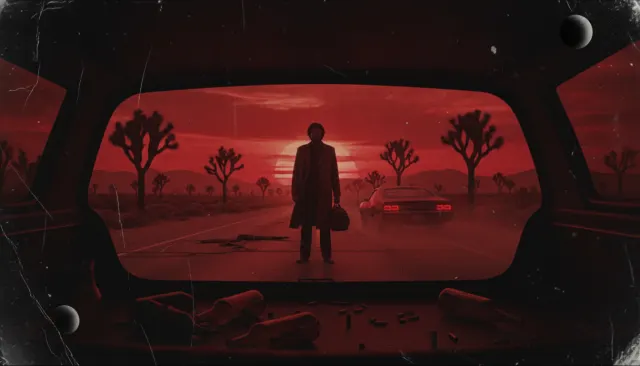
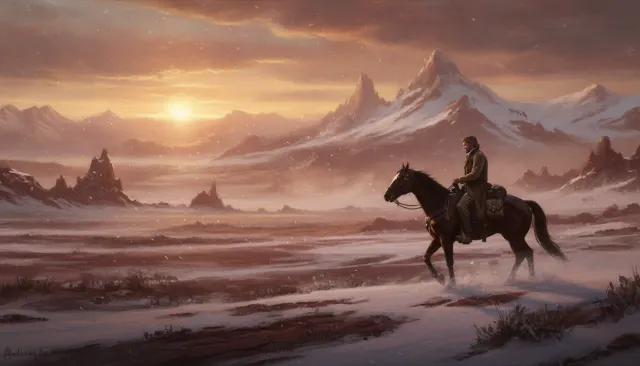
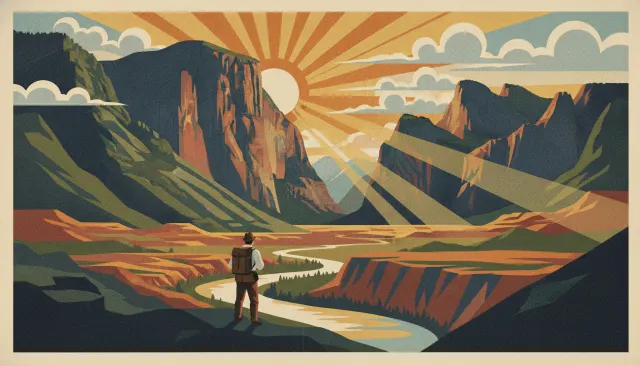
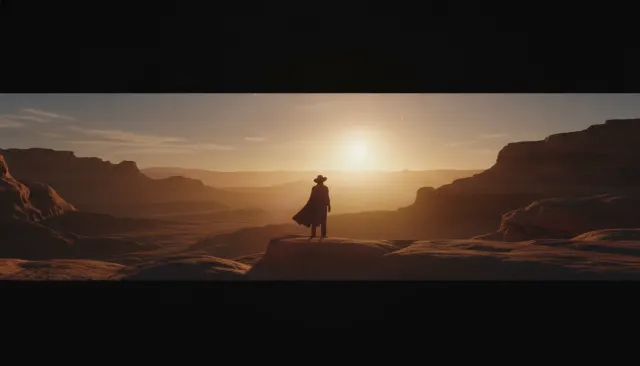
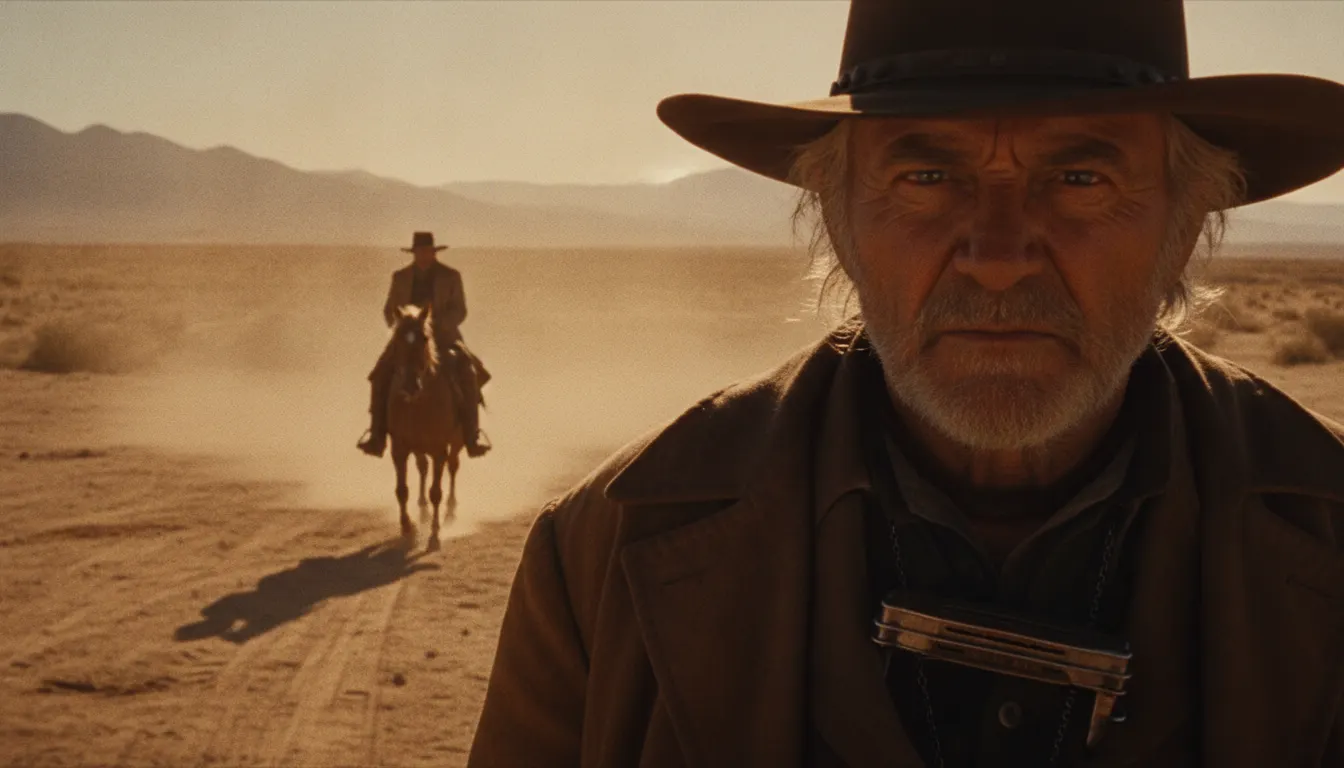
Sergio Leone spaghetti western. Extreme close-ups of squinting eyes, sun-baked Andalusian desert, dust, Morricone-coded silence.
The moves a human crew would use to get here. Cue applies them for you, and knowing their names is how you ask for a change.
Telephoto close-ups of eyes, hands, and gun handles during standoff sequences build near-unbearable tension.
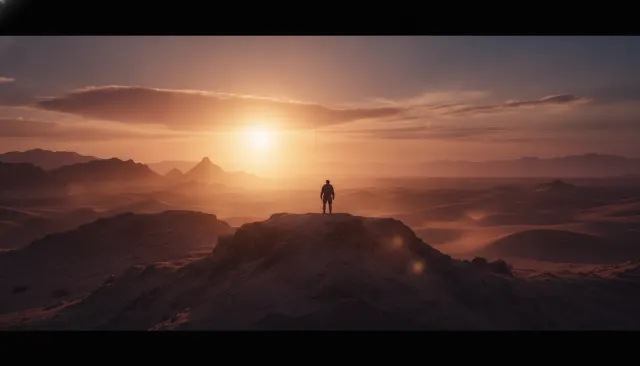
Long anamorphic telephoto lenses compress Spanish desert landscapes into heat-shimmer mirage quality.
Rapid cutting between extreme close-ups and vast wide shots creates the operatic scale-shift that is the Leone signature.
Music composed before shooting and played on set; editing and performance choreographed to the score.
Standoff sequences accumulate environmental detail across several minutes before the explosive resolution.
Spanish and Italian locations provide authentic arid landscape; heat-haze distortion is used rather than corrected.
Sergio Leone's spaghetti westerns constitute one of cinema's most fully realised and stylistically coherent bodies of work. Shot primarily in Spain and Italy with international casts, Leone's Dollar Trilogy and the subsequent masterwork Once Upon a Time in the West (1968) invented a visual grammar for the western genre that has influenced every subsequent practitioner: extreme close-up cutting sequences, vast wide-angle landscapes, Ennio Morricone's musical counterpoint, and a choreographed ritual of violence that drew on Italian operatic tradition.
A Fistful of Dollars (1964), Leone's debut feature (and an unlicensed remake of Kurosawa's Yojimbo, 1961), introduced the grammar: the Man with No Name (Clint Eastwood) framed in extreme close-ups of eyes, hands on holsters, cigarello. Cinematographer Massimo Dallamano used long anamorphic telephoto lenses to compress the dusty Spanish landscapes into heat-shimmer mirages, then cut to extreme wide-angle close-ups of the same distance - the compression-expansion contrast was immediate and original.
For a Few Dollars More (1965) refined the duel grammar, introducing the pocket watch motif and a more developed villain in Lee Van Cleef. The Good, the Bad and the Ugly (1966), photographed by Tonino Delli Colli, is the culmination: the three-way standoff at Sad Hill cemetery is cinema's most technically elaborate piece of suspense editing, a three-minute sequence involving dozens of extreme close-ups and wide shots cut to Morricone's score with split-second precision.
Leone's masterpiece, also shot by Tonino Delli Colli, extended the grammar to a mythological scale. The 14-minute opening sequence - three gunmen waiting at a small station, photographed with extreme patience - established a different tempo: slower, more contemplative, organised around the accumulation of environmental detail (a fly, a dripping water tank, creaking windmill). Henry Fonda, cast against type as the villain Frank, is introduced in a moment of deliberate horror: Leone's camera reveals Fonda's blue eyes in extreme close-up before showing that he has just committed a massacre of a child.
The most distinctive technical signatures: 1) extreme telephoto close-ups of eyes and hands during standoff sequences, 2) vast wide-angle anamorphic landscapes with small figures, 3) Morricone's score treated as a structural element rather than accompaniment, 4) slow ritual build-up to violence followed by explosive brief resolution. These techniques influenced Tarantino, Sam Raimi, George Miller, and the entire tradition of operatically styled genre filmmaking.
Sergio Leone / Massimo Dallamano · 1964
Inventing the spaghetti western grammar; Man with No Name + extreme close-up duel
Sergio Leone / Massimo Dallamano · 1965
Refined duel grammar; pocket-watch motif; Van Cleef as equal protagonist
Sergio Leone / Tonino Delli Colli · 1966
Three-way standoff editing; Sad Hill cemetery; Morricone score as architecture
Sergio Leone / Tonino Delli Colli · 1968
14-minute opening; mythological scale; Henry Fonda as villain; Leone's masterpiece
Sergio Leone / Giuseppe Ruzzolini · 1971
Mexican revolution setting; Leone's most politically inflected western
Sergio Leone / Tonino Delli Colli · 1984
Leone's techniques transferred to gangster epic; memory structure and nostalgic melancholy
A Look is not a filter. It is a set of stored decisions the pipeline reads before it makes a single frame, so two videos in the same Look actually match.