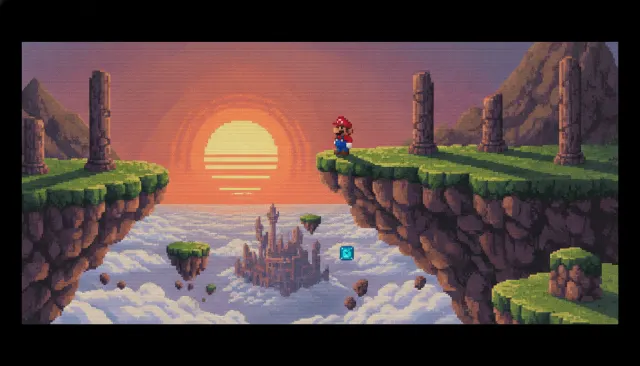
Super Mario 64
Nintendo, 1996 - the game that introduced the world to real-time 3D exploration
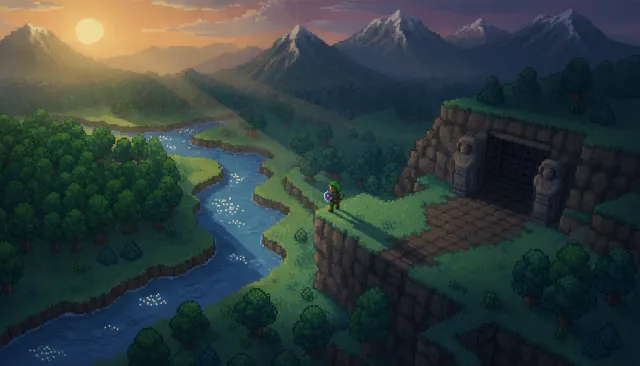
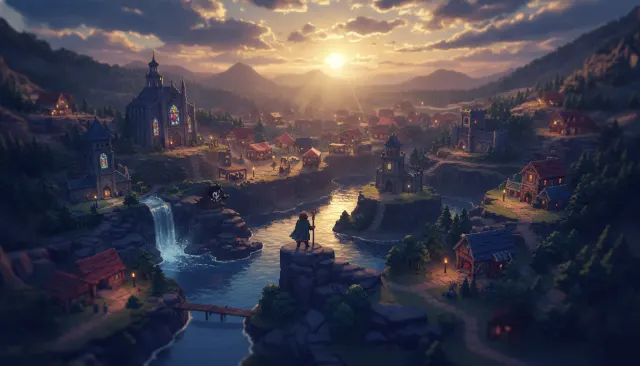
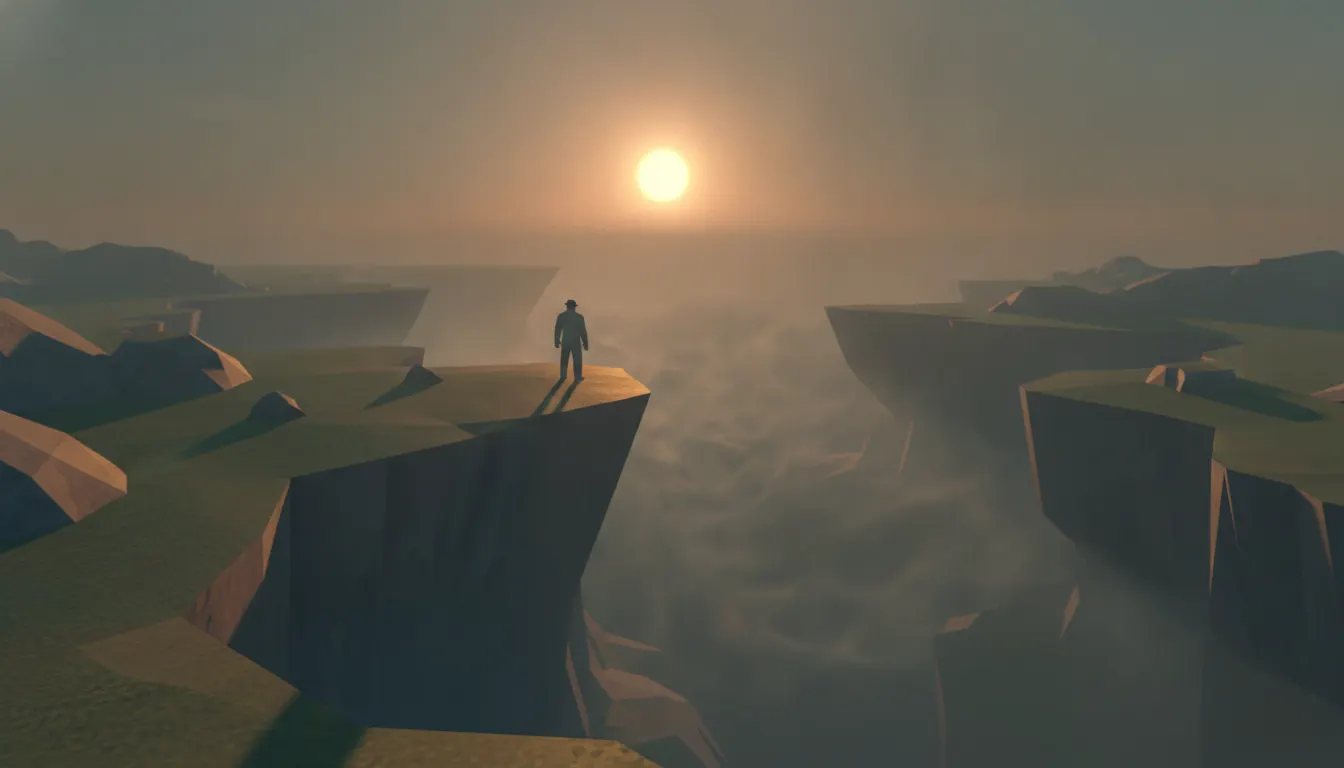
Nintendo 64 low-poly aesthetic. Bilinear-filter blur, fog draw-distance, Goldeneye Mario 64 era smooth-blob textures, antialiased polygons.
The moves a human crew would use to get here. Cue applies them for you, and knowing their names is how you ask for a change.
32-64px texture maps blurred across polygon surfaces producing soft watercolor-like coverage
vertex lighting with color banding: light and shadow interpolated across polygon faces creating ceramic-glaze quality
complex forms built from minimal polygons requiring silhouette-perfect shape decisions
painted detail: architectural complexity implied through texture maps rather than geometric modeling
ambient colored light baked into vertex color arrays, not a separate light pass
close-range distance fog used to hide draw distance limits, creating atmospheric depth
The Nintendo 64, released in Japan in June 1996 and North America in September 1996, introduced an entire generation to real-time 3D graphics. The console's SGI-derived RCP (Reality Co-Processor) chip rendered textured polygons with a hardware bilinear filter that blurred texture samples between pixels - a technical choice intended to reduce the visual harshness of low-resolution textures that instead created the N64's characteristic soft, dreamlike visual quality.
N64 textures were extremely low resolution: 32x32 or 64x64 pixels were common, with rare 128x128 luxury. The bilinear filter blended these pixels smoothly across larger polygon surfaces, producing textures that appear soft and slightly luminous rather than pixelated. This is the defining quality of the N64 look: not sharp pixels but blurred, almost painted surfaces that have a watercolor quality in motion.
Polygon lighting on the N64 was per-vertex rather than per-pixel, meaning colored light values were calculated at each polygon corner and linearly interpolated across the face. This created characteristic color banding on curved surfaces - a face would show distinct bands of light and shadow across the polygon mesh. Combined with the blurred textures, characters had a quality closer to ceramic glaze than photorealistic skin.
Character and environment polygon counts were extremely limited by modern standards: Mario in Super Mario 64 (1996) is approximately 700 polygons; Navi the fairy is a few dozen. Buildings in The Legend of Zelda: Ocarina of Time (1998) are box constructions with texture-painted detail standing in for geometric complexity. This minimalism forced art direction to be elegant: shapes needed to read perfectly at limited polygon budgets.
For the generation that grew up with N64, its visual quality carries profound emotional resonance. Ocarina of Time's Hyrule Field, Mario 64's Bob-omb Battlefield, GoldenEye 007's Facility corridors - these low-poly spaces are recalled with the same nostalgic power as childhood photographs.
Nintendo, 1996 - the game that introduced the world to real-time 3D exploration
Nintendo, 1998 - the aesthetic and design peak of the N64 era
Rare, 1997 - defined N64 first-person shooter visual grammar
Rare, 1998 - colorful platformer pushing the N64 look toward cartoon warmth
Nintendo / HAL Laboratory, 1999 - plastic-toy N64 character rendering
Nintendo, 2000 - darker atmospheric use of the N64 visual language
Nintendo, 1997 - ultra-low-poly space shooter with deliberate geometric stylization
A Look is not a filter. It is a set of stored decisions the pipeline reads before it makes a single frame, so two videos in the same Look actually match.