The Magic School Bus
Joanna Cole, Bruce Degen, Nelvana · 1994
PBS Kids series; definitive illustrated educational animation template
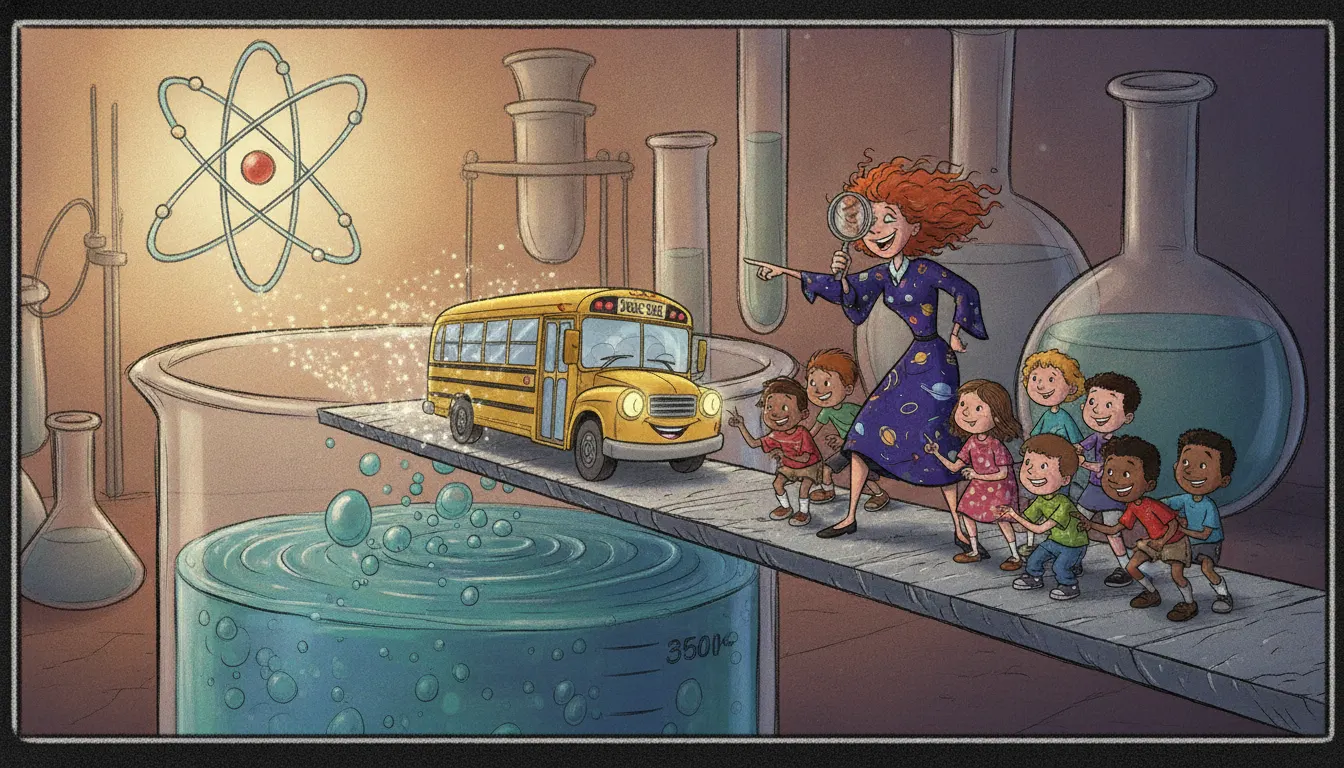
Joanna Cole and Bruce Degen book adaptation, Scholastic PBS Kids science series. Ms Frizzle yellow bus shrinks to ride through anatomy and ecosystems, hand-drawn illustrated edutainment palette.
The moves a human crew would use to get here. Cue applies them for you, and knowing their names is how you ask for a change.
Scientific labels, arrows, and explanatory text appear as visual elements within the scene rather than as separate title cards - information embedded in the story space.
Microscopic cells, atmospheric layers, geological strata, and astronomical scales rendered with consultant-verified accuracy within an accessible illustration aesthetic.
Character designs maintain the rounded, approachable quality of Degen's book illustrations - warm line quality and expressive faces prioritized over animation economy.
Ms. Frizzle's dresses feature patterns matching the episode's scientific subject - cells, atoms, solar systems - integrating costuming with curriculum.
The school bus's transformations into submarines, bloodstream cells, rockets, and other forms are animated with physical specificity - each transformation references the destination environment.
Characters frequently consult illustrated books and build models that appear on screen, reinforcing the show's message that scientific understanding comes from investigation.
Brief 'producer call' sequences where students break the fourth wall to fact-check or correct the episode's content, adding a meta-educational layer.
The Magic School Bus is an animated educational television series that aired on PBS Kids from September 10, 1994 to December 6, 1997, based on the book series by Joanna Cole and illustrated by Bruce Degen. The series, produced by Scholastic Productions and Nelvana, follows Ms. Frizzle and her class aboard a transforming school bus through microscopic, geological, meteorological, and astronomical environments. Its visual style is a direct extension of Bruce Degen's picture book illustration sensibility - a hybrid of scientific diagram precision and warm, accessible children's book art.
The original Magic School Bus book series (beginning 1986) established a visual vocabulary that the animated series faithfully extended. Degen's illustration style combines detailed, research-based biological and scientific illustration with warm, rounded character design and playful typographic and diagrammatic elements integrated into the page (and screen) space. Information labels, diagram arrows, and scientific notation appear directly on screen as visual elements, blurring the line between the narrative and the educational content.
This hybrid of 'educational diagram' and 'storybook illustration' is the show's defining contribution to visual design: it treats scientific accuracy and narrative warmth as compatible rather than competing goals.
Nelvana's animation production maintained the illustration quality by keeping character designs very close to Degen's book originals rather than redesigning for animation economy. Characters are slightly more animated and expressive than the book illustrations but retain the same rounded, approachable forms and the same warm line quality. The bus itself - which transforms into submarines, rockets, cells, and countless other forms - required the most elaborate animation design.
Background environments vary dramatically by episode: a single episode might require accurate cellular biology environments, then shift to atmospheric cross-sections, then return to school. The production team worked with scientific consultants to ensure environmental accuracy while maintaining visual accessibility for a K-6 audience.
The show's most distinctive visual element is its integration of labeled diagrams, text overlays, and 'documentary' sequences - characters pull out books, create models, and consult diagrams that appear on screen. This treatment of information as a visual material rather than a verbal interruption was innovative in children's educational television and anticipated later infographic design trends.
Ms. Frizzle's dresses, illustrated throughout the series with thematic patterns related to the lesson (cell structures, solar system maps, atom diagrams), are themselves a recurring educational visual element.
The show ran for 52 episodes and won multiple Daytime Emmy Awards. A revival, The Magic School Bus Rides Again, produced by Netflix and Scholastic with updated animation, ran from 2017 to 2020. The original series remains a foundational reference for educational media design and a nostalgic touchstone for Millennial and Gen Z audiences who grew up watching PBS Kids in the 1990s.
Joanna Cole, Bruce Degen, Nelvana · 1994
PBS Kids series; definitive illustrated educational animation template
Joanna Cole & Bruce Degen · 1986
Source material establishing the diagram-narrative illustration hybrid
Netflix / Scholastic Entertainment · 2017
Revival series with updated animation maintaining original visual philosophy
Bill Nye & Erren Gottlieb · 1993
PBS/Disney peer combining live-action and illustrated graphics in similar educational register
Judy Brown · 1992
Contemporary children's science show sharing educational illustration sensibility
A Look is not a filter. It is a set of stored decisions the pipeline reads before it makes a single frame, so two videos in the same Look actually match.