FASHION EDITORIAL · 2000S · INTERNATIONAL
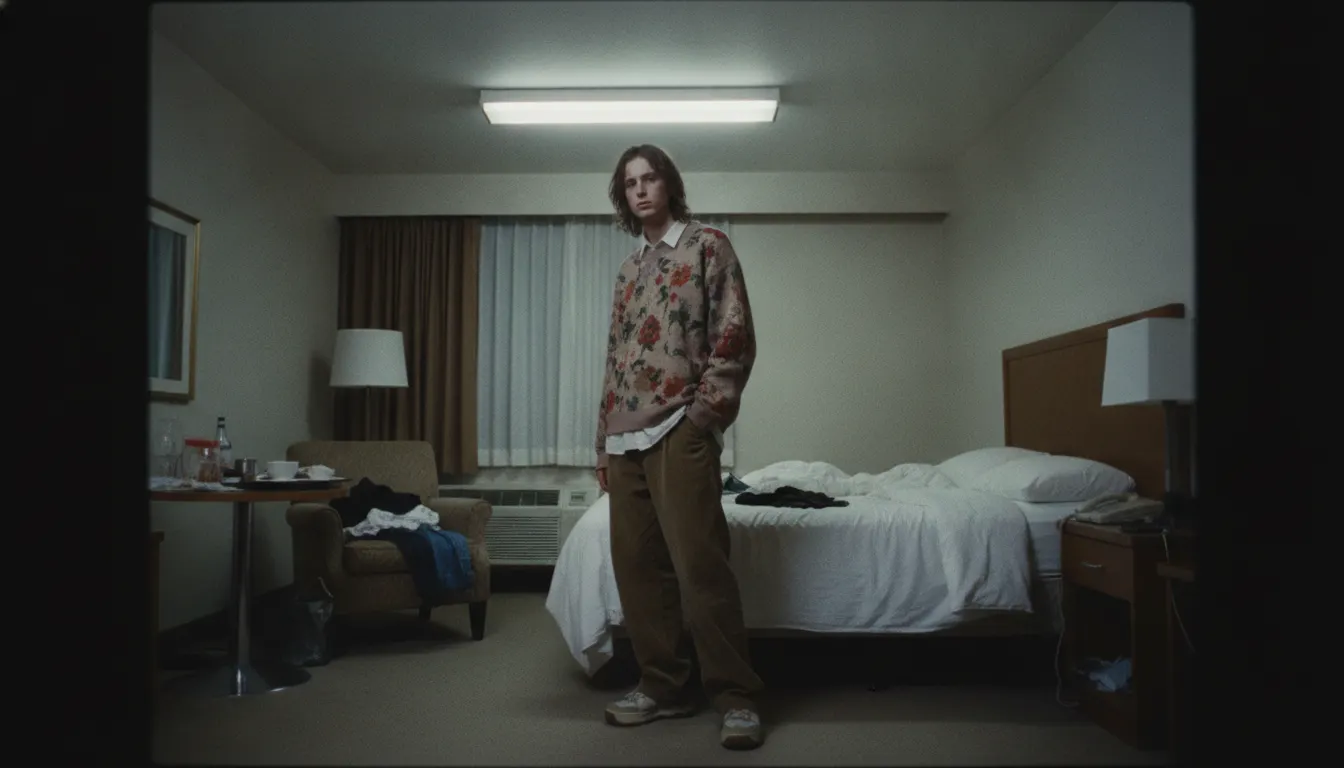
Juergen Teller Flash Snapshot
Juergen Teller anti-fashion flash. Marc Jacobs ad in unstaged hotel, direct on-camera flash, deliberately unglamorous, awkward charm.
telleranti-fashionflashunstaged
LUT teller-direct-flash
WHEN TO USE
- Fashion editorial and campaign work for brands wanting to reject traditional glamour
- Youth culture and music photography - concerts, backstage, tour content
- Portrait series prioritizing psychological honesty over flattery
- Brand campaigns for brands whose identity is built on informality and authenticity
- Documentary portrait work requiring fast, low-prep working method
WHEN NOT TO USE
- Luxury brands requiring unambiguous prestige signaling - the anti-fashion register undercuts it
- Corporate portrait photography where subjects need to appear professional
- Product photography requiring controlled color accuracy
- Any context where unflattering or uncomfortable images would be inappropriate
SIGNATURE TECHNIQUES
How the look is made.
The moves a human crew would use to get here. Cue applies them for you, and knowing their names is how you ask for a change.
- 01On
camera direct flash: frontal flat light, hard shadow behind subject on background
- 0235mm film at ISO 400
1600: visible grain embraced, not suppressed
- 03One
shot working method: minimal frames, no extensive setup or bracketing
- 04Uncomfortable or anti
posed subject positioning: no conventional flattery
- 05Location as found
hotel rooms, kitchens, parking lots - no set dressing
- 06Including himself in images as subject alongside editorial subjects
- 07Color uncorrected from lab
slightly bleached highlights, neutral midtones
HISTORY & CONTEXT
Where it comes from.
Juergen Teller: Flash Snapshot
Juergen Teller (born 1964, Erlangen, Germany) is the photographer most responsible for introducing the snapshot aesthetic into high fashion photography. Since the early 1990s he has shot for every major fashion magazine and designed campaigns for Marc Jacobs, Celine, Vivienne Westwood, Helmut Lang, and Louis Vuitton using a direct-flash, grainy-film methodology that systematically rejects every convention of professional fashion photography.
Anti-Fashion Photography as Fashion Photography
Teller's technique is, on its surface, simple: he uses a 35mm camera (principally a Nikon) with an on-camera flash, often using fast grainy film (ISO 400-1600), and makes images that look like they were taken by someone with no photography training at a party in 1993. The subjects are frequently nude or partially undressed, the locations are hotel rooms, kitchens, parking lots, and backyards, and the poses are uncomfortable, unflattering, or both.
The paradox - and Teller is entirely aware of it - is that these images appear in the most prestigious fashion magazines in the world and sell the most expensive clothes and perfumes. His Marc Jacobs campaigns, which began in 1997 and continued for over a decade, featured celebrities and models in contexts of deliberate ordinariness: Sofia Coppola in a white t-shirt, Victoria Beckham in a shopping bag, Cindy Sherman photographing herself in a mirror. The anti-fashion register became a fashion register of its own.
Film and Flash
Teller works almost exclusively on film - typically Kodak or Fuji print film at ISO 400 or 800. He rarely brackets or makes multiple exposures; he works quickly, often making a final image on the first or second frame. The on-camera flash creates the signature flat, frontal light with a hard shadow on the wall or background behind the subject. Skin tones are slightly bleached in the highlights, and grain is visible and embraced.
This technical signature is the opposite of fashion photography's conventional lighting setups. A standard fashion shoot uses three to five lights to sculpt and flatter; Teller uses one, positioned on the camera axis, which eliminates all shadows except the background drop-shadow.
Cultural Position
Teller has published extensively in book form: Märchenstüberl (1993), Go-Sees (1999), Marc Jacobs Advertising (2008), More (2012). He has received honorary doctorates and major photography prizes, and is represented by major galleries. The snapshot aesthetic he pioneered has been so widely imitated that it is now a genre rather than a signature.
NOTABLE WORKS
Where you have seen it.
Courtney Love for Frank magazine, 1994
Go-Sees (book, Scalo, 1999)
models visiting his studio
Märchenstüberl (book, 1993)
Kurt Cobain, Nirvana promotional portraits, 1991-1993
Celine campaigns, 2010s
Victoria Beckham in Marc Jacobs bag, 2008 campaign
THE RECIPE
The exact knobs
the renderer turns.
A Look is not a filter. It is a set of stored decisions the pipeline reads before it makes a single frame, so two videos in the same Look actually match.
SettingValue
GradeColour LUT applied to every frame
teller-direct-flashTransitionHow one shot becomes the next
hard cuts · 140ms · linearKen BurnsCamera move applied to stills
Static framesTypographyDisplay / body / mono pairing
Inter · Inter · CourierMusic moodWhat the bed under the voice sounds like
indie-rock-2000s · electroclashPrompt suffixAppended to every shot prompt in this Look
Juergen Teller Marc Jacobs anti-fashion direct flash, unstaged hotel room, deliberately unglamorous awkward charmPALETTE
Primary
#C8C8C0
Secondary
#7A8FA8
Accent
#7A2030
Text/Light
#0A0A0A
Text/Dark
#F0F0EC
BG 900
#1A1A1A
BG 800
#2A2A28
RELATED LOOKS
Next to it on the shelf.
 Photographic EraKodak Disposable 90s Flash
 Era Specific Color1990s Grunge Music Portrait
 Street PhotographyBruce Davidson Subway Flash
 Photographic EraInstagram 2010s VSCO Filter
 Portrait TraditionsLifestyle Editorial Portrait
 Fashion EditorialHarpers Bazaar Richard Avedon
 Photographic EraLomography Toy Camera
Your first cut
is on us.
+ New videoFree plan · no card · 1080p export